So near and yet so far – Samarkand
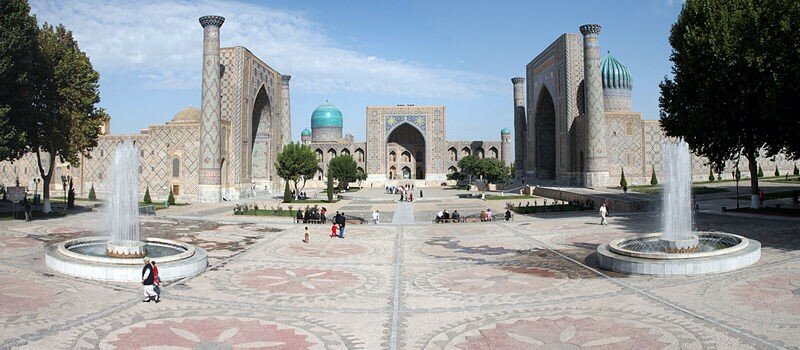
The Registan and its three madrasahs. From left to right: Ulugh Beg Madrasah, Tilya-Kori Madrasah and Sher-Dor Madrasah. Perhaps the most photographed spot in Samarkand.
Back in 1995, when I had landed at Almaty airport – in those days there weren’t really any flights to Bishkek from Western Europe … that was to come later … and Almaty in Kazakhstan was the gateway that most Westerners used when coming to Kyrgyzstan. After passing through Immigration and Customs I was met by my friend Tony who had asked me to come out and help set up an office and Sasha, a driver, who was going to bring us the 250 kilometers to Bishkek.
Like most Long haul flights it arrived in the early hours of the morning – although the sun was already up and it was already quite warm it was only about four or five o’clock in the morning. Although I was eager to see everything, I succumbed to tiredness and dozed off in the car as we drove the long straight road under the slopes of the Zailiiskiy Alatau Mountain Range, (as the Kazakhs refer to the Kungei Ala Too Krebet), where the foothills meet the rolling steppe.
Several times I found myself awakening with a start … on one occasion to see a pair of Kazakh ”cowboys” riding horses bareback – that is, without saddles – chasing a “steer” along a ditch at the side of the road, coaxing it back to join the rest of the herd – thinking to myself about having landed in the Wild West with a front row seat at the Rodeo.
On another occasion, I looked up and saw a road sign at a road junction showing that the road straight ahead took you to Bishkek … and if you turned Right then you were heading off to Samarkand.
The name startled me and I sat bolt up, thinking to myself … “While I am here I must go there”. Remember, I was only coming for a year – but I thought I that had plenty of time to fit in a short trip to take in the sights of that romantic ancient city. As it happens, it’s now almost nineteen years later … and I still haven’t made it!
That’s not necessarily for the lack of trying … I have nearly made it … twice … on one occasion the plans fell through – I am not sure I can remember why, but … these things happen. The other occasion was a “disaster” … well, not like the Titanic – no-one lost their lives … but I lost all interest in visiting Uzbekistan again. It was all to do with getting a visa … The Uzbeks had a complicated system and gave the impression and the officials I saw when applying for my visa was that they didn’t really want tourists visiting the country … they seemed to be regarded as a “necessary evil” or, at least, as an inconvenience which had to put up with … a bit like an itching back where the tingling sensation is clearly centered on that spine on the spine which your hands just cannot reach; neither from above nor from below … neither from the left nor from the right, It’s just there – Get over it – Live with it as best you can.
As it happens, it’s mot just foreigners who have problems getting into Uzbekistan … I was talking to a local person who was going to see a relative that she hasn’t seen for something like 20 years – but who has recently fallen ill. She decided to travel by bus – it’s a lot cheaper but a long journey, overnight to Tashkent, via Kazakhstan, and then another day onwards to where her relatives live. She turned up to the bus station in the evening, bought her ticket and went to sit waiting for the bus … and when it arrived she loaded her bag into the baggage compartment and waited to be told to board the bus for departure.
As often happens in these situations, she struck up a conversation with another passenger – someone with a lot more luggage … probably a “commersant” here to buy things in the Dordoi bazaar to sell back home in an Uzbek market. The conversation went this way and that and my friend explained that she was visiting a relative who had been taken ill. That’s when her new “friend” dropped her bombshell: “You’ve got your telegram, haven’t you?”
“Telegram? … What Telegram?” It seems that she was told, in order to cross the border into Uzbekistan, even as a Kyrgyz citizen, she needs a Telegram from whoever it is she is visiting – a sort of invitation – which she has to show at the border. That came as a surprise – to her and to me alike (but then, we don’t normally send local people abroad … not even to Uzbekistan).
At first she couldn’t believe her ears … she turned to the other travelers and ansked them – and they confirmed the information … then the two drivers of the bus … off she went to the ticket office and asked there … “What, you didn’t know?” ”No, why didn’t you tell me? ask me if I had a telegram before selling me the ticket?” ”That’s not my job, I’m here to sell tickets …”. So much for customer service!
If she attempted to try and see if she could cross the border without the telegram, she risked being turned back and who knows what other problems she might encounter … so, instead she decided to collect her bag from the us, go back home and see if she could arrange a telegram. To make matters worse, even though the bus still hadn’t actually left, she was told that there was no way she could cancel the ticket and get a refund …
Finally, it was already late when she arrived home, and all her family had gone to bed. They were roused by the sound of her fumbling for her keys and trying to unlock the gate in the dark … and thinking they had an intruder they picked up the phone to call the police … only to be stopped dead in their tracks as she opened the door and walked in.
It seems that the only way for a Kyrgyz citizen to enter Uzbekistan at the moment is to have such a telegram – with no less than three stamps … if even one of them is missing, the border authorities won’t let them cross … or to buy a tour.
I would still like to go Samarkand … but I just don’t want to go through that visa circus again … it’s a very frustrating and time consuming procedure … and when greeted by inefficiency, indifference – or even worse, downright rudeness, I wonder that anyone is prepared to submit themselves to that sort of experience more than once.
To be fair, not all of the officials are like this … and I may just have “drawn the short straw”, because we’ve had clients obtain their visa at the embassy here in Bishkek – and although some have also had top run a gauntlet of officialdom, others have experienced no trouble at all.
In fact, when we were lobbying for the Visa Free Regime here in Kyrgyzstan, I used to tell this story to try and emphasize how the visa – even if it is, basically, just a formality – still presents a barrier which puts people off visiting a country … and at the very worst actively discourages potential visitors.
In fact, it’s one of my greatest regrets after almost twenty years here, there are still a lot of places around the country that I have yet to visit. Sometimes it can lead to embarrassing conversations because visitors assume that I must have been everywhere and ask me quite detailed questions. Although it’s not in Kyrgyzstan … Samarkand is the classic example of what I mean. I have heard so much about the city, the Registan, mosques, mausoleums and Madrassah’s, the bazaar and the observatory … the sense of history tinged with spirituality, the arts and sciences … I’ve seen the photographs and the watched the video clips … I heard the travelers’ tales … and it’s about time that I went and had a look for myself.
Who knows, maybe one day …
.
Samarkand lies in a valley between spurs of the Pamir-Alai mountain range. It is an oasis town and has long been a center of human habitation and claims to be ancient as Rome and Babylon. The origins of the city, however, are lost in time and legend. It was a centre for Silk Road traffic and served as capital for the Transoxiana region – being conquered by the troops of Alexander the Great, the Chinese, the Arabs, and the Monguls under Genghis Khan.
Perhaps it’s most famous “son” of Samarkand was Tamerlane – who was born on 9th April, although he was actually born in the city of Kesh – modern day Shakhrisabz, about 80 kilometers to the South. He is association with Samarkand is because he made it his capital when he became the Khan, adorning it with many beautiful buildings.
However, the beauty of the city predates Tamerlane. Even Alexander the Great said: “everything I have heard about the beauty of the city is indeed true, except that it is much more beautiful than I imagined.”
After Alexander’s time, the city went into decline, before rising to prominence one more. This was a pattern which was to repeat itself several times over the centuries. Perhaps the nadir came with the slaughter of the city’s inhabitants at the hands of Genghis Khan’s Mongol horde. It was his descendant, Timur, who eventually restored the city and laid the foundations which can still be seen in the modern city.
From the 17th century, Bukhara became more important than Samarkand – but it was still a prize for the Tsarist Russian General Kaufmann – and in 1920 the Red Army General Mikhail Frunze massed the communist forces here for an assault on Bukhara. In 1925 it was declared the capital of the Uzbek SSR – a status it later lost to Tashkent.
- At the center of the city is the spectacular Registan complex with three Madrassahs: Uleg Beg Madrassah, Shir Dor and Tilla Kari (with its dazzling, golden interior). Perhaps this is the most photographed spot in Samarkand and the sandy square surrounded by blue tiled buildings, may well bring about a sense of déjà vu – even for people like me who have visited it before.
- The Bibi Khanum mosque with its blue cupola is on the road towards the Bazaar , and is named after one of Timur’s wives who was apparently a great beauty.
- Shah-I-Zander is a cemetery where many influential advisers of the Timurid Empire are buried in spectacular mausoleums which are covered in blue and green tiles. The name, Shah-I-Zander, translates as “The Living King” – and refers to the grave of Kusam Ibn Abbas who came to Samarkand in the 12th century with the Arab conquerors and who was instrumental in spreading Islam throughout the region. There are many legends about how devout he was, and his sufferings for his faith – and apparently he was killed whilst deep in prayer. There are 20 sites in the complete ensemble.
- Gur-E-Mir is the surprisingly modest mausoleum where the remains of Tamerlane lie, along with two of his sons, and two of his grandsons.
- The Ulugbek observatory is named after one of Tamerlane’s descendants – who was better known as an astronomer than as a ruler.
- Samakand also has a number of churches: an Armenian Church; several Orthodox churches and a Catholic Church.
- The city also hosts the State Museum of the Cultural History of Uzbekistan.
- In addition, there are other mosques, mausoleums … and museums.




 Bishkek