The price of Gold
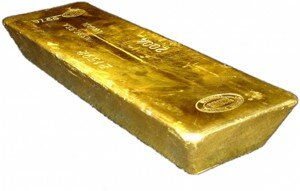
BullionVault / Foter / Creative Commons Attribution-NoDerivs 2.0 Generic (CC BY-ND 2.0)
Gold is an important part of the Kyrgyz economy … the Kumtor Gold mine, the country’s biggest enterprise, contributes something like 14% of the country’s GDP and 40% of its exports and almost 50% of the country’s industrial output.
Recent controversy over the ownership and operation of the mine, (which in recent years has produced something like 17-18 tons of gold per year), has been riddled with statistics – confusing statistics.
As the Centerra company’s share price has fluctuated on the stock market, the value of the country’s shareholding has followed it.
It hasn’t just been the troubles that the company has been experiencing here in Kyrgyzstan that has affected the value of the shares … the price of gold on the open market has also fluctuated somewhat … and each movement affects the potential earnings of the mine and hence its attractiveness as an investment … and so its share price.
There’s change to the tax regime regarding gold mines and processing firms in the offering as well … Since last year the tax paid by these firms are taxed, not on profits like most firms but on revenues. New amendments to the Tax Code have been proposed so that the tax rates will be variable – ranging from 1% to 20% – depending on the world gold price. Based on the price of $1724 an ounce, (the price at the end of 2012), the rate would be 11% but at the current price of #1260.12 per ounce the rate would be just 1%. Goodness knows what will happen if the price falls any lower!
Trying to make sense of the various statistics can be confusing … I am reminded of an occasion when, as a schoolboy, I was caught out by the question: “Which is heavier, a ton of coal or a ton of feathers?” Without thinking about it I replied “A ton of coal, of course.” As everyone around me fell into hysterics I tried to cope with my confusion … and then, my inquisitor revealed the correct answer with a certain amount of revelry – “Neither … they weigh the same … a ton is a ton whether its coal or feathers”, I had to try and hide my embarrassment at falling for such a simple, (mean), trick.
As he pointed out, a ton of feathers may well take up far more space (volume) than a ton of coal because of the density and the fact that whilst coal is solid, feathers encompass a lot of air.
To be fair it was all in good humour … there were lots of similar puzzles … “You are a train driver and taking the London to Brighton train. You leave London at 10:30, traveling at 20 miles an hour for 30 minutes before … ” and so on … with lots of detail until you get to the ‘punch line’: “You arrive at Brighton 5 minutes late at 12:24. What’s the name of the driver?” … Having tried to remember all the details and juggle with lots of calculations in your mind … it’s easy to miss the point … Even if you realize that most of the data you’ve been given is irrelevant, you’ve probably forgotten the opening sentence. ”Name of the driver? What’s that got to do with it?”
Life is like that – we get lots of information as part of our everyday life, some of which is vital but much of which is extraneous and irrelevant and we have to sift through it to extract exactly what is important and can help us solve a particular problem … and even then, there is often something vital that we either forget or overlook.
There was, however, another important lesson that I was able to draw from this trick question … check the definition of your terms. If I had known better then I might have retorted with something like. “Well, it all depends … are we talking Metric tons or Imperial tonnes?”. That might sound like nitpicking but it can make an important difference. For example … had the question been, “Which is heavier, a pound of gold or a pound of feathers?” then it is important to know that gold and feathers are measured using different system.
A pound of feathers would be weighed using the standard system – comprising of sixteen ounces – about 7000 grains, to use another system of measurement.
A pound of gold on the other hand is measured using the troy system, using troy ounces … and comprises just twelve troy ounces – or 5760 grains or 373.25 grams.
So … a pound of gold actually weighs more than a pound of feathers … about 1240 grains or 435.59 grams – about 22% more!
Then again, when considering the Centerra share price, there’s the amount of gold reserves in the Kumtor deposit – the more gold waiting to be extracted, the more valuable the mine which makes it more attractive as a potential investment opportunity.
The State Geological Agency has recently announced that there are more than 500 tons of proven gold reserves in Kyrgyzstan – not all of them, of course, part of the Kumtor deposit. Kumtor, however, as the main producer in the country, is of vital importance to the country’s economy and in order to reduce its influence, Kyrgyzstan is trying to develop some of the other deposits.
To put that into some sort of context … it’s estimated that something like 168000 tonnes have been mined up until the end of 2010 – most of it in the last 60 years … and, according to some sources, all the gold ever produced is still circulating somewhere – and there is about 100,000 tons left in the earth to be mined.
As an aside: Just to make things even more complicated, when considering the value of something made of gold it is also important to take into account the concentration of gold. Gold can be alloyed with various other metals to give it specific qualities – depending upon its intended purpose: jewelry, coins, for use in electrical or industrial processes … and even as teeth. This concentration is traditionally measured in the number of karats … which is not to be confused with carats (another system of weight), or “parts per thousand”. The weight of an artifact, (a wedding ring, earrings gold bar or coin), does not necessarily indicate the amount of gold in it.
- 24K – which is “pure” gold – at least about 99.9% gold … or .999 as it is quoted here.
- 22K – 91.3% or .913
- 18K – 75% or .750
- 16K – 66.7% or .667
- 15K – 62.5% or .625
- 14K – 58.3% (or 58.5%) or .583 (or .585)
- 12K – 50% or .500
- 10K – 47.1% or .471 (sometimes referred to as 420)
- 9K – 37.5% or .375





 Bishkek