A Saint visits Kyrgyzstan
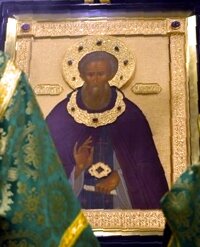
St. Sergius – a detail from the photograph in the Knews artcle
Yesterday, when I left the office to go down to the hotel, my accountant still hadn’t arrived. That’s not unusual because on Mondays she has to visit the banks to collect some paperwork and I assumed that she had gone there on her way to work.
When I got back to the office in the afternoon and scanned the news reports, however, I thought I had discovered another reason for her absence … I came across a couple of reports, (here and here - they are both in Russian), about a Holy Icon arriving at the Cathedral of the Resurrection in Bishkek. She is a devout believer and member of the Orthodox Church.
I asked her why she hadn’t told me about it, and she said that she didn’t know what I was talking about. When she went to church in the morning (on the way into work – and to the bank) there was quite a crowd and a new icon … but she hadn’t seen any announcements beforehand and didn’t know anything about it. I presume that her visit to the church just happened to coincide with the arrival and presentation of the icon to the Cathedral …
We read the articles and she was quite taken aback when she discovered it was of St. Sergius of Radonezh, on loan from the Holy Trinity-St. Sergius Lavra, and that it was at the start of a tour throughout Central Asia and Russia to commemorate the 700th anniversary of his birth … and was accompanied by some of his relics. Bishkek was its second port of call, having arrived in the city from Tashkent on Sunday evening and would be here for six days before moving on to Dushanbe.
There was to be another service with a solemn procession with the icon to be presided over by the Head of the Central Asian Metropolitan Church and Bishkek’s own Bishop, Theodosius, and she asked if she could leave early to go and take part. Of course, I agreed.
I was intrigued by her “excitement” and “agitation”, (those aren’t quite the right words but I hope they give some impression of the effect the news seemed to have on her), and I thought I had better found out a little about him … who he was?, why his visit merited the blessing of Kirill, (the Patriarch of Moscow and All Russia)?, and why his visit was so momentous?
It seems that St. Sergius is no ordinary Holy Man … he’s one of the Russian Orthodox Church’s most highly venerated Saints – and, according to some sources, is regarded as one the Patron Saints of the country. One source claims that “few people have had such a profound influence on Russian life as St. Sergius and his his monastery.”
Although this Grand Tour is intended to commemorate the 700th anniversary of his birth, there is some doubt as to the actual year when he was born … three possible dates are given, 14th May (N.S., that is, according to the Gregorian Calendar – 3rd May Old Style according to the Julian Calendar.), 1314, 1319 and 1322. If the eight year gap seems surprising, we should remember that we are talking about the medieval times when records weren’t always kept as rigorously as they are today … and we could point to several modern day examples where there is some doubt as to the efficacy of the official records.
On the other hand, everyone seems to agree that he died on 25th September, 1392, in the Church that he had founded, the Holy Trinity in Lavra … which is also named after after him. This day was to become one of his Saint’s Days – the other being 5th July.
Whatever the year in which he was born, the medieval records tell us that it was into a Boyar, (aristocratic), family living in Rostov Veliky, (Rostov the Great or Great Rostov). He was the second of three sons; the others being Stefan, and Peter. Sergius was the name he took when he became a monk – originally he had been baptized Bartholomew.
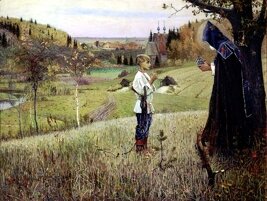
“Vision of the Youth Bartholomew” by Mikhail Nesterov … (1889/90) The boy Bartholomew meets the monk and explains his dilemma …
The young Bartholomew was an intelligent boy, but when he started school at the age of seven, he had trouble learning to read and write. One day, according to the hagiography, he was out looking for horses that had gone astray and encountered a monk he had not seen before, praying under a tree. He told the monk his story … who heard him out and then gave him a piece of Holy Bread to eat, with the blessing “:Take and eat it, this is given to you as a sign of God’s grace and for understanding the scriptures” … and from that day he had no further problems. Indeed, that night he astounded his parents by reading fluently from the Psalter.
It seems that this experience served to increase his piety – he felt attracted to follow a secluded ascetic life but out of devotion to his parents he remained within the family home. Both of his brothers had already left home to get married and he agreed to stay and care for his parents. Even so, he embarked on religious path of humility and modesty, quiet and reticence, showing kindness to all and sundry, never showing irritation and obeying his parents in everything. He would eat mainly bread and water, but often fasting for periods as well,
When the principality of Rostov fell into the hands of another nobleman, the Grand Duke Ivan Danilovich of Moscow, sometime around 1328 his parents became impoverished and the family moved to Radonezh - a small village near Moscow.
When his parents died he joined his brother Stefan, who was now a widower and had become a monk, who was living in Khotkhovo, also near Moscow. In 1340, he persuaded Stefan to find a more secluded place where they live an aesthetic life and they built a small cell and a church dedicated to the Holy Trinity in the forest at Markovets – about 70 kilometers to the North East of Moscow – which was later to become the great monastery church of Trinity-St. Sergius Lavra, where his icon that is visiting Bishkek came from.
Apparently it was a very austere life … marked by extreme poverty, hard physical labour, (it was a general principle that the monks all had to live by the dint of their own labour – chopping wood, drawing wate, grinding flour, baking bread, making candles … and so forth), and profound humility and simplicity.
Later Stefan moved to the Epiphany monastery in Moscow – it’s not clear if he found the austere life too much or simply that he had been appointed as Father Superior – and Bartholomew in turn took his vows as a monk – and the name Sergius, after a martyr on whose commemoration day he was tonsured. He spent a year alone, living as a hermit and the hagiography tells how he lived in harmony with the wildlife – including one story of how he shared his last bread with a bear that had come to visit him.
Over time, he was joined by other monks who sought to follow the aesthetic life that he was practicing, building their own cells and people came to seek spiritual guidance from him. After a while, in 1354, he was persuaded to overcome his reluctance and become their leader and he was, once again reluctantly, ordained as a priest. More monks arrived and a number of small villages grew in the neighbourhood.
As the fortunes of the monastery improved thanks to donations and support from the neighbouring communities, it was able to offer hospitality for the traveler and alms to the needy, in keeping with Sergius’ understanding of the gospel message.
Apparently, it wasn’t all harmonious and a dispute grew as to the direction the community should follow. Sergius decided to move away in order to resolve the dispute, but in his absence the community started to decline and after four years the brothers sent to him begging him to return.
News of the establishment reached the Patriarch in Constantinople and the community received a monastic charter.
During the reign of Dmitry Donski, monks from the monastery went as missionaries throughout central and northern Russia, settling in places which were inhospitable and establishing new monasteries – one source say 25, another 40, (and another suggests as many as 400 – but that probably refers to the monasteries established over the subsequent centuries rather than in his lifetime), and these were to play an important role in the subsequent life of the country. Even the smaller numbers represented a considerable increase in the reach, influence and authority of the order – with Moscow at the center of the network.
As a measure of his importance within the church, in 1378 Sergius was asked by a retiring Metropolitan of Moscow to become his successor … but he declined, saying that he preferred the simple life of a monk.
He also had an importance in the secular world. He was called upon to act as arboter in a number of internecine disputes that had plagued the Russians, and when Dmitry Donski went to fight the Tatars in 1380, Sergius was prevailed upon to bless the venture … but he would do so once he was convinced that Dmitry had exhausted all available avenues to seek a peaceful solution to the dispute. Dmitry’s victory meant that Moscow was now on the way to becoming the political center as well as a spiritual heart of the country.
Even during his lifetime, there are stories of miraculous wonders and visions that he is said to have received. Among his immediate disciples, about a hundred o them were to be canonized as saints.
As I said, if there are some doubts as to his exact birthdate, everyone seems to agree that Sergius died on 25th September, 1392 – and this became the date his first Saint’s Day is commemorated. Some thirty years later, in 1492, (on 5th July – his second Saint’s Day), the original wooden church that he had built burned down and when work was underway to construct a new one from white stone, (which was to be decorated with icons by the master painter of icons, Andrei Rublev), it was discovered that his body had remained incorruptible, (had not decayed), and were placed in a special reliquary and put into the care of the monastery church that he had founded, the Trinity Cathedral at Lavra. It was another thirty years before he was canonized, in 1452.
There is a story that when the Bolsheviks came to power, the faithful decided to protect his relics removing them from the cathedral and hiding them. The atheistic NKVD wanted to find them and destroy them … and in 1937 they condemned and executed the priest and mathematician, Pavel Florensky, for refusing to disclose their location. It’s not clear whether Florensky knew where they were, but they were eventually returned to the Cathedral in 1946, when Stalin had adopted a more liberal approach towards the Church.




 Bishkek