Sambo
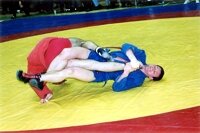
Sambo leglock (knee bar)
The Winter Olympics may be underway in Sochi but it’s not the only sporting event to be in the headlines at the moment.
Here in Bishkek there’s been a number of international competitions in the last few weeks – the latest, which took place over the weekend, was the 27th tournament tournament dedicated to the memory of Vitaly Gordeeva, (a soldier and winner of the Order of the Red Star), and the 25th anniversary of the Soviet troops from Afghanistan.
Apparently, there were more than 300 competitors from Russia, Kazakhstan, Tajikistan and, of course, Kyrgyzstan. This tournament was one of the martial arts which are popular here in Kyrgyzstan – Sambo. Sambo is an acronym from the Russian SAMozashchita Bez Oruzhiya, or Self Defence without Weapons.
In fact there are a number of different variations of Sambo: Sport Sambo which is similar to Judo, but with a number of variations in rules and techniques; Combat Sambo which is still taught and used in the military training programmes, including a number of moves and techniques (striking – punching, grappling, choking, joint locks … even kicking), that are not permitted in the Sport; Self Defense Sambo, with an emphasis on defending oneself from an opponent – especially an armed one … and even different variations which were more suited to smaller or less powerful people – even wounded soldiers – this is an example of Special Sambo, variations designed to meet the needs of specific groups such as Rapid Response Law Enforcement groups.
There is also Freestyle Sambo, which is an American version which permits an even wider range of moves and techniques – but doesn’t permit striking .
Competitors wear different coloured jackets, (kurtka), tied with a belt, and shorts. The colours do not indicate a competitors status – as the colour of the belt might in Judo or Karate, they are simply to aid distinguishing the competitors during combat.
Ranks are allocated and there are eight classes, each divided into three levels, (Razryad): Novice, Junior, Senior, Candidate, Master, International Master, Grand Master, Uchitel, (literally, Teacher, but usually translated as Distinguished Grand Master).
Sambo is a relatively modern martial art, combat sport and self-defense system based on combining the most effective techniques to be found in Judo an a number of other traditional martial arts, (one source suggests as many as 200 different forms of combat sport), especially native wrestling styles drawn from different regions from around the former Soviet Union.
In a way, this points to a political agenda as it helped to serve as a unifying instrument helping to meld the different nationalities found in the huge Russian Empire that became the Soviet Union, into a single unit.
It’s origins lie in the Red Army in the 1920s, where it was developed in order to improve training in hand to hand combat … aiming to thwart an adversary, armed or not, in the shortest time possible. As such it emphasizes grappling skills, throwing skills producing “takedowns”, leg locks, and fast footwork – using the adversary’s strength against them, deflecting their aggression in a direction that they did not want it to go.
One of the creative minds behind the sport, Vasiliy Oshchepov, fell foul of the Stalinist purges, being accused of being a spy for the Japanese, (he had lived in Japan for a long time where he studied Judo), was imprisoned … and died in prison.
Another of the creative minds behind the sport, Victor Spirindonov, had been injured with a bayonet wound whilst serving as a soldier in the First World War … which was one of the reasons for his interest in improving the techniques of personal self defense.
There were others involved in the process, perhaps most notably. Anatoly Kharlampiev who is often regarded as the “father” of the sport … possibly because he had political connections that helped to gain official support for the adoption of the techniques.
Techniques from the different martial arts were analysed and “perfected” before being combined into a new unified repertoire which could be taught as a form of personal self defense and could be adapted to meet any threat.
It was not a simple process … involving traveling to different regions, Mongolia and China as well as building on previous knowledge. It took about ten years to produce a comprehensive manual of techniques.
Sambo was recognized as an official sport by the All-Union Sports Committee of the USSR in 1938. It remained an almost exclusively Soviet sport until the 1960′s when some competitors from the Soviet Union, who had trained in Sambo, started to achieve successes in international Judo competitions. Interest in the sport started to grow in the rest of the world gaining popularity in both Europe and Japan in particular.
In 1968 the International Federation if Associated Wrestling Styles also recognized it as a form of International wrestling. I
n was featured in the opening ceremony of the Moscow Olympics, although it has never actually been an Olympic Sport – although there are hopes that it might achieve this status someday. It has, however, been accepted as a sport for the Asian Games and may appear in 2019 Games due to be held in Vietnam.
Logo of the International Federation of Amateur Sambo
Problems started appearing, arising from disputes between the sport’s organizers and the growing popularity of Brazilian jujitsu … and a few years later, in 1985, an international organization was formed to represent the sport, the International Federation of Amateur Sambo. This was to split into two organizations in 1993, one centered on Russia and the other on Europe and the US.
World Championships have been held since 1973, hosted by countries as varied as Belarus, Bulgaria, Canada, the Czech Republic, England, France, Georgia, Greece, Iran – Which hosted the first competition in 1973, Italy, Japan, Kazakhstan, Lithuania, Moldova, Mongolia, Panama, Spain, the United States, Uzbekistan, Yugoslavia and, of course, Russia and the Soviet Union. Kyrgyzstan has yet to be chosen to host the games … but who knows, maybe some day.
Russia seems to dominate the sport followed by other Soviet block countries – including Kyrgyzstan – with Venezuela probably being the most successful Western country (although they have never won a Gold Medal in the World Championships.
That’s not to say that there aren’t any Western athletes that managed to achieve success in the sport – perhaps most notably there was the America Ron Tripp who won a World Championship in 1994.
Amongst the skilled aficionados of the sport is Vladimir Putin who holds the title of Master of Sports in both Sambo and Judo.


 Bishkek