Town and Gown
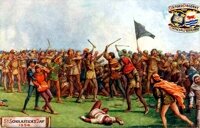
An artist’s impression of the riot
In was on St Scholastica’s Day in 1355 that one of the most notorious events in the history of Oxford – both the town and he University. It was such a significant event that the city museum used to have, (and I presume still has), a whole room dedicated to an audio visual presentation about the events.
It was a two day riot that was lead to almost a 100 deaths, (63 scholars and maybe 30 townspeople – no-on knows for certain). It all started from a argument in one of taverns in the city center, when two students complained about the quality of the beer … words were exchanged, followed by blows and then armed clashes between locals and students. The Mayor, (who just happened to be the landolord of the tavern), asked the Chancellor to arrest the students but to no avail … indeed their fellow students rallied to their support – and apparently assaulted the Mayor. The townspeople weren’t going to sit back and let that happen, and even locals from the surrounding countryside flooded into the city to defend it. Eventually the students were routed, but the city Councillors had to pay an annual fine had to pay a fine of one penny for each of the students killed … and did so for the next 470 years, until 1825, when the Mayor finally said enough is enough.
For the record: Saint Scholastica was a nun who was born in Italy in 480. She was the head of a religious community in Plombariola, about five miles from the Abbey founded by Benedict at Mote Cassino, and it is likely that it followed the same order as the Benedictine monks.
There is a story that shortly before her death, she and Benedict were deep in discussion on some theological point and, as evening approach, Benedict rose saying that it was time he returned to his abbey but she was intent to continue the debate, so when he insisted that he had to go, she prayed and a storm blew up which prevented his departure … and so they continued their disputation.
Three says later, (on 10th February, 542), as he looked out from his cell in the Abbey, he ad a vision of her soul ascending to heaven in the form of a white dove, and this day became her Saint’s Day.
Town and Gown – the division between University and the local community is often quite marked – even though the townspeople actually outnumber the students by about seven to one (thee being about 22,000 students and the population of Oxford is about 152,000) … and quite a large proportion of the townspeople who earn their living from the university. (As a student in the city, however, I used to feel that there were actually three constituents: Town, Gown and Tourist.)
My mind has had to get to terms with the system of Higher Education recently because three of the kids, Maxim, Andrei and Sveta, are coming to the end of their General Education and are beginning to think what to do next.
Kyrgyzstan has about a quarter of a million students in Higher Education, studying in 54 establishments – about two thirds of them (33) are state run and the others, (21), are private institutions. They are divided into several types or categories:
- Universities – offering undergraduate and postgraduate courses across a wide range of specialisms. Some are international universities, with some element of investment and control from overseas – such as Slavonic University, Manas University, the Kyrgz-Uzbek University, the American University in Central Asia, the University of Central Asia … and so on – not forgetting the branches of other CIS Univversities;
- Academies – which usually specialize in specific areas of knowledge – such as the Medical Academy, The Diplomatic Academy, the Academy of Management and the Academy of Tourism;
- Institutes, which can be either a separate institution in its own right, or a branch of a university or academy; and
- Specialized institutions often called Uchilische, (but including establishments like the National Conservatory), which offer courses across a narrow specific field of study – including specialist training and retraining courses.
These institutions offer a range of courses leading to different types of qualifications: a five year Bachelor’s Degree (called a bakalavr), which can lead to a two years Master’s Degree, (known as a Magisitra), which in turn leads to a the Aspirantura, which is similar to the Licentiate in some countries – between a Masters and a Doctorate, (known here as a docturantura).
Many institutions also offer specialist programmes – especially at the postgraduate level – which lead to specific employment opportunities.
Although students are evaluated by the institutions themselves, the State Examination Board awards professional qualifications or academic degrees and issues a state education certificate based on final examination results. Some institutions also offer supplementary certificates validated by other bodies.
The institutions all have to be licensed by the Ministry of Education and Science … which also grants accreditation of institutes and programmes, as well as collects statistics and monitors results as a form of quality control or assurance. There was a problem last year when one of the (private) universities was accused of accepting students and teaching a course for which it didn’t have the appropriate license. They also exercise some control over the content of courses, especially in the state run institutions where they provide the finance, but private institutions have more autonomy and independence over the content and method of delivery.
The course content is governed by the State Standards programme and there are two elements – a compulsory element which can amount to as much as 70% of the course, and an elective element.
Most institutions operate a modular system of courses, with terms (semesters), lasting about 18 weeks with tests both half way through and at the end of the semester.
The state decides on how many scholarship students should be admitted – funded from the state budget – but the institute can decide for itself how many fee paying students they will accept, (contract students). Only about 15% of the students receive scholarships – all the rest pay fees for their education. The scholarships are awarded on the basis of scores awarded on a National Test in May each year. According to some sources that is one of the highest proportions in the world. This includes a not insignificant number of foreign students who pay more than local students.
Contact fees can vary considerably around the country, (from several thousand som a year to several thousand dollars), depending on the institution, course and method of learning … and there is always a lot of talk about corruption in being allocated a place.
In addition to the national testing scheme, institutions operate their own procedures which can include entrance exams which tend to take place during the first part of August.
Quite a few students seem to work on a system of distance learning – they do not attend lectures but study privately and simply take the exams.
Vocational Education and Training is also offered at specialist institutions of Higher Education. There are three levels of Vocational Education: at the Primary level the institutions are under the auspices of the Ministry of Labour and Social Protection … but at the Secondary and Higher Education levels, the lyceums, college and special schools come under the auspices of the Ministry of Education. Some of them are privately run and others are attached to universities.
To enter a Vocational course, students are usually required to be at least 16 and have completed either 9 or 11 years of general education. Those who have completed the eleventh class usually follow a one year course leading to a qualification on one of the 155 or so specialism that are on offer. If they have only completed the ninth class then the course tends to be two or three years long.
Since Independence in 1991, there has been a shift towards developing the institutions in the regions. Back in 1991, something like 4 out of 5 students in Higher Education studied in the capital, but today it’s probably just over half.




 Bishkek