Swans – the ugly ducklings?
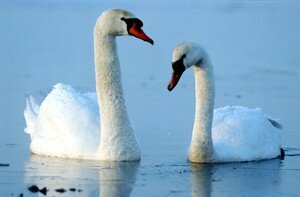
A pair of Mute Swans
In his first collection of Fairy tales, (published in 1843), the Danish author Hans Christian Anderson included four stories – one of which was the story the Ugly Duckling – a “homely” little bird born in a barnyard who suffers abuse from the others around him until, much to his delight (and to the surprise of others), he matures into a beautiful swan, “the most beautiful bird of all”.
For the record: Andersen was by all accounts was “a tall, ugly boy with a big nose and big feet, and when he grew up with a beautiful singing voice and a passion for the theater he was cruelly teased and mocked by other children”, and he later confessed that the story was “a reflection of my own life”, and, when he was later asked whether he would write his autobiography, he claimed that it had already been written — “The Ugly Duckling”.
Some years ago, on one my trips back to the UK, I was accompanied by someone from Kyrgyzstan and having dealt with business, we hired a car and went on a quick trip around the country. In Cambridge, as we wondered through the parks, he stopped an insisted that I photograph him by the side of the river with some swans in the background.
Although the birds are indeed majestic, I was a bit surprised at the reaction. We do have swans here in Kyrgyzstan – although they are not native. It is thought that they originate in Europe or the Western part of Eurasia. They normally live in temperate climates, and are found near water.
Swans are the largest birds in the Cygnus genus of the Anatidae family, (which includes Geese and Ducks). Adults can reach over one and a half meters in length, with a wingspan of three meters.
They enjoy a lifespan of between ten and twenty years. The males (cobs) tend to be larger than the females, (pens). The young are called cygnets and they reach maturity somewhere between 4 and 7 years old. When they mate they form lifelong partnerships - although “divorce” may follow a particularly unsuccessful nesting.
Both sexes are involved in the construction of the nest - the nests are placed either in shallow water or on land near to water - and they are known to be very aggressive in protecting them – hissing and flapping their wings in order to beat off a perceived threat. The male will even help with incubating the eggs. A clutch of eggs usually consists of somewhere between three and eight eggs – averaging 113 by 74 mm.
Most people think of swans as white birds with long, curved, necks … but those in the Southern hemisphere also have some black feathers in their plumage. In Australia there is a Black Swan and in South Africa there is the Black Necked Swan. All Swans have a bare patch (without feathers) between the eyes and the bill. Although in some species, the bill is black in many it is the one area of colour, (Orange or with yellow and red flashes). The cygnets tend to be darker in colour, off white, grey or buff.
Swans are interesting in that, unlike most birds, they have small jagged “teeth” as part of their beks which are used when catching fish, although generally, they are herbivores. They sometimes feed on land, but also take food on water, upending or dabbling (with their backsides pointing to the sky) with their necks extended under water to grasp the food.
There are six or seven species of Swan but only three are found in Kyrgyzstan – although Jorst ban der Ven only lists two in his handbook, Birds in the Kyrgyz Republic:
-
The Mute Swam – (Cygnus olor) - thought to be one of the oldest species of bird still to be found. It is a “partial migratory” bird, found throughout Europe and Asia.Generally, Mute Swans are very territorial with just a single pair (or family) on a stretch of water, however, they do sometimes establish small colonies. Juveniles in particular form small flocks before mating.
The name Mute Swan derives from the fact that it is less vocal than other species.
Here in Kyrgyzstan, although some breeding pairs can be found in the Issyk Kul region, most of the residents are non-breeding birds … in larger numbers during the Winter. They are rarely seen elsewhere in the country.
-
The Whooper Swan – (Cygnus Cygnus) – a migratory bird which breeds in Iceland and subarctic Eurasia, migrating to temperate climes in Winter.They require large areas of water in their habitat, especially when they are still growing because their legs have difficulty supporting their full weight and they spend much of their time swimming on the water. Despite their weight, they are powerful fliers.
Here in Kyrgyzstan it is found in Son Kul, where they breed and Issyk Kul.
Some other sources suggest that the Bewick’s Swan (Cygnus Bewickii) - a subspecies of the Tundra Swan (Cygnus Columbianus) - is also to be found in Kyrgyzstan. This is a small swan with a shorter neck that migrates between the Tundra of Northern Russia and the grasslands and marshlands of Europe. They are particularly noted for their deep calls, and the typical V shaped flight formation adopted by a flock during migration.
.
The swans of Issyk Kul were in the news last week … it seems that because of the cold winter and spring this year a sizeable number of young immature birds have not been able to put on enough weight in order to fly away their their usual summer habitats … and so are in need of protection.
As is usual, during the Spring Census of birds, the bodies of some young were discovered, but what was unusual was that a surprising number – as many as 200 individuals – were discovered that had not been able to accumulate sufficient fat to enable them to power their flight. Given that it takes them about four years to reach maturity, it is important to protect them so that they can survive the summer and be able to participate in next year’s migration.
.
Another interesting piece of related news also emerged last week … Kyrgyzstan has become the 120th country to ratify the Convention on Migratory Species … with effect from 1st May.
With its accession to the Convention, Kyrgyzstan is now a Party to all treaties participating in the Biological Liaison Group: the Convention on Biological Diversity (CBD), the Ramsar Convention on Wetlands, the Convention on International Trade in Endangered Species of Wild Fauna and Flora (CITES), the International Treaty on Plant Genetic Resources for Food and Agriculture (ITPGRFA), the World Heritage Convention (WHC) and CMS.



 Bishkek