The Longest Day
Here in Kyrgyzstan, people tend to consider June 1st as the first day Summer. This always strikes me as odd because when I was growing up, back in the UK, we used to consider that summer started on June 21st – the date of the Summer Solstice, when the sun’s path across the sky appears to stop its daily drift Northward before turning around and drifting Southwards once more, as a result of the tilt of the earth’s axis. At midday, the sun appears to be overhead above the Tropic of Cancer. In the Northern hemisphere, it marks the longest day of the year, when the Arctic circle experience 24 hours of daylight, and in the Southern hemisphere, the shortest, when the South pole experience 24 hours of night.
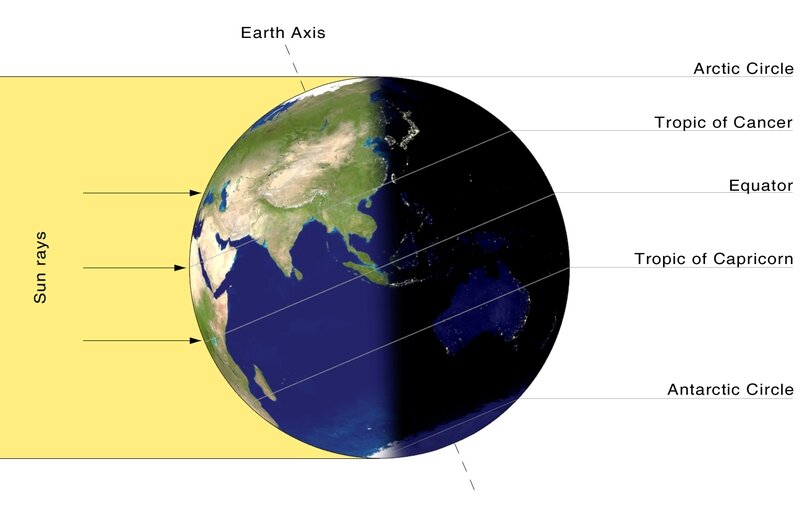
A graphic from NASA
Actually, because of variations in the earth’s orbit around the sun, the solstice sometimes occurs on the 20th, not the 21st. The last time this happened was in 2008, and the next will be in 2012, but it is not regular four year cycle.
Another thing that always seemed a little odd to me was that the Summer Solstice, (21st June), marked the first day of summer whilst Midsummer’s Day is June 24th … and, as a result, I have often cracked a joke about the shortness of the British summer as this, logically, appears to suggest that the last day of summer should be on, or about, the 27th. (In fact Midsummer’s Day isn’t really meant to indicate the actual middle of summer … June 24th was apparently the date of the Summer Solstice in the ancient world under the Roman calendar.)
Midsummer, was a pagan festival. In Northern Europe many stone circles and other monuments and structures were constructed in such a way as be aligned to sunrise on Midsummer Day … which was the day of the Solstice. Perhaps the most famous example is Stonehenge on Salisbury Plain in Wiltshire, in the United Kingdom, which attracts a mixture of Druids, hippies, “sun worshippers”, and those who just want to stay up all night, each year to celebrate the occasion at dawn on the day. Apparently, this year, the thirty-odd thousand revelers were lucky in that they had clear views of the sunrise which, in previous years, has often been obscured by mist and cloud. As part of the celebrations in antiquity, fires would be lit in high places all around the country, and there were still fires lit in Scotland well into the eighteenth century.
Under the influence of the church, however, pagan rites and practices were discouraged and the date became with St. John … it was traditionally identified as the birthday of St. John the Baptist, sixth months before that of Jesus … and became an important day in the church calendar in medieval times. As with many other pagan festivals, many aspects of the traditional midsummer celebrations came to be “borrowed” and transferred into new Christian holidays, resulting in rites and practices, beliefs and celebrations that mixed both traditions. Superstition held, for example, that “the veil between this world and the next” was particularly thin at this time of the year … and “powerful forces” roamed the earth and so special vigils were held overnight. It was said that spending this night in a sacred place it was possible to obtain the powers of a bard … or be driven insane … or die … or be spirited away by “the fairies”, as in Shakespeare’s play. This didn’t always put people off, however, and I remember climbing the Malvern Hills, myself, one year, to join a band of revelers watch the Midsummer sunrise in a reenactment of this ancient tradition. Herbs, such as St. John’s Wort, were thought to be imbued with power by the sun, and so were considered to be at their strongest on this, the longest day … when the sun shone for longer than on any other day of the year, and so scrimmaging parties would be assembled in order to gather and harvest them.
The rites and rituals, festivities and celebrations associated with the Solstice and Midsummer were probably much stronger in the extreme Northern regions of Europe than elsewhere, where the pagan traditions associated with the passage of the sun and the seasons was more marked, (although in countries where the church was strong, the celebrations of St. John’s Day assumed a prominence and importance of their own). In Britain, despite the references above, the importance of Midsummer is more or less forgotten.
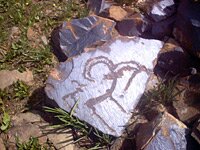
That’s true here in Kyrgyzstan as well, even though Sun worship was an ancient tradition in the region, (as marked by the multitude of petroglyphs at Saimaluu Tash – often referred to as the Stonehenge of Central Asia – which figure many “solar images”), and the fact that many age old shaman traditions have been preserved down to the present day …
This year, however, I decided to mark the occasion. It was a “spur of the moment” decision … nothing planned … in fact, I had forgotten that it was the solstice until I got phone call from John, (a consultant from the UK who has been working here for the last couple of years), and he reminded me. He seems to be good at remembering “important” dates and anniversaries – I am not … I could easily forget my own birthday if it wasn’t a public holiday here. In that respect he is bit like Roma, a friend of mine who died earlier this year. He would ring and tell me, “Tomorrow is ‘so-and-so’s birthday … ” and that I ought to buy a small present … he could even tell me what I had bought them before … last year … and for several year’s before that.
There was no special reason behind my decision to commemorate the Solstice … I’m not a Druid, hippie, “sun worshipper” or anything like that, and although I do sometimes stay up all night, I’ve got the age where I need my “beauty sleep”. It was simply the fact that we have had a difficult year and I thought it would be nice to try and bring a little cheer to the office. So, I went and bought a cake and we had a little competition in the office … what was the occasion it was meant to commemorate. It took a few guesses, but with a hint or two, someone finally got it.
It was a hot day – the sun shone in the morning and the heat slowly built up. The afternoon was marked by strong gusts of wind and loud claps of thunder accompanied by a light, but persistent shower of rain … all in all, it was almost like a summers’ day in England.
The phrase, “The Longest Day” has other connotations …
For example, I will always associate it with a film. I remember being taken as a young child of nine or ten to the Cinema to see it, and it was probably only the second time I had been to the cinema … on the previous occasion my Grandfather took me to see a Western – but I don’t remember which. I do the impression it made on me as the characters all appeared so much larger than life, literally, as they appeared on the big screen. This was only heightened when the chief character, an officer in the US Cavalry, walked forward in his bright blue uniform – apparently out of the screen … and the camera followed him … I was left with a sense of awe and wonder at this miraculous effect … .
It was some years later, when I was taken to see the 1962 film called “The Longest Day”, (based on the 1959 book of the same name by Cornelius Ryan), about the D-Day landings in Normandy on June 6th 1944. The film was notable for a number of reasons: Apart fropm the fact that it won two Oscars and was nominated for three others, it was an epic, filmed in black and white, it had a star-studded cast, many of whom played cameo roles; all the main characters spoke in their native languages with subtitles in English – although an English only version also exists – and showed participants on both sides of the conflict in a, more or less, sympathetic light and avoiding the typical stereotypes common in other war films of the period. This proved to be quite controversial in some quarters.
On this particular Longest Day, here in Kyrgyzstan where we have recently experienced our own period of violent conflict, perhaps it has something to teach us about seeing the picture from the point of view of others.





 Bishkek