What do you do when you’re at the end of your tether?
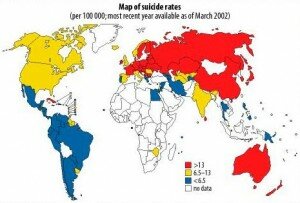
Suicide rates in 2002 – according to the World Health Organization
As a former schoolteacher, I always take an interest in news reports about education … so, I was intrigued last December to see a report of a meeting of the Parliamentary Committee on Social Policy addressed by the Deputy Minister of Education and Science who quoted a number of very interesting statistics – another of my abiding interests.
She told the deputies, for example, that for the academic year 2012-3 (September 2012-June 2013) the authorities had “registered”:
- a total of 142 “bundles” as we used to call them when I was school – here they are called “group fights” (I wonder if that means what it says or if it includes one-on-one fights that are sufficiently severe to warrant “registration” – e.g. a formal complaint is made or someone needs to go to hospital) …
- 74 of them were between boys but a surprising 68 were between girls!
- 18 cases of attacks on children from other schools
- it’s not exactly clear from the reports that I read, but it seems that there were another 19 “attempts at group fights”
- 226 children were registered as “leaving home” … which I presume means “run away” from home;
- 315 “accidents” – although there were no details in the reports that I saw as to what sort of incident this referred to;
- 834 cases of racketeering and extortion;
- 157 cases of “malicious hooliganism”;
- 7 bomb hoaxes;
- the social services and psychologists had conducted something like 2500 conversations with schoolchildren … and 16000 meetings with their parents (!)
Considering that last point in particular … I couldn’t help wondering why there was such an imbalance in the ratio of children to parents … almost six and a half times more consultations with parents than with the children … what does that tell us?
Much more striking, however, was the fact that she reported that, in the last two years, some 121 children had committed suicide.
I am not sure if such statistics are kept elsewhere in the world … but it would be fascinating to see the equivalent figures for, say, the UK. According to one set of data that I have seen, in 2011 suicide accounted for 582, or 1.36% of all deaths in the country .. or 11.4 deaths per 100,000 … and it was number 17 in the hierarchy of causes of death in the country, (after such things as Hearth Disease, Stroke, … Tuberculosis, Road Traffic Accidents … Cancer of the Stomach, Breast and Lungs). It ranked 50th place in the world (out of 192 countries and territories).
Historically, according the World Health Organization, the figures are:
| Year |
1981 |
1985 |
1990 |
1995 |
2000 |
2005 |
2009 |
| Suicide Rate (per 100,000) |
13.8 |
11.7 |
12.5 |
13.5 |
10.5 |
9.2 |
8.8 |
To put this into a wide context … according to the website suicide.org, (quoting data from the World Health Organization), in 2004 the suicide rate in Kyrgyzstan was 8.9 per 100,000 which put it in 50th place – below, for example: Lithuania, Belarus, Russia and Kazakhstan, (which held the top 4 places), Austria, Belgium, Canada, China, Denmark,Finland, France, Germany, Iceland, Ireland, Japan, the Netherlands, New Zealand, Norway, Singapore, South Korea and Switzerland, (in alphabetical order) … oh, and the US (in 43rd place with 11.0) … (and, for the record, the United Kingdom came in 62nd place at 7.0). The global suicide rate was 16 per 100,000.
.
As it happens, there seems to have been a growing trend of more and more attention being given to the issue of suicide in news reports.
Back in 2012 we saw protests being organized about the problems being faced by people having taken loans from various Microfinance institutions and being unable to make repayments due, they said, to the exorbitant rates of interest which were being charged – and it was alleged that the pressure was such that many chose to commit suicide when they realized that they couldn’t make the repayments that were due. It is true that rates were higher – higher than those offered by high street banks – and even some of those who took out loans from such mainstream banks also faced difficulties and similar pressures. The campaign had, however, hit a sore point and several politicians joined in the cause with lots of them using the word “usury” in their condemnation of “excessive” interest rates. The National Bank started to pay closer attention and suspended the licenses of several institutions, closed others and basically things have changed quite a bit – for the better, I hope.
In July, 2012, we were treated to a report about the rise of incidences of suicide – particularly in the South … the number of cases in Osh had quadrupled compared to the precious year were “alarming society” The vast majority (80%) had involved women, (taking medicines or poison, whereas the men tended to hang themselves or jump from a height, so we were told). Whilst some connections were drawn with trying to cope with the extraordinary pressures of trying to cope with the stresses following in the wake of the disturbances two years earlier, some felt that the main causes for the rise were economic … especially the lack of employment opportunities. The authorities turned to the religious authorities, social services, youth groups and schools to help address the issue … in sermons, training sessions, seminars and discussions and role play.
Then, in March last year, we were told that Kyrgyzstan had the second highest suicide rate in Central Asia with 17.7 suicides per 200,000 people*. Kazakhstan had the honour of being top of this unfortunate league table with an astounding 52.4 suicides (!) whilst Tajikistan came had the lowest with just 5.2, (there were no figures available for Turkmenistan). Oddly enough, Kazakhstan also highest GNP figure at over $10,000 per person, whereas Kyrgyzstan with just just over $2000 had the lowest … so, even if it was a significant contributing factor behind the figures of suicide, it doesn’t look as economics was the most significant factor.
*Why the statistics were quoted per 200,000 population I don’t know … elsewhere the figures are always quoted per 100,000 … 17.7 per 200,000 presumably equates to 8.85 per 100,000 … which, oddly enough, equates quite well with the figures quoted earlier.
Indeed, in June the previous year, there was a considerable outcry when, in a highly publicized case, a young woman, (20 years old) committed suicide as the result of having been the victim of a “bride kidnapping”. The practice of Ala Kachuu is highly controversial … some consider that it is “tradition” or simply a case of a couple eloping – the equivalent of “running off to Gretna Green”, (as in some cases it really is), or a necessity forced on young people who cannot afford the expense of a wedding … whilst others consider it to be reprehensible. In this particular case, it appears, the young woman was not a consenting party to the arrangement and faced pressure to conform to tradition … but in the end decided that she couldn’t cope and there was only one course of action left open to her.
Another contributing factor also came to light in October when it was reported that just over 1% of all childbirths in Kyrgyzstan were registered to teenagers and that, annually, there were about 1200 abortions among adolescents aged between 12 and 17 – i.e. schoolgirls. What is more, the number cases of early motherhood, teenage abortions, unregistered child marriages, abandoned babies, suicides and deaths among teenage mother was increasing.
Also in October, came the news that there had been up to that point there had been 79 suicides committed by schoolchildren since the beginning of the year. That statistic was revealed in a meeting considering the issue of “racketeering” among teenagers (basically, extortion under threat) and it was suggested that most of these cases represented children from low income families … so, once again, in a way economics was being cited as an important factor. The question of bullying and “organized gangs” wasn’t being ignored, however, and the Ministry of Education and Science started pushing for increased penalties for such activities – including holding parents responsible for the actions of their offspring.
A month later another potential aspect of the issue came to light when it was revealed that some 21 soldiers serving in the military had died during the year – although it was suggested at a rally of the mothers of conscripts that they thought is was around 100. One of the speakers went on to cite hazing, saying that most of the soldiers “moved to suicide by the officers and non-commissioned officers”. There is a lot of concern expressed here about living conditions in the military. Although some soldiers are volunteers, under contract, many are conscripts straight from school. Last year a video appeared on social media which appeared to show recruits being berated and abused by their NCO and it led to quite to quite an outcry – albeit a short lived one. As it happens, there are quite a lot of stories about abuse in the services in other countries – especially Russia, but also, I am sorry to have to admit, in places like the US and the UK … including cases which have to suicide. It’s not clear from the reports, however, how many of these 21 deaths represented suicides … one of the mothers, for example, had succeeded in obtaining forensic evidence that “proved” her son had not committed suicide but had been shot.
At the end of the year came somewhat surprising news that the Ministry of Social Development were planning to open a Crisis Center for Men … there already are several for women, including one financed by donations from the Manas Transit Center (… which, incidentally, is reported to have never opened its doors after it was completed). In announcing its plans, the Ministry pointed out that the figures for things like the death rate aged between 35 and 65 were higher among men than women (three times higher) … alcohol addition was higher (by a factor of eight) … and suicide rates were four times higher. That’s not to mention the rates for certain illnesses which were higher for men than for women. What is more, men are less likely to seek help when experiencing stress, having to cope with “high expectations” placed on men’s roles which aggravates the situation. When I saw the report, however, the cynic in me couldn’t help asking if this really was a case of Kyrgyzstan becoming a more liberated, egalitarian society … or if someone was trying to make a point … the way those statistics were being quoted seemed a little disingenuous. However, for the purpose of today’s postcard … note that it was claimed that among men in this age group the suicide rate is four times than that among women.
On Monday we saw some interesting statistics … which led to some apparently conflicting reports:
- The Deputy Defense Minister reported to the Parliamentary Committee on Defense and Security and told them that last year saw some 47 illegal actions, soldiers taking absence without leave, robberies and other offences … that 15 soldiers and officers were killed: 3 were killed in road accidents, and 3 were killed in road accidents, another 3 died from illness, one as a result of “hazing”, and another after a fight with a civilian, two drowned and another died of carbon monoxide poisoning … and then there were some 3 facts of suicide recorded;
- At the same meeting, the Military Prosecutor reported that in the defense units there were seven suicide attempts and (if I understood the Russian correctly) another five further attempts. In 2012 there had been 12 suicide attempts, 11 of them successful. The apparent discrepancy with the previous report was explained when he gave a more detailed breakdown: three suicides were reported in the Ministry of Defense – as the Deputy Minister reported, but there was also another three in the Interior Ministry, one in the anti narcotics service, and an attempt in the border Service. It was interesting to note that he also said, there are several criminal cases opened in relation to the cases, which suggests that they might have been related to hazing.
- A different news agency reporting on the same meeting said that there had been some 12 cases of suicide – (not 3 nor 7 … but, I suppose could, if we accept the other reports, relate to the 12 attempts the previous year) – which had led to four criminal cases and, in addition, that there had been some 860 violations – including the misuse of funds, which seem to led to just 12 prosecutions.
.
To be honest … although, in the past, I have thought several times about writing this postcard, (for example – I was thinking of it for September 19th last year … to commemorate International Suicide Prevention Day), but I have always put it off as too depressing a topic … so, why did I change my mind?
The choice of today is tied up with those strange statistics … but there’s also another reason …
It just so happens that I recently saw a link to a “Stop Suicide” – (“enough is enough”) – website which offered a list of “crisis lines”, telephone numbers for people who felt that they were at their ends of their tether to call for help. It promised: someone who will listen to YOU; who will make time for you; who will not be judgmental; who will not pressure you; who will not offer advice (how can they? … no-one knows exactly how YOU feel and what YOU’RE going through), or tell you what to do … with telephone numbers to call in many countries around the globe.
So, I went and had a look … and it seemed quite promising … they even had a pages in Russian … (not in Kyrgyz, but that wasn’t really surprising – not even Google or Wikipedia have managed that yet …).
The “Find help in your area” page had a pull down list of countries around the globe and I tried Kyrgyzstan … but they had no numbers for help services here in their database.
Again, that didn’t really surprise me … but I was a little surprised that, although they had pages in Russian, they had no services listed for the Russian Federation either.
So, I did some asking around … and I found one service … but to be honest, I know nothing about them apart from what they say on their website, and I have to admit to some reservations …
- they are a private medical service and at 2000 som for an initial consultation, (1600 som by skype) they are not necessarily cheap … and probably out of the price range of those “low income families” identified earlier,
- the offer to “give answers to those who want to get them!” … if only it was that simple.
… but they do also have some information on their approach to their work including an interesting article on suicide …
… and it would be nice to think that their is Help out there for those who need it.





 Bishkek
What makes you say, there is no Kyrgyz Wikipedia?
https://ky.wikipedia.org/
Richard,
You are right, of course … what I meant by that was that they haven’t managed to translate pages into Kyrgyz.
BUT thinking about it now, (now that you’ve raised it), that’s not really fair either because Wikipedia doesn’t translate pages anyway, they are all written specifically for each language version. (If, for example, you compare the pages for Kyrgyzstan in English, Russian and Kyrgyz they are all different – similar, as they should be, but different.)
Anyway, Sorry for any misunderstanding,