Write it down
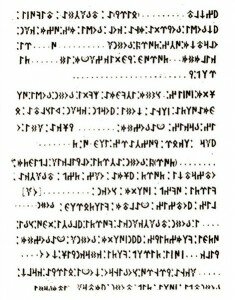
Turkic Runes
My father was a trade union official and, even if I say it myself, somewhat of a “barrack room lawyer”. Years later, when I was to follow in his footsteps and also became a trade union official, one of the lessons he taught me proved to be invaluable: “Get it in writing.”
“If all you’ve got,” he said, “is the spoken word then it it is difficult to challenged and can’t really be relied upon. It’s one man’s word against another. Get it down in black and white … then it is much more difficult for someone to go deny it and go back on their word.”
As today happens to be National Handwriting Day, (in the US), I decided I would spend a bit of time looking at the history of writing in Kyrgyzstan – OK, I appreciate it’s not exactly handwriting but I hope you’ll allow me a little leeway …
It is often said, (and I am as guilty in this as the next man), that the traditional nomadic Kyrgyz had an oral culture – and that Kyrgyz was first written down in the late nineteenth century – and became a formal written thanks to the efforts of linguists like Tynyzstanov, (who appears on the 10 som banknote).
As a result we basically have no written sources on which to base our knowledge of their history – only references in the literature of others, such as the ancient Chinese Chronicles – and that, in many respects. we have to rely on what is contained in the epics and sagas that have been handed down over the generations, peeling back layer after layer of accrued material, to reveal aspects of the history, customs, traditions and daily life of the people.
Now, whilst that is basically true … it’s not that simple – indeed, sometimes it seems as if nothing in life is ever simple.
There is no doubt, for example, that we owe a great deal to the manaschi and akyns who must have spent hours, days, weeks, months … years even learning millions of lines of the sagas and reciting them to the next generation … and to to the people like Radlov, and more recently Togolok Moldo, Ogunbaev and Karalaev, who spent their time transcribing and recording them for prosperity and a wider audience. We shouldn’t think, however, the fact that the written word, (rare though it might have been), had no role to play in this story.
It’s also true that the average Kyrgyz shepherd migrating with his flocks to the rich summer pastures in the mountain jailoo every Spring and then back down to the the lower kyshoo in the Autumn, may not have needed to read and write – but that’s probably just as true for the peasants and serfs of Medieval Europe. Just as in Europe there were other people who could read and write – so there were here in Central Asia.
In fact, according to an article by the two historians, Mokrynin and Ploskikh, (both called Vladimir), although we are not sure exactly when the Kyrgyz developed their own written language, there are artifacts unearthed by archaeologists which include ancient texts that date back to the third century BC – albeit, as they point out, most of the evidence from this period that have been found in the Semirecheye (Seven Rivers) region were discovered in the Issyk Kurgan, (Barrow – burial mound).
This suggests that the ancient Saks, (Scythians), and Usuns did make use of writing to record and fix important facts, (edicts, laws, contracts and agreements, events and so forth). We have a problem, however, in that much of the material still cannot be deciphered.
Once you get into the Middle Ages, however, the evidence of the existence of writing here in Kyrgyzstan abounds. There are numerous monuments, inscriptions, coins which contain writing – in a variety of scripts and alphabets: Sogdian, Chinesem ancient Turkic runes, Uighur graphemes, Syrian, even Sanskrit, Tibetan, Arabic and Latin .
As an aside: Perhaps the most famous example of Tibetan script is to be found above the village of Tamga – the Tamga Tash (which means “letter stone”). A stone inscribed with ancient Tibetan runes. The rock is high above the water is quite difficult to find – and nobody knows how or why the inscription (some of which has worn away) comes to be here. Apparently it is an ancient mantra – still chanted by Buddhist monks today.
Of course, those texts could well have been written by visitors to the region, (for example, travelers along the Great Silk Road, and the Nestorian community that settled in the region, for example – at Nevkat (Krasnaya Rechka), would have used the Syrian alphabet and script), but some texts, such as the presence of inscriptions on monuments, suggests that, at least for some people – the authorities), writing did have an important role to play.
In the Issyk Kul region, for example, many examples have been found of monuments inscribed in ancient Turkic, Syrian, Tibetan and Arabic.
The two Vladimirs suggest that Sogdian and Arabic were predominant at this time. Sogdian was basically a Turkic language and following adaptions was probably to become the basis for two specifically Turkic Scripts – Runic and Uighur. Arabic, on the other hand, being the language of Islam also developed and became the preferred language for literature, art and science.
When I first came here, I was surprised how often I would come across depictions of runic inscriptions. I had grown up thinking of runes as being Nordic or Germanic in origin and so they seemed out of of place here. So I was surprised to discover that the ancient Turkic people had developed a similar system here sometime around the seventh century. It seems that they had been using a Sogdian cursive script but it didn’t really match Turkic phonetics, (not having sufficient characters to match the different phonemes in the spoken language) and hence they adapted it, enlarged it and developed a new alphabet.
There have been many examples of texts written in Turkic runes discovered in Kyrgyzstan – especially, for some reason, in the Talas region – apparently only example is recorded of having been found in Issyk Kul … but it was an important one because, like the Rosetta Stone, it recorded text in different languages: Turkic and Arabic. Unfortunately, it went missing shortly after it had been found … and, more importantly, before it could be studied properly.
Despite the fact that the Runic alphabet had been especially crafted to meet the needs of the Turkic oral languages, it seems that Syrian remained popular in everyday use … judging by the available archaeological evidence. The two Vladimirs suggest that the reason for this is probably the fact that it was used by the Nestorians and the scale of the adoption of the religion in the region supported and sponsored its use.
In due course, however, the fortunes of Nestorian Christianity were to wane and the ascendant Islamic faith brought about a greater predominance of Arabic.
Apparently the earliest texts in Syriac script date from about the eighth century, found in Krasnaya Rechka in the Chui valley, but what I found surprising was that apparently there are monuments found in Issyk Kul bearing Syrian inscriptions that seem to come from much later and refer to the fourteenth century.
Arabic texts predominate both in terms of number and the variety of uses and contexts in which they were found. There are inscriptions on monuments and what could be called tombstone, but also, for example, on bronze vessels; they represent not epitaphs and religious incantations, quotations from the Quran and so forth, but also secular verses, diplomatic notes and so on. Yusuf Balasugin who wrote one of the great Turkic masterpieces, Kutagdu Bilig, (which is sometimes translated as ‘The theory of knowledge’, or ‘The Knowledge that Brings Happiness’), wrote in an Arabic script.
Apparently, the level of language skills was not as high as might be hoped for … many of the texts exhibit basic errors in grammar, spelling and so forth – perhaps indicating the influence of local languages and culture – perhaps even representing direct quotations of words and phrases used in local Turkic languages of the time translated into Arabic – and also, perhaps, the fact that it was the ritual language in the same way as Latin was at that time in European Christianity.
As an aside: Arabic was to remain important right into the twentieth century. For a time, the Arabic script was used for written Kyrgyz until it was decided to adopt a slightly modified Cyrillic alphabet and the first Kyrgyz Language Newspaper, was printed in an Arabic script. Indeed, across the border in China, Uighur is still written using the Arabic script.


 Bishkek