Off your trolley ???

An early trolleybus passing in front of Opera and Ballet Theater
In 13th January, 1951, Bishkek opened a brand new era in public transport in the city … the first Trolleybus service was introduced.
It is run by the Bishkek Trolleybus Company, an independent legal entity which is owned by the municipality. The company has two depots: the original one which can house up to 60 vehicles and a larger one, (which can accommodate up to 100), built in 1976. At one point, however, they had some on the balance sheet – I have no idea where they parked the others. At the moment it is not clear how many they still have – one report says 168 and another, 107. The difference may be accounted for, according to yet another source, by the vehicles which have broken down and need repair.
The trolleybuses ply their route, (the company operate a total of 9 routes – out of a potential 18 which are possible – the shortest measuring just 7.5 kilometers and the longest at just over 18 – with an overall total of 240 kilometers in the complete network), picking up and dropping passengers only at the designated stops. Entrance is through the doors at the back or in the middle of the vehicle, and once the vehicle arrives at the passengers desired destination, they exit through the door at the front, paying the driver their fare – currently 8 som.
For the record: A trolleybus draws electric power from overhead power lines, usually suspended from roadside posts, using spring-loaded poles. The first trolleybus system was introduced in Berlin in 1882, and as far as I am aware, it is still running. Other cities and countries picked up on the idea and soon there were several hundred introduced around the world.
They are quite efficient – especially in cities with steep hills, although they can outperform diesel fueled buses on flat stretches as well – and, because they don’t produce exhaust fumes, they are more environmentally friendly than ordinary buses. Unlike trams, they don’t use rails so a vehicle that becomes inoperable for some reason can be moved to the side of the road, parked and disconnected from the circuit and thus not cause a major traffic jam. They are also much quieter than other vehicles – although this can be a disadvantage for unobservant pedestrians as there is little or no warning of an approaching vehicle.
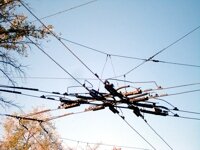
An unsightly tangle of overhead wires?
They have also several other disadvantages, the most obvious one being that re-routing a service, (or introducing a new one – for example to the new suburbs going up around the city), is not easy. Another is that when a pole becomes detached from the overhead wires for some reason, then the vehicle loses power and is stranded until it is reconnected to the circuit – and I have seen instances here in Bishkek where a long row of trolleybuses have been lined up waiting for power to be delivered to the next section of the system. It is, of course, impossible for a trolley bus to pass another. In some cities the overhead wires have been criticized as unsightly – especially at busy junctions.
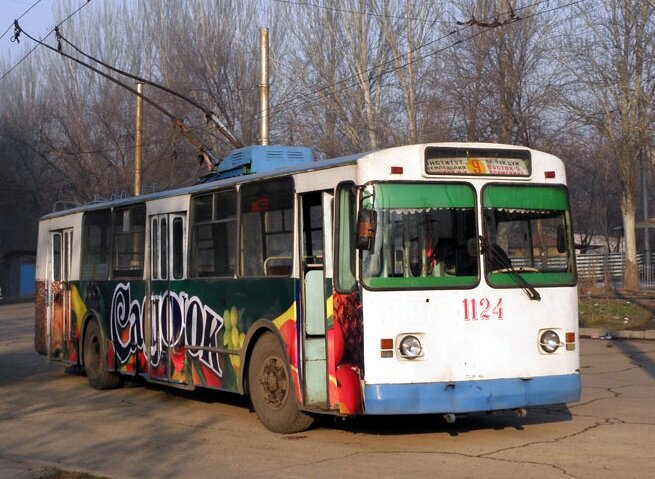
An older generation of trolleybus still in use in Bishkek
When I first came to Bishkek, a ride on a trolleybus seemed quite an exotic thing to do – although I had had taken rides on such transport before. It’s just that there aren’t that many cities around the world that operate trolleybuses – apparently there are only about 300 systems around the world, spread across about 40 different countries, although some are withdrawn from time to time other cities are apparently looking to reintroduce them … including parts of London.
In a way, it seemed an archaic form of transport – an impression underlined by the age of the vehicles plying their various routes around the city. About 40% of the cities fleet of vehicles are over ten years old – their intended working life, (dating from 1980, 1994 and 2003), and, of course, the older vehicles suffer more from technical problems.
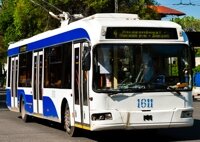
A recent addition to the fleet
Recently, however, there have been moves to update the fleet and, most recently, a loan from the European Bank, a grant from the European Union and entering a special leasing contract with the manufacturers have enabled the city to order some new vehicles from Belarus. (The contract worth about three million dollars to be repaid over three years will cost the city about USD800,000 a year). About 75 new vehicles are expected in total, (bringing the city’s compliment up to about 180 vehicles), and the first batch have already arrived in the city. The new vehicles are much more comfortable and better equipped – for example, with heaters and air conditioners, than those in the existing fleet.
The funding is also intended to help update the infrastructure – it is hoped to extend the system out into the new suburbs and a new ticketing system is proposed.
The arrival of new vehicles will make it possible to retire the older ones, which will be broken up to provide spare parts, where possible, and/or be sold off for scrap metal.
.
The Bishkek network was the first of three systems introduced in Kyrgyzstan.
Osh got its first trolleybus system on 1st November, 1977, operating operating 22 vehicles over two different routes, (a third is under construction), totaling some 46 kilometers in length. Osh has also recently received some new vehicles – these manufactured in Russia
Naryn introduced a service on 13th December, 1994, which for some time operated with just three vehicles, (one of which has broken down), which ply the one five kilometer route which runs along the main street of the narrow town – technically, there is a second route but, as I understand it, it does not operate. Naryn has also recently received some vehicles donated by Bishkek.
There is something about buses and trains … and trams … and trolleybuses which attracts attracts great interest and devotion among some people … here in Bishkek there are a couple of websites which are of particular interest:
- Bishkek, Naryn and Osh trolley
- Bus.kg – Bishkek Map Route Finder & Public Transportation Guide - which is also available as an app.


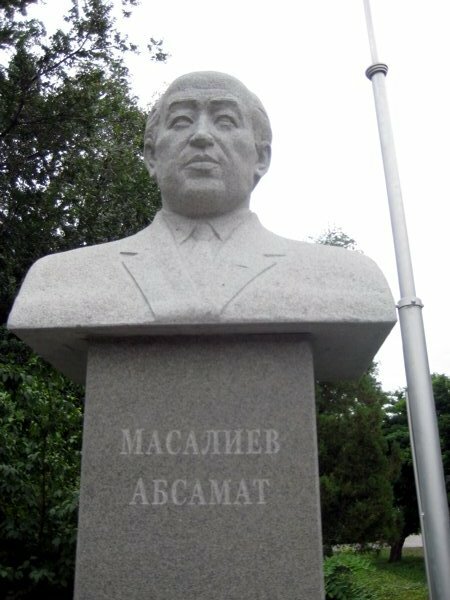



 Bishkek
As usual, your post is excellent.
Spasibo!
One of my favourite Trolleybus stories was told to me by a friend who had been up in Naryn on business. As he was walking down the main street – Lenin Street, of course – they saw a babushka emerge from one of the apartment blocks and look up at the overhead wires … apparently listening for something.
She said something like “Five more minutes”, turned round and went into one of the shops … emerging a short while later with her purchases and walked back to the trolleystop.
Sure enough, when the five minutes were up … the trolleybus rolled up.
He said that he had no idea if there was a timetable or if she really had a way of diving how far away a trolleybus was by looking/listening to the wires … but he was reminded of the old tales of trackers and hunters putting their ears to the ground and listening before uttering some profound comment … “another five minutes”.