Soviet Tourism
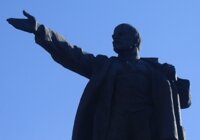
Lenin – pointing to the future
A short time ago I saw an article about the attractions of Central Asia and the traveling along the Great Silk Road. One of the options it highlighted was Soviet Tourism.
I have long felt that here in Kyrgyzstan we don’t make enough of Soviet Heritage when pointing out the attractions of the country In a way that is understandable … the great attractions of the country are the mountains – with all that they offer for adventure and activities be it mountaineering, trekking, rafting, cycling, horse riding, and so on; as an integral part of the Great Silk Road and the traditional Nomadic Culture of the Kyrgyz.
The seventy years of the Soviet Union, however, has a special draw – especially to people of a certain age from the West who remember the Superpower, and were brought up to think of them as “Them” … as opposed to “Us“.
As one author recently put it … Kyrgyzstan offers am “historian’s dream of a soviet time capsule”.
Churchill described Russia as “a riddle wrapped in a mystery inside an enigma” and the same is true of the Superpower that was dominated by Moscow and “closed” to foreigners … at least, most of us. As opportunities for foreign travel increased, tourists traveled throughout Europe – usually in search of the sun, sand and sea – but occasionally of landscapes, culture and “experience”.
The Soviet Union, however, was a mystery almost as inscrutable as that posed by China and the Orient. Access to the country was strictly controlled and regulated. The sheer vastness of the country encompassing Europe and Asia, mountains and desert, steppes and tundra … all of it out of reach inviting yet forbidden.
Even those who managed to get visas found that the country presented difficulties. In Oxford, I once spoke to someone who traveled through the country in the 1970′s – on their way from New Zealand to England to take up a place at University. His stories were fascinating, like the time he was berated on a metro train in Moscow for not getting up and giving up his seat to a pensioner … and when he replied in English, and it became obvious he was a foreigner, the complete “about face” as everyone apologized for the outburst and refused to allow their “honoured guest” to rise even though he was in a designated seat for the elderly and infirm. I couldn’t – and still can’t – imagine that happening on the London Underground.
His photographs, (for example, of Samarkand), were even more spectacular.
For some people, of course, there was the attraction of the Promised Land – Lenin’s Socialist Paradise built here on Earth. Then there was the fascination of characters like:
- the founders of the nation who helped to shape so much of the Twentieth Century: Lenin, Trotsky and Stalin;
- the conflicting relationship with and attitude towards Khrushchev … the man who courageously denounced his predecessor, his emotional outbursts hammering the podium at the United Nations with his shoe (even if he didn’t … the image persists), the eyeball to eyeball contest between K and K, (Kennedy and Khrushchev), over Cuba that almost saw the inauguration of Armageddon; the two great postwar races between the Superpowers – the Arms race and the Space Race;
- the ageing Brezhnev “wheeled out” on occasion; the courage Mikhail Gorbachev – the man “with whom we can do business” – in opening the windows and letting in the fresh air of Glasnost; Boris Yeltsin, the bumbling man who liked a drink and faced down the plotters of the attempted coup, ushering in a new – albeit, (for a time, at least), chaotic era and overseeing the final collapse of the Union.
I remember with great affection my first visit to a former Communist country, and I would like to help experience the same fascination and the sense of encountering history … and entering another world.
.
I was a little disappointed when the article concentrated on the theme of the “Legacies of Colonialism and Environmental Disasters” – the Darvaza Gas Crater in the dessert of Turkmenistan and the disappearing Aral Sea.
There is no doubt that these environmental phenomena exist … and we have our own examples here in Kyrgyzstan, for example the radioactive waste dumps around places like Mailiy Suu … but there is so, so much more.
Walking around Bishkek, or almost any sizable community here in Kyrgyzstan the are the obvious monuments of the former state – effigies of Lenin and striking war memorials – some of them complete with preserved Mig fighters and Tanks. Here in Bishkek there are even likenesses of the fathers of Communism, Marx and Engels … not forgetting people like Derzhinsky, the founder of the KGB -
Bishkek is full of Soviet architecture – from the early constructions of Interhelpa – the Czech volunteers who answered Lenin’s call to come and help build the Socialist paradise on Earth, to the classical style favoured in the Stalin era, (such as the Opera Theater and Union House), the “characterless” identical “blocks” of the Khrushchev’s Great Leap Forward and the white marble facades of the 1980s drive to create a modern city worthy of being the capital of one of the 15 constituent republics of the USSR, and .
Many of them are decorated with mosaics, murals, paintings and slogans – each expressing a political (and social) message, policy or aspiration of the time.
The museums such as the Historical and Frunze Museums, offer a fascinating glimpse of, not only these seventy years, but also of the into the hagiography – reveration paid to characters that we in the West had been brought up to see in a completely different light. The image of former President Reagan tiding an Inter Continental Ballistic Missile on one of the ceilings of the Historical Museum being photographed almost as much as the massive statues of Lenin addressing the crowds.
Out of town there are also signs. It is possible to visit the National Parks created in the USSR, (such as Ala Archa just outside Bishkek, Sary Chelek, and Salkyn Tur outside Naryn); some of which were reserved for use by the Party Hierarchy.
Things are changing, of course, and although many monuments are being erected to Kyrgyz characters Lenin and the war memorials still stand are joined by other symbols of the Soviet Union, such as the hammer and sickle. Kochkor in particular still has the street lamp decorations representing the emphasis and advances of science and technology. Perhaps the most poignant monument does not date from the Soviet period itself, but is intrinsically associated with it, is the Ata Beyit (Memorial to the Fathers of the Nation), in Chong Tash – where over the course two nights in 1937, some 130-odd of the Kyrgyz elite, (it is uncertain if it was 137 or 138), were eliminated as part of Stalin’s Great Purges.
But it is not all monuments and architecture … the Soviets did much to develop Lake Issyk Kul as a tourist destination with Intourist issuing vouchers (putyovka) to workers to come and spend a fortnight or more in one of the resorts or Sanatoria that line the shores of this Pearl of the Tien Shan. They may been joined by more recent additions, but they are still there and it is possible to stay and get a feel of what it must have been like.
The ethnic and cultural mix represented in the country is also a result, (at least in part), of the Soviet Union – with many groups of people being brought here either as internal exile, forced migrations or as part of the mass relocation of factories and institutes during the Second World War. Each group brought with it their own distinctive culture and cuisine – much of which is still evident in the republic and helps to give a real sense and feel of being in a cosmopolitan society.
As I said, there is a lot more to offer and explore in Kyrgyzstan’s Soviet heritage …
__________________________________________________
Here’s a starter suggestion, it can be customized to meet specific wishes, flight timetable and so forth but should give some feel of both contemporary Kyrgyzstan and its Soviet past:
Tour in Kyrgyzstan


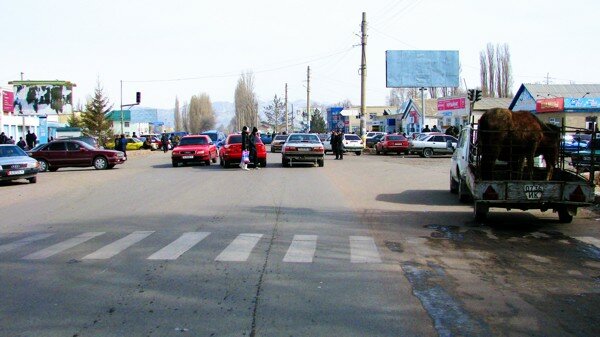

 Bishkek