Kydyr Ake – the Kyrgyz Solomon
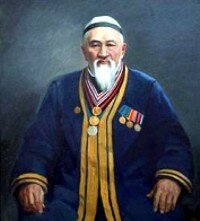
Kyrdyr Ake
Titles are quite important here … a polite form of address which a younger person might use when addressing an older man, in order to show respect, is Baike and when addressing an older woman – Eje.
There are variations and Ake is one of them. In the South of the country it is used to mean Uncle or elder brother, in some other parts of the country it’s used like Baike – as a title of respect for an older man, but I am told that in the Issyk Kul region it is granted only to Great men … a bit like the title Great as in Alexander the Great, Alfred the Great …and so on.
Apparently there have only been seven Akeler: Hag Ake; Moyut Ake; Sarthe Ake; Tilekmat Ake; Sadyr Ake; Karachi Ake and Kydyr Ake … although I have come across references to others, such as Karga Ake, and I still have to work out if these simply different versions of the same names.
The title Ake was granted to people of great wisdom, knowledge and perspicacity, who concerned themselves to the fortunes of the Kyrgyz people as a whole, (not simply their own community and tribe), a person with the ability to bring peace between the tribes. They were given the right to take important decisions in the name of the community in times of historical unrest.
As well as the qualities of wisdom, justice, and their prophetic, diplomatic and possibly psychic skills, many of them were also talented and creative musicians, or skilled berkutchi (falconers or eagle hunters) and horsemen.
The mausoleum of the Akeler became places of worship and considered as sacred sites.

Obshestenniye Reiting
It’s actually been quite difficult to find material on the Akeler … although I have found three biographical articles.
One was in the newspaper Obshestvenniye Reiting, (Public Record), which was about the most recent of the seven Akeler was Baisary uulu Kydyr, or Kydyr Ake, which I have drawn on for this postcard.

24.kg – one of the main news agencies based in Bishkek
There was another posted on the site of the news agency 24.kg which also provided a number of additional interesting facts.
Kydyr Ake was born in 1843 in the Baiysh jailoo in the Sary Jaz valley, (near to Khan Tengri and the Chinese border), into an aristocratic family – the grandson of a tribal leader who often performed diplomatic duties, even travelling to Omsk as an emissary to the Governor General of Western Siberia.
There is an interesting family story told about his birth by his great grandson. |Apparently, his motheer was unable to bear children and his parents had given up hope of ever having a child of their own. Then, one day, a stranger came to visit and, as was the usual practice, they made him welcome and spread a dastorkan. After the meal he said that he surprised them by had divined that she was childless but in fact she had a son in her and when he was born they should name him Kydyr … then they retired for the night. In the morning the visitor had mysteriously disappeared and there was no sign of him, the bed was even untouched. In due course, howeber, she discovered that she really was with child, who was delivered at the due time as he had foretold.
They named the boy Kydyr as the stranger had instructed. They noted that the infant had a birthmark in the right eye, and at the time there was a traditional belief that someone with such a mark was special, holy, possessing special powers and could jinx people … as a result the boy learned not to look people in the eye.
He was raised from an early age by his Uncle who held a post in the Russian Imperial administration. This would involve taking trips and he often took young Kydyr with him and allowed him to see and experience many things not normally available to young boys. At the age of 12, for example, in 1855 he traveled with a delegation from the Bagu tribe, (which at that time numbered about 10000 yurts), which carried the agreement of the local tribes to enter the Russian empire. (The southern tribes, under the influence of the Kokand Khanate), however, were still opposed to this step at the time.
His intelligence and insight were evident from early childhood and when he became an adolescent he was already making decisions in cases, demonstrating an understanding of different aspects of the cases and justice. By the time he was 18 he was elected to local Turgenskoye council on which he served for many years.
His youth was spent in the service of the Imperial authorities, fulfilling administrative, judicial and fiscal roles and was responsible for public order. He also worked as a traditional “folk arbiter” – where his knowledge of customs and traditions, helped his reputation for wise, fair and honest decisions and his stature to grow. Apparently, the text of many of his judgments are preserved and some have been passed down through the family.
The Tsarist authorities found his experience, opinions and diplomatic skills invaluable when it came to defining the the boundaries between the territories allocated to different ethnic groups in the region – and in the delimination of the state borders in 1873. In order to complete these roles he had to have had the respect of the other ethnic groups living in the region – indeed, it seems that they also sought his assistance in resolving disputes and he received the support of representatives of the Russian and Kazakh representatives in an election as chairman to preside over the Semirechye kurultai at Almaty in 1910. As a result of his efforts he was granted several awards and several received gifts from the Governor General of Turkestan.
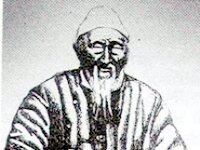
Kadyr Ake
In 1913, one hundred years ago, when he was already 70, he was invited as a representative to the celebrations to mark the 300th anniversary of the Romanov dynasty in St. Petersburg. It was a long and difficult journey – by horse to Omsk and then by train to St Petersburg. He took with him as a gift to the Tsar a Tiger cub caught in the Naryn region … one of the last few Tigers left in the Tien Shan. Although he understood Russian, he spoke it only with difficulty so took with him also a Tatar to act as an interpreter.
At the celebrations he was awarded a gold medal and the rank of Lieutenant Colonel and presented with two chests of presents. There is another family story that on the return journey, whilst on horseback on the Kazakh steppe, some of his travelling companions decided to steal these gifts from him … st one of the rest stops they loaded the valuables up on the horses and galloped away … but after a while tyhe horses refused to go any further – AND some ravenous beasts appeared in their path … frightened out of their wits, they turned back, returning to the camp where they apologized to the great man – and then the party continued on its way together.
In the events of 1916, Unkun, he did all that he could to bring peace between the opposing parties. urging the people to not to destroy but to seek reconciliation. Those at the Karakol kurultai, however, did not heed his appeals for a peaceful resolution to the argument over the Tsars decree … It is said that it was thanks to his personal authority and the regard in which he was held by the Russian authorities that he was able to save many of the people, although he too fled to China, sharing the hardships of the journey and exile … but also gaining the respect of the Chinese authorities.
Apparently there are some photographs of him at the reception.
He was renowned as a talented musician, (it seems he played the komuz), and even performed occasionally as an akyn, and is reputed to have been a skilled storyteller. He was also famous for his horsemanship (riding well into his seventies) and as a Berkutchi.
He died on 26th March, 1926, in a family home and was buried in the village of Kerege Tash, which had been his home for all his life. It is said that funeral was attende by over a nundred Russians as well as family and friends, neighbours and representatives of the people. A gumbez, (mausoleum) was constructed and a monument in his honour was erected outside the Ak Suu District Administration. There’s also a “sacred site” called the Spring of Kydyr Ake in the village of Ak Suu, (Teplokluchenka – not far from Karakol) along the road leading to Altyn Arashan which consists of Juniper trees and a hot spring emerging from under a rock.




 Bishkek