Abdynasyra Elebesova
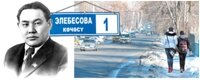
Elebesova Street
Abdynasyra Elebesova was born into a poor peasant family in the village of Kairma in the Djumgal valley, on 5th December, 1912. He was one of four children – with a brother and two sisters.
He was to play an important role in the establishment of Soviet power, laying the foundation of the economy and culture and the formation of it’s intelligentsia of Kyrgyzstan in the 1930s and 40s.
The young Abdynasyr distinguished himself by his curiosity, diligence and hard work from his early children – and after leaving school began to take steps to help eliminate illiteracy among the local population.
In 1930 he enrolled at a Agricultural technological college and two years later transferred to the Kyrgyz Agricultural Institute – eventually graduating in 1937 with the equivalent of a First class degree in livestock management.
The young undergraduate took an active part in the Young Communist League and other student bodies, and two years after graduating he joined the ranks of the Communist Party.
Even before then, in 1938 – … at the tender age of 26, he had been appointed Commissar of Education in the Kyrgyz SSR. In that role he played a great role in strengthening the education system, creating a structure of higher education and teacher training.
Between 1940 and 1942 he served as Deputy Commissar for Agriculture, and this was followed by a two year term as the First Deputy Chairman of the State Planning Commission, and then as the Minister responsible for State Farms and eventually as Minister for Livestock.
This led to a role as representative of the Republic on the Council of Ministers of the USSR which put him at the center of events and brought him in experience of dealing with a wide variety of urgent problem issues.
On his return from Moscow he took up once again the role of Deputy Chairman of the State Planning Committee.
In 1954 he transferred from government and worked in the Research Institute and Veterinary science where he proved to be an organized and thoughtful scholar; single minded, demanding, hard working, honest- “a highly qualified expert” and effective leader.
In 1966 he successfully defended his thesis on the issues of intensive fattening of the Alatausky breed of cattle – earning his doctorate.
His contribution to the development of the country brought him many awards … two “Badge of Honour” awards, two “Red Star” awards, the Soviet Union and other medals and diplomas. A plague was erected on the block of flats where he lived at the intersection of Prospects Manas and Chui, and a bust of him was erected in one of the microdistricts. There’s a school named in his honour and, it appears two streets: one a short residential street near to the Hyatt Regency and the other is part of what was once called Bakinskaya, North from the Bolshoi Chuiskiy Canal towards the Dordoi Market.
He twice served as a deputy to the Supreme Soviet.
His brother died in the defence of Moscow in the Second World War, and both of his sisters worked as teachers in rural schools.
His wife was active in the cultural life of the republic – heading the Republican Library. Together they had three children – two sons and a daughter. the younger son died early, but the older boy followed his fathjer’s example and as well as working as Chief Engineer in a number of factories, he also worked in the State Planning Committee, the State Standards body, the State Commission for Economic Reform and the State Property Fund.






 Bishkek