Andreeva Noch – Andrew’s Night
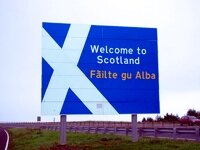
Welcome to Scotland
Tomorrow is St. Andrew’s Day … Saint Andrew happens to be the Patron Saint of Scotland, so I wish all my Scottish readers a Happy St. Andrew’s Day.
As it happens, Andrew is quite a popular Saint around the world … as well as being Scotland’s Patron Saint, he also fulfills that role for several other countries – Greece, Romania, Ukraine and Russia, where the celebrations begin the evening before, that is tonight, which is known as Andreeva Noch – Andrew’s Night.
In parts of Germany, Austria, Slovakia, Poland, Russia and Romania, superstitious beliefs hold that this night is especially suitable for divination – such as for revealing a young woman’s future husband.
For the record: The Russians also lay claim to:
- the parents of Jesus – both of them, Mary and Joseph;
- St. Basil the Great who supported the Nicene Creed and opposed various heresies in the early church such as Arianism;
- St. Nicholas of Myra – the original Santa Claus;
- St. Casimir – a Crown Prince of Poland and the Grand Duchy of Lithuania;
- St. Vladimir the Great – a Prince of Novgorod, Grand Prince of Kiev and ruler of the Kievan Rus from 980 until 1015;
- St. Thérèse de Lisieux and
- St. George.
In the past, I have written a postcard mentioning the use or the flag of St. Andrew is used as an ensign by the Russian Navy.
St. Andrew was one of the disciples of Jesus and the brother of St. Peter, (whose bones may or may not have recently gone on display in Rome after having been discovered during excavations of an ancient Roman cemetery under St. Peter’s Basilica during World War II. It’s not known if they are really his bones – and the Pope seems to think that it doesn’t matter – but the archaeologist that discovered them also discovered a piece of purple cloth decorated with gold thread and a Greek inscription saying,”Peter is here”).
Nobody really knows why he is associated with Scotland … it’s not as if he ever visit the Highlands – or the Lowlands for that matter … although there is a legend that his bonbes were brought to Scotland in the fourth Century … and the Cathedral bearing his name in Kinrymount, Fife, where they were supposed to be interred was a favourite spot for medieval pilgrims – before they were destroyed along with other reliquaries in the Reformation in the 1500′s.
There’s an alternative suggestion in that the ninth century Pictish King Angus MacFerguson saw a saltine cross, (the diagonal cross which adorns the Scottish flag and on which the Saint was crucified by the Romans), in the sky before a battle and took it as a sign or omen … and adopted Andrew as his Patron from then on.
The official adoption of Andrew as Patron Saint seems to have come in the Declaration of Arbroath in 1320, and later that century he started to appear on Scottish coins.
More recently, in 2006, the Scottish Parliament designated St Andrew’s Day as an official bank holiday.
Some interesting things are happening in Scotland at the moment … as they prepare for a referendum on declaring Independence from the United Kingdom. As I understand it …
- There will be a 16 week campaign period beforehand when supporters from both camps – Yes and No – will be able to put their cases.
- Voting will be open to all British citizens resident in Scotland, (even the English), but anyone born in Scotland who is now living somewhere else in the UK will be disenfranchised, (if that’s not too strong a term).
- There is no threshold vote required and a simple majority 50%+1 of the votes cast would be enough for th country to gain it’s independence.
I have no idea how the vote will go – the polling evidence is not clear, although the indications seem to suggest that support for this move is at it’s lowest over the last fifteen years, that is since before the turn of the century. If it does result in a “Yes” vote, however, it will lead to some important changes. Also, it wouldn’t necessarily happen overnight. I understand that the Scottish National Party plan for Independence Day to be commemorated in three years time – on 26th March 2016.
This week, for example, it was reported that Scottish voters were being told that a vote for independence will mean saying “goodbye” to the British pound. Apparently Scottish leaders have been told that the rest of Britain will not support their favoured option of creating a “sterling zone” and quite a few politicians have been lining up to say that the idea itself is impractical, unworkable, a non-starter and even “ridiculous”. Critics of the proposal are calling for alternatives – join the Euro, establish their own national currency, or will they tie themselves to the pound as Panama and Ecuador are tied to the US Dollar.
It took Kyrgyzstan a couple of years to decide and implement the steps necessary to introduce it’s own currency … having experienced the difficulties of being in the Ruble Zone during a financial crisis which saw many lose the value of their savings – if not overnight, at least rapidly. There are many who argued and would presumably still day, that having your own currency is not only a symbolic step but also a necessary one to ensure and give credence to “independence”.
There are other issues that need to be addressed, for example:
- Defence … especially as Scotland wants to distance itself from Britain’s nuclear weapons – some of which are currently based at the Naval base on the Clyde;
- Foreign Policy – and relationships with international organizations like NATO and the European Union;
- A whole host of practical issues like Passports and border controls – Customs and Immigration; retirement; health care provisions; the division of assets and liabilities; how cross border organizations such as the BBC work;
Whatever is decided, at least they will have time to plan their independence and the steps that they will need to take … unlike Kyrgyzstan which seized independence as a response to difficult circumstances – perhaps they need to examine the Kyrgyz experience (and that of other former Soviet republics) in order to learn what steps need to be taken, what opportunities the process will bring and what pitfalls they need to try and avoid.


 Bishkek