Hello Sailor!
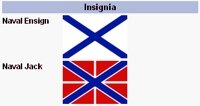
Russian Naval Flags
Walking around Bishkek, I am surprised by the number of people wearing T-shirts displaying the Union Jack: the flag of the United Kingdom. I know that they are popular purchases from the shops and stalls selling souvenirs along Oxford Street … but it seems a little out of place on the streets of Bishkek.
Occasionally you encounter variations on a theme … such as pink Union Jacks which seem to be a protest symbol sported by Emos, Goths or Punks. On the other hand, there seems to be a fair number of reverse image red, white and blue Union Jacks … another popular image seems to be the Cross of St Andrew – although, once again, the colours are reversed from those on the Scottish flag.
At first I wondered if really was a sign of respect for Britain and for Scotland … then I discovered … these are the flags of the Russian Navy.
For the record: The St. Andrew’s Flag served as the ensign of the Imperial Russian Navy from 1712 until the Bolshevik Revolution in 1917, and was readopted after the collapse of the Soviet Union in 1991. (An Ensign is flag that are usually flown when entering and leaving harbour, or when sailing through foreign waters). The Naval Jack seems to be a relatively new design, (I haven’t been able to find out if it also served in the Imperial Navy before 1917), and was adopted in 1992. (A Jack is a flag flown by warships at the head of the ship – the bow – usually when the ship is not under way and when the ship is “dressed” on special occasions.)
It might seem odd that the symbols of the Russian Navy are popular here – but perhaps no more than the Union Jack or the Stars and Stripes are common found as designs adorning apparel. There is, at least, some connection between Kyrgyzstan and the Russian Navy.
When I first came here I used here jokes about the Kyrgyz Navy – steamers that ply their way between piers on Lake Issyk Kul … and the Kyrgyz elevated to the rank of Vice Admiral in the Soviet Fleet. I have actually met people, (not many to be true, but one or two), who did their military service in the Soviet Navy. More to the point, however, Russia maintains a couple of Naval Bases here.
Yes, that’s correct … Russia maintains a couple of Naval Bases here. They not only have the Air force base at Kant, established shortly after the Americans were granted the right to use Manas Airport as a base. Ever since the days of the Soviet Union, there have been a number of military installations maintained by Russia here.
The first is on Lake Issyk Kul, at the Eastern end, not far from Karakol. It’s a restricted area and foreigners are not supposed to approach it so, (although I have been tempted), I have never gone looking for it. A few years ago we were asked by a tour firm in Russia if we could arrange speed boat trips form out of the base for their clients. Apparently, they already had experience of organizing Military Tours in Russia, including driving tanks or taking a ride in a fighter plane and they were looking to extend their activities. Personally, I wasn’t too happy about speed boats zooming up and down the lake … after all, it’s supposed to be a fragile environment … but it turned out to be an irrelevant question anyway, the answer was a resolute No!.
The reason that there is a naval base up at Lake Issyk Kul is quite simple … it was deemed an ideal place to test torpedoes. Although Kyrgyzstan is landlocked, and about as from the see as it is possible to get, the Dastan company in Bishkek has manufactured torpedoes since the days of the Soviet Union. Being so far from the sea, with restricted access, it was relatively easy to maintain security. Also, Issyk Kul is not only close to the factory, it offers a large expanse of salt water, similar to the sea water in which the torpedoes will actually have to work, (and therefore far better for test purposes than a freshwater body of water). What’s more, as an enclosed body of water, it is ideal for a test bed as, even if they go astray, spent torpedoes can be located more easily than in the open sea, collected and taken for further analysis. (Having said that, apparently there are quite a few that have not been located and lie somewhere on the floor of the lake).
Perhaps more surprising is the the radio array at Chaldovar in the Chui valley.
The origins of this base dates back to the final days of the Second World War when the secrets of Nazi Germany about long distance communication with submarines were captured by the advancing Soviet forces. Using ELW frequency radio signals, (extra long wave), signals could be received by submarines whilst submerged even to a depth of something like 28m in the North Altlantic and 18m in the distant Indian Ocean. The Goliath project was stored in Leningrad for three years and then relocated to Nizhniy Novgorod before eventually being relocated to Chaldovar in the early 1960′s.
In fact Chaldovar is only one of several such stations constructed in the Soviet Union, as part of a global communications system. It consists of some 18 different antennae, the tallest reaching some 312m into the air, (that’s almost as tall as the Eiffel tower), spread over 600 hectares, all enclosed in a perimeter 10km long.
To be honest, I felt a bit anxious about writing this postcard … because of the subject matter … BUT all of the information, (and more!), is in the public domain … see here, for example.
Kyrgyzstan is a landlocked country and although February 23rd, which is known as the Defenders of the Fatherland Day, is based on the old Soviet Army and Navy Day, today, (October 21st), happens to be Trafalgar Day, which is the closes that we in Britain have to a Navy Day … .





 Bishkek