Frederick Engels
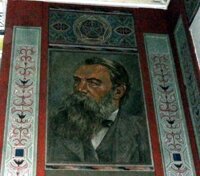
Portrait of Engels in the American University
On 28th November, 1820, a young boy was born in the town of Barmen in the Kingdom of Prussia, (today it is known as Wuppertal in Germany), Frederick Engels.
Although he was the son of an influential and relatively affluent businessman, (a cotton manufacturer), he developed an interest in revolutionary politics and dropped out of school and was frequently on the run from the authorities who had a warrant out for his arrest.
His father decided to send him to Manchester in England to to work at a mill in the hope that it help to rid the twenty two year old of his revolutionary tendencies. As it happens, it provided the opportunity for him to meet the man with whom his name will forever be associated – Karl Marx.
Although we tend to think of the together, they weren’t exactly impressed with each other on their first meeting.
His time in Manchester fave him the opportunity of observing the slums of the city in close detail, taking notes of the horrors he observed, (notably child labor, the despoiled environment and the overworked and impoverished laborers), which he used in writing articles and later collected and published in his influential first book, The Condition of the Working Class in England, (written over half a year,between September 1844 and March 1845 and printed in German later in 1845 – but didn’t appear in English until 1887). The book describes Engels views on the “grim future of capitalism and the industrial age”, describing in detail the squalor in which the working people lived.
On his way back to German, he met Marc again in Paris, and this time a friendship blossomed which was to last for the rest of their lives. Marx had read Engel’s book and was impressed by it – and some say that was from here that he adopted the coming revolution would be led by the Working Class.
The subsequent years saw him moving between Belgium, Prussia (Germany), Italy and Britain, supporting workers groups. Back in Britain he reentered the Manchester works in order to raise money to help finance the activities of his friend, Marx, who was working on his opus, Das Capital. Apparently, he wasn’t that keen on the book, but felt that it would be “good for the cause”.
He was still writing in his own right … including a wide range of articles and a “monumental work” on the Luther, the Reformation and the Peasants Revolt.
1848 saw the publication of the Communist Manifesto which was credited to the authorship of both Marx and Engels. Engels is usually credited with writing the first drafts for the book, and Marx with polishing off the final text. However, in the introduction to the 1883 edition, Engels gave the credit to his friend, saying that it was “essentially Marx’s work” and that “the basic thought… belongs solely and exclusively to Marx.”
After Marx’s death in 1883, Engels set about editing his writings – especially the unfinished Das Capital.
.
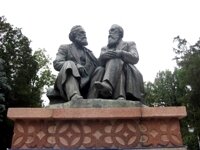
Marx and Engels deep in conversation
Although he was well traveled, Engels never made it to Kyrgyzstan, he is still commemorated in a statue in Central Bishkek where is depicted as sitting on a bench discussing some points of philosophy with his friend and collaborator, Karl Marx.
There are also several portraits of him around the city … for example: his portrait is one of several, (including Marx and Lenin), that can still be seen in the conference hall of the building which currently houses the American University in Central Asia.
There was also a street named after him here in Frunze, (as Bishkek used to be called), but it has since been renamed after the Kyrgyz actor and painter Suimonkul Chokmorov whose portrait adorns the 5000 som banknote.



 Bishkek