Encyclopaedia Kyrgyzstana
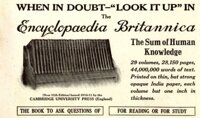
1913 advert for the Encyclopaedia Britannica
“Google it!” – that’s the standard advice these days when you want to look something up … but back in 1913, the advice given in the advert said: “When in doubt – “Look it up” in The Encyclopaedia Britannica” … or “A Dictionary of Arts and Sciences, compiled upon a New Plan“.
The first “installment” of the first volume of the first edition of the classic, standard reference book was published in Edinburgh on 6th December, 1768. Actually – the encyclopaedia was what we would now call a “part work” issued in weekly installments – each containing fairly extensive essays on various topics. By 1771, a hundred parts had been published, comprising 2400 pages and 160 illustrations … when collected and placed in alphabetical order, they could then be bound into a three volume set.
For the record: It wasn’t the first such work … but was conceived as a reaction to the French Encyclopédie published in France and Chambers Cyclopaedia, in America.
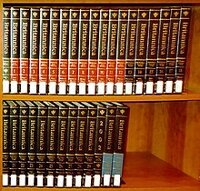
The last version of the Encyclopaedia ran to 32 volumes
Despite the cost of twelve pounds, which was a considerable expense at that time … it proved to be a success with some three thousand copies being produced.
The authors of articles in Britannica are recognized experts in their field and have included in their ranks the like of Sigmund Freud, Albert Einstein, Marie Curie, Henry Ford and Leon Trotsky amongst a host of other easily recognizable names.
Although it is called Britannica, and was first published in Edinburgh, the ownership first of all moved South to England and then across the Atlantic to the States … It is now in it’s 15th edition with 32 volumes … organized into three sections:
- the Micropædia - 12 volumes of short articles, (usually less than 7500 words), which is meant for quick fact-checking … and as a guide to
- the Macropædia - 19 volumes containing longer more detailed articles … which could be anything up to 300 pages long;
- and the Propædia - a single volume which attempts to organize knowledge in a hierarchy and giving an outline in order to understand a subject’s context … and to find more detailed articles.
That was probably the last print edition … as the publishers move towards CD and on-line versions as being more amenable in the new information age.
Indeed, it is now close to be being superceded both as a standard reference book and as an educational tool … by Google and Wikipedia – the on-line encyclopedia, to which anyone can contribute.

Encyclopaedia Kyrgyzstana
An Encyclopaedia is a type of reference work – a compendium holding a summary of information … either drawn from either “all branches” of knowledge … as in the case of Britannica … or from a particular, specific, branch of knowledge … as in the case of the Encyclopaedia Kyrgyzstana.
The decision to publishe such a work of reference was taken taken in December 1998 and the first volume of the National Encyclopaedia “Kyrgyzstan”, (as it should properly be called), was published in 2000. A total of twelve volumes were planned – eight in the Kyrgyz language and four in Russian – with a print run of 5000 copies of each. It was envisaged that the project should be completed by 2015.
They won’t make the deadline, however, as only four volumes have been published, the latest in September this year to commemorate the Day of the State Language on 23rd September and a presentation was held in the National Library.
According to the Editors, the text of the next four volumes is more or less finished … but they can’t find the money to finance the printing of the rest.
Copies of each volume are distributed to educational institutions, but some were retained and are available for sale.
Actually, it won’t be the first such Encyclopedia … having been preceded by the Kyrgyz Soviet Encyclopaedia, in Kyrgyz, the six volumes of which were published between 1976 and 1980. It was one of a series of such encyclopaedia published in all of the Soviet Republics.
Although it covered almost all areas of knowledge, the selection and interpretation of facts and the details of presentation markedly reflected the influence of communist ideology.
This in turn served as the basis for the single volume Encyclopaedia of the Kyrgyz SSR which was published in both Russian and Kyrgyz in 1982.
Following Independence, the Encyclopaedic Center also published a series of bools dedicated to each of the oblasts, Chui, Issyk Kul, Naryn, Talas and Djalal Abad … plus one for Bishkek, (I have seen copies of each of these but I don’t know what happened to the volume for Osh … which, at that time, of course, included Batken).
There are other works that have been published which are referred to as encyclopaedia … but they tend to be single volumes and dedicated to specific topics. They include, for example:
- The Encyclopaedia Manas … dedicated to the epic saga about the legendary hero of the Kyrgyz … indeed, the epic poem is often referred to, itself, as an encyclopedia of information about Kyrgyz folklore, history and and so on.
- The Mountains of Kyrgyzstan – prepared as part of the arrangements for the Global Mountain Summit in 2002
- The Sports Encyclopedia – a private publication with a print run of 1000 copies, prepared by a local sports journalist which took three years to complete and lists about 1000 sports personalities and informative entries on events, terms and so on.
- An encyclopaedia of Music … written by Balbala Alagushev, one of the editorial board of Encyclopedia Kyrgyzstana, who also wrote text about traditional national music for the Kyrgyz Soviet Encyclopaedia back in 1969. It’s only about 140 pages and covers music in general – not just Kyrgyz traditional music, but also contains entries on many European composers and so forth.
I am not sure if the Encyclopaedia Kyrgyzstan will go the same way as Britannica, in other words – electronic.
In a way, it almost has by default. A lot of the information in the volumes that have already been already published has been mined for use on a number of websites. Then again … there’s Wikipedia …
The entire Wikipedia project currently has about 30 million articles … over a million of them in Russian. A Kyrgyz Wikipedia was established in June 2002 and at the number of contributions was few. By the end of 2011 there were just 1389 pages … but a year later the Soros foundation launched an initiative to recruit and train contributors and now there almost 25,000 articles in the Kyrgyz version … with something like 8313 registered contributors … and it gets about 600,000 hits a month.
That seems quite impressive.





 Bishkek