Konstantin Scriabin
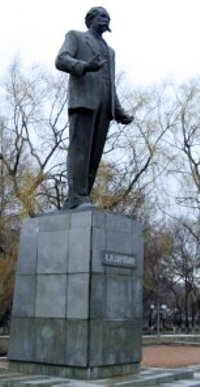
Konstantin Scriabin
Opposite the Kyrgyz Agrarian Academy, on Mederova Street, (in the Southern part of town, near the junction with Sovietskaya – nowadays renamed after Baaytik Baatyr,) there is a Statue which has a striking feature – a long flowing handlebar moustache which surmounts a full beard. It’s a statue of the Biologist Konstantin Scriabin. It faces the Academy that now bears his name … and the mountains beyond.
Although the statue stands in Bishkek … Scriabin himself wasn’t from these parts – having been born in St. Petersburg on November 25th, 1878. This was in Russia, which was still on the Julian Calendar at that time, so it was December 7th elsewhere in the world.
He had, however, a long career that kept him travelling around the Russian Empire – and then the Soviet Union – which did bring him to Frunze – as Bishkek was then called.
- In 1905 he graduated from the Veterinary Institute in Tartu in Estonia, (which was originally called Yuriev – but for most of its history has been known by its German name, Dorpat).
- Between 1907 and 1911 he worked as a veterinarian in Aulie Ata in Central Asia, (which was later known as Djambul but is now called Taraz, – just over the border in Southern Kazakhstan) …
- … before returning to St. Petersburg where he stayed until 1917 when he became a Professor at the Don Veterinary Institute at Novocherkassk – near Rostov, the capital of the Don Cossacks.
- He then moved back to Moscow in 1920 where he worked at the State Institute of Experimental Veterinary Medicine, and then as Head of the Parasitology …
- … when the unit was transformed into the All Union Institute of Helminthology, (the study of parasitic worms), of which he served as the director until 1957,
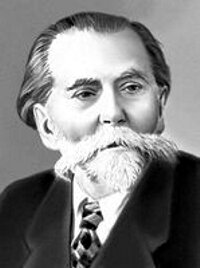
Konstantin Scriabin
During the Second World War, the Kyrgyz Academy of Sciences was created in 1943 as a branch of the National Academy … which was to serve as a research center with one of its tasks being to help the Red Army in the struggle against the Fascist invaders – for example, by organizing the most efficient and low-cost operation of the ore deposits of the Tien Shan, increase the production of coal and construction materials. In terms of agriculture, this task included improving the grain yield, as well as that of sugar beet, cotton and livestock.
Scriabin was elected as President of the branch – a post which he held until 1952 when he was succeeded by the surgeon, Akhunbaev. During his eleven year tenure, the Academy became one of the major research centers in the country with departments working in language, literature and history, chemistry, botany, zoology and parasitology, Water and Energy, Geology, soil science, geophysics and economics. It also established a branch of the Museum of the United National Culture, the Botanical Gardens, Zoological Museum, a research library, a forest fruit experiment station – “Arslanbob Grove” and the Tien Shan Mountain physical and geographical station.
After relinquishing the mantle of President, Scriabin remained an active member of the Academy.
During his time in Frunze he lived in a small house on the corner of Pioneer and May Streets – now Moskovskaya and Razzakova. Unfortunately, it no longer exists and on the site stands the building of the BTA bank. Built in the early twentieth century, constructed with a wooden base and topped with plastered whitewashed walls, with large windows with carved frames, the house was supposed to be typical of those of the time. Although it was overshadowed by tall poplar trees, it appeared relatively small but had several large rooms and a large terrace which overlooked the courtyard garden. It was in a part of the town where the elite lived, both the scientific elite (several leaders of the Academy of Sciences living in the same building) and that of the party, (such as Suerkulov, Razzakov and Suyumbaev).
All through his career Scriabin was busy with research, leading some 300 projects – discovering more than 200 new species of worms.
In 1939 he had been elected as an Academician of the National Academy of Sciences, playing a role in the creation the National Society of Helminthologists. He was twice, (in 1941 and 1950), awarded the Stalin Prize, the Gold Medal of the Academy of Sciences, the Lenin Prize and the title Hero of Socialist Labour as well as six distinct Orders of Lenin, three Orders of the Red Banner, the Order of the Red Star … and numerous other medals.
He died on 27th October, 1972 – aged 94 – and was buried in Moscow’s Novodevichy Cemetery.
Both his son and grandson followed in his footsteps, respectively becoming important scientists in the realms of microbiology and biochemistry, molecular biology, genetic engineering and biotechnology.





 Bishkek