Voron
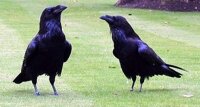
Ravens in the Tower of London …
There’s a “legend” that the Kingdom and the Tower of London will fall if the Raven that live in the tower ever leave … although it called a “legend”, even on the Tower’s own website, it may date back only as far as Victorian times.
The Tower of London is a fortress based on a fortress built in the city by William the Conqueror following the Battle of Hastings in 1066. It’s been added to by various monarchs over the centuries and has become one of the nation’s landmarks and most visited tourist attractions.
There’s small group of ravens, (called an “unkindness”), that live in the Tower … and according to tradition, there should be a group of six – but there’s usually some kept others kept in “reserve” to maintain that number. It is thought that Ravens were once commonplace in the surrounding countryside and originally took up residence in the castle as the city expanded and their natural habitat slowly disappeared. King Charles II appears to have been the first to demand that they be given special protection and a “Raven Master” was appointed to care for and feed them.
Despite the fact that their wings are clipped in order to prevent them flying off … some do actually get away, (go AWOL – “absent without leave”, according to the Tower’s website), and, recently two were killed by an urban fox – causing a certain flutter of speculation in the press about the perilous state of the monarchy. Others have been “sacked” for misbehaviour.
These birds belong to the Corvus family – the Crows. In Russian they are known as Voron, (vorony in plural).
Although they are found throughout the world – except, perhaps, South America … and it’s thought that they may have originated in Asia. There are certainly Vorony here in Bishkek … it was probably the first bird that I came across – even before the eponymous Eagle.
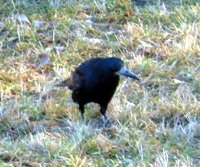
A raven in Gorky Park
They are a common sight here in Bishkek and I often come across an “unkindness” in Gorky Park as I walk down to the hotel from my office.
Their jet black plumage, long beaks, prancing strut, raucous “cawing” call and, especially at this time of year, they often hold in their beaks a nut which they are trying are crack.
They are also known to use other objects as “tools” in order to help complete such tasks as cracking nuts. In fact they are are also thought to be construct tools and are thought of as amongst the world’s most intelligent animals … I saw a recent report which not only cited evidence to the effect that they have the ability to recognize faces … but also seem to “hold a grudge” against people they perceive as “enemies” … and, possibly even, to share intelligence about such enemies with others!
Here in Kyrgyzstan we have nine related species of the Crow family:
- Black-billed Magpie (Pica pica) – a resident found throughout the country;
- Spotted Nutcracker (Nucifraga caryocatactes) – a resident found mainly in the North of the country although there are some migrations in Winter;
- Red-billed Chough (Pyrrhocorax pyrrhocorax) – a resident, found throughout the country in the high mountain regions, although also at lower altitudes during the Winter;
- Yellow-billed Chough (Pyrrhocorax graculus) - a resident, found throughout the country in the high mountain regions, although also at lower altitudes during the Winter – less populous than its Red-billed relative;
- Jackdaw (Corvus monedula) – a resident found throughout the country although migrates throughout the West Tien Shan, it is found in large groups in Winter;
- Rook (Corvus frugilegus) - a resident found throughout the country although migrates throughout the West Tien Shan, it is found in large groups in Winter;
- Carrion Crow (Corvus corone) – a resident found throughout the country;
- Hooded Crow (Corvus cornix) – a resident in the Winter found throughout the country;
- Common Raven (Corvus corax) - a resident found throughout the country although migrates throughout the West Tien Shan, it is found in small groups in Winter;
Joost van der Ven also cites the:
- Brown necked Raven (Corvus ruficollis)
which some scholars consider to be a subspecies of the Common Raven but others regard as a separate species.



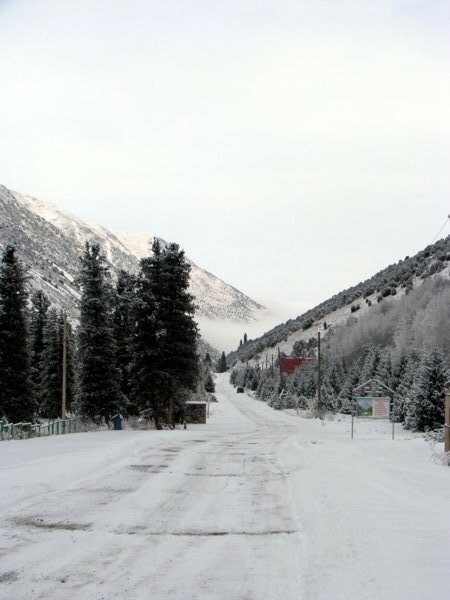


 Bishkek