To boldly go …
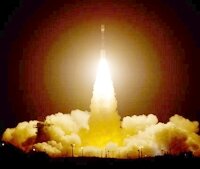
Lift off …
As India launched a rocket carrying it Mars Orbital Mission, (MOM), there were some critical comments in the ‘blogosphere’ and social media about the wisdom of spending huge sums of money in this way when the country has far from impressive levels of malnutrition and comparisons between the cost with the amount of aid given to the Indian government.
I can imagine the popular reaction here in Kyrgyzstan if the government chose to spend millions on a high profile space exploration project. Although there would be pride in achievement – and like in the Olympics, (where it’s not just the winners of the Gold Medals that need recognition but all who have striven against all obstacles and participated), the very act of preparing the mission would be a worthy source of great pride – there would almost certainly also be a cynical reaction about the people struggling below the poverty line, the apparent inability to defend the country’s borders and maintain law and order on the streets, or to provide basic facilities for schools and hospitals.
So, the news earlier this week that Kazakhstan has made an offer to Kyrgyzstan to participate in such a prestigious project came as a bit of a surprise.
It wasn’t on the same scale as a the Indian space mission. Instead of a trip to Mars, the Kazakhs have offered the “joint use” of their KazSat spacecraft, designed to provide satellite communications and broadcasting, “in the interests of the telecommunications sector in Kyrgyzstan” by offering to “rent” some of the KazSat satellite capacity on mutually beneficial terms.
According to the AkiPress news agency:
The sides agreed to hold an introductory meetings at the ground control complex “Akkol” and reserve ground control center “Almaty”, as well as to demonstrate technical feasibility of space communication infrastructure of Kazakhstan.
Kyrgyzstan, in turn, offered to enhance cooperation in the fields of introduction of digital broadcasting, telecommunications infrastructure of e-government, coordination of the frequency spectrum.
The Kyrgyz side will study the offer … and give their answer by the end of the first quarter of 2014.
If they do decide to “go for it”, it won’t be the first connection that Kyrgyzstan has with space.
People here will often speak with pride of the contribution the republic made to the Soviet space program:
- … the fact that the uranium used from the early days of the programme came from Min Kush, in the Naryn oblast;
- … that many of the components used in the programme were manufactured in “top secret” factories and plants in the country – apparently, so I am told – in the area south of Kemin;
- … that Yuri Gagarin, the first cosmonaut, came to the Military Sanatorium at Tamga, on the southern shores of Lake Issyk Kul, after his return from space for assessment and recuperation – and apparently he returned several times;
- … that Kyrgyzstan has its own cosmonaut – Salijan Sharipov - although, to be fair, although he was born in Uzgen, he is also claimed by Uzbekistan and Russia as their own.
Less commonly referred to is the fact that the drill used on the Luna-24 mission in 1976, was designed and manufactured in Kyrgyzstan by a team led by Oleg Alimov.
This was the last of the Luna series of spacecraft and the third Soviet mission to retrieve lunar soil samples from the moon – the others were Luna 16 and Luna 20 – which landed in the Mare Crisium (Sea of Crisis) and returned to the earth just over 170 grams of lunar samples from as much as two meters below the surface of the moon.
Alimov was also in similar projects, Venera13 and Venera14, in 1984 …
Although there may well be some justification of the expressions of indignation about the Indian project I suppose that we should remember what Jesus had to say to Judas Iscariot about the fact that the poor will always be with us. That may sound cynical – I know it has worried more than just a few Christians down the centuries – but there is no guarantee that the money spent on space research would be spent on something else which would directly affect poverty and/or malnutrition … and there are other reasons for going in for space research, including:
- Scientific experiments to improve life on Earth
- Military surveillance and spying
- Weather forecasting through satellites
- International broadcasting and communication
- Nuclear weapons monitoring
- National pride in technological advances
During the early years of the “space race” between the US and the USSR, National Pride was an important driver – but there was a definite role played by other factors.
The elite and exclusive club of nations involved in “space exploration” was joined in 1965 by France, then in 1970 by both Japan and China, the United Kingdom a year later, and in 1975 by a group of European nations which had united to form the European Space Agency, launching their first mission four years later. Since then the “club” has seen a growing membership including: Israel, Iran, the Ukraine and, of course, India.
Other countries have also made progress. The third country to design and build a satellite, (although they didn’t launch it themselves) was Canada.
One of the standard reasons which often cited to justify the expense of space programmes is that it provides a stimulus to industry and research … and that might just be an appropriate justification for a Kyrgyz programme, on a par with creating Technological Parks to stimulate and foster research and economic development.






 Bishkek
Frankly, I would be very excited if we took a small part in this activity. In hopes, of course, that it would provide low cost access in the provinces to the internet and to better telecommunications access.