Keremet Koch – A Magic Journey
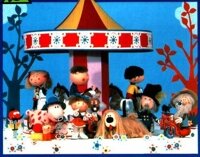
The cast of Magic Roundabout
“‘Time for bed,’ said Zeberdee”
Those were the closing words of (I think) every episode of a 1970′s a children’s stop motion animation series shown on BBC TV in Britain called The Magic Roundabout.
Zebedee, (of “Time for Bed” fame), was a “jack in the box” and his co-stars included a grumpy dog (Dougal), a snail, (Brian), a cow, (Ermintrude), a rabbit, (Dylan – modelled on Bob Dylan), a young girl, (Florence) and the old man who operates the roundabout in the title, (Mr. Rusty). There were other humans – as you can see in the picture – Basil, Paul and Rosalie, Mr McHenry the gardener, Soldier Sam, Uncle Hamish and Angus … and even a talking train … but they rarely featured apart from in the credits where they are seen riding on the roundabout.
The programme was a phenomenon in many ways.
- It was a remarkable example of Franco-British collaboration, but one with a twist. The contract gave the BBC the rights to the animation but not to the scripts – so, rather than pay an additional fee for those, they gave the films to Eric Thompson who wrote totally new scripts based on story lines that he developed just from the visuals on screen. As a result, the French and the British versions are totally different.
- It was originally rejected by the BBC as “charming but difficult to dub into English”, they eventually agreed to the project … and eventually over 550 episodes were produced – and two films, one (Dougal and the Blue Cat) and a full length feature film made in 2005 and imaginatively called The Magic Roundabout Film
- As with many animations these days, (such as Spongebob and Toy Story – and some are written specifically with an adult audience in mind, like South Park and the Simpsons), The Magic Roundabout appealed as much to adults as it did to children – developing a cult following and when the BBC planned to move it from its regular timetabled spot just before the main evening news to an earlier time in what was recognized as “Children’s Hour”, as it was thought more appropriate for the child audience it was aimed at, the station was inundated with complaints.
- As well as in Britain and France, it was broadcast in countries as diverse as: America, Angola, Austria, Australia, Cape Verde. the Czech Republic, East Timor. Germany, Indonesia, Israel, Italy, Mozambique, Portugal, Qatar, Spain,
The enigmatic Theme Tune – easily recognizable by all Brits of a certain age
Today happens to be International Animation Day, (IAD). The day was proclaimed in 2002 by the International Animated Film Association, (ASIFA, which is affiliated with UNESCO), as the main global event to celebrate the art of animation.
The date was chosen to commemorate the first public performance of an animated film, Emile Reynaud’s Theatre Optique at the Grevin Museum in Paris, 1892 – before live action “movies” were shot. By 1895, however, the Cinematograph developed by the Lumiere brothers was was to supercede Reynaud’s invention, driving him into bankruptcy.
IAD is now observed in over 50 countries around the globe with more than a thousand special events.
It seemed an appropriate moment to review a particular UNESCO initiative – what was claimed to be the first cartoon made in Kyrgyzstan in twenty years … not a magic roundabout, but a Magic Journey.
The cartoon began as a series of five books, developed by UNICEF in 2004, as part of their Behaviour Change Communication Programme which aims to help parents, (especially those from remote and poor areas with no kindergarten facilities), stimulate the learning and development of their children. Then in 2006 they moved to the small screen in a project supported by UNICEF and some other organizations in partnership with a local TV station.
Obviously, with UNICEF as a backer, there is more behind the project – it is more than just an exercise in producing children’s entertainment. A bit like Sesame Street and the Archers, there is an educational element. Indeed, the original idea had been to produce something targeted at parents … but as the planning process progressed, the concept evolved into one revolving around materials aimed at a different audience but which could still reach the original target group.
The books addressed issues like: vitamins that can be found in the garden; the need to wash their hands; why iodized salt should be used for cooking; and the benefits of using flour made from wheat enriched with vitamins, and minerals (including iron).
Both the books and the animated cartoons follow the adventures of Aktan and Akylai as the set out on their fabulous journeys where they meet friends from countries with names like Knowledge, Health, Art, Music, Magic events and Skillful hands. Sensitive issues about social issues, (such as violence and neglect – even mundane issues like preparing for school), are dealt with when the children are transformed into “super heroes” in order to help their new friends face their problems.
At the end of each episode, the viewers are set a task, which sometimes leads to phone calls to the TV studio from young viewers asking to speak to Aktan or Akylai because they need help with the problem they have been set … who, unfortunately, Aktan and Akylai always seems to be away on another of the Magical Journeys. That’s not the only form of feedback … children from all over the country apparently send in letters, stories, drawings, models … and questions, some of which may inspire a future episode … and every letter receives a reply.
The programmes are shown every day during prime time television and they have proved to be extremely popular … it’s estimated that 95% of the target audience of 3-6 year olds watch it. It has proved so popular, in fact, that some children have been named after the main characters. (Both Aktan and Akylai are traditional names … but, as one seven year old told his parents when the discussing what to call their new born son, “Let’s give my brother the name Aktan, because he is clever, strong and all the children in the village love him.”
Indeed, when I spoke to one of our staff about Keremet Koch, her face immediately lit up with a beaming smile …
In 2008, the five minute episodes were lengthened … which allowed it to Introduce new characters and tackle more complex issues … address questions and issues raised in viewers’ letters … nurture imagination and problem solving skills … and also introduce some “live action” sequences.
The programme has even gone international … it may not have been screened in as many countries as the Magic Roundabout … but it has been picked up by Turkish TV and can now been seen in Afghanistan, Azerbaijan, Bulgaria, Georgia, Greece, Iran, Iraq, Kazakhstan, Moldova, Russia, Syria, Turkmenistan, the Ukraine, Uzbekistan, the Balkan countries, Eastern Europe and the Uyghur Autonomous Region.
The original, of course, is in Kyrgyz – but there have been requests for it to be translated into other languages like Russian and Uzbek. In case you are interested, here is one episode … with subtitles in English:




 Bishkek