Komsomol
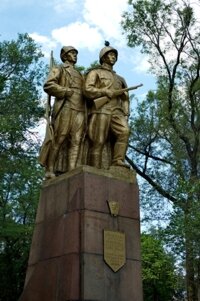
Komsomolets Monument in Bishkek
At the intersection of Prospects Chui and Molodaya Gvardia, (The Avenue of the Young Guards), in downtown Bishkek, there is a striking memorial depicting two soldiers on a granite pedestal – a young Russian in a Red Army helmet, dressed in an Army coat and boots, holding a rifle in his hands. Next to him is a Kyrgyz man in a helmet and a cape with a machine gun in his hands.
The first represented the fight against the enemies of the young Soviet Union during the Civil War and the second the war with fascist invaders in the Great Patriotic War – the Second World War.
It is known as the Monument to the heroes of Komsomol of the 20s and 40s, and was sculpted in 1963 by V. Puzyrevsky and G. Tupyh.
Engraved in gold is the text : “Heroes of Komsomol of an older generation. Komsomols of sixties. July 1963″. Flanking the statue are plinths with the text “We went to fight for communism”.
It was intended as a symbol of unbreakable friendship of the people of Soviet Union.
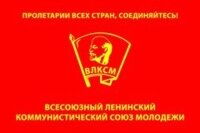
The Komsomol banner
Komsomol is an acronym from the formal title of the organization, the All-Union Leninist Young Communist League, (or, in Russian, Kommunisticheskii Soyuz Molodyozhi).
As is often the case, the February Revolution of 1917 led to an increase in the political activity among young people. A number of youth organizations sprang up such as “Labour and Light“, whose members of which were guided by the leadership of the Socialist party and the Petrograd Bolsheviks created the Socialist Union of Working Youth, (CCPM).
At the All-Russian Congress of Unions of Young Workers and Peasants, a decision was taken on 29th October, 1918, to merge the separate fragmented unions into a nationwide organization with a single center, working under the leadership of the Communist Bolshevik Party becoming the youth division of the party.
In 1924 after the death of Lenin, the organization was renamed in his honour, and in 1926 was renamed once more as the Young Communist League. and through its ranks passed more than 160 million people. At its largest, during the 1970s, Komsomol had tens of millions of members; about two-thirds of the present adult population of Russia is believed to have once been a member.
Membership was open to young people between the ages of 14 and 28, (although Komsomol functionaries could be older). Younger children joined the allied Young Pioneer organization of the Soviet Union.
Whilst membership was nominally voluntary, those who didn’t join lost access to officially sponsored holidays and found it very difficult (if not impossible) to pursue higher education. The organization had little direct influence on the Communist Party or the government, but it played an important role as a mechanism for teaching the values of the CPSU to youngsters and also served as a mobile pool of labor and political activism, with the ability to relocate to areas of high-priority at short notice. Active members received privileges and preferences in promotion.
A few years ago I was in a meeting when one of the government officials tried to discredit one of the “liberals” who was arguing for relaxation of government controls by drawing attention to the fact that he had once been a member – indeed, an official – of Komsomol … which drew the retort: “Yes, it’s true, I was a member … but … I left and there are those who are still there, at heart.
In fact Komsomol was, in many ways, involved in the introduction of the policy of perestroika being granted several privileges with regard to establishing enterprises, earning it the “folklore” motto: “Komsomol is a school of Capitalism”, an echo of Lenin’s phrase “Trade unions are a school of Communism”
A decision to disband the All-Union Leninist Young Communist League was taken in September 1991 at the Emergency XXII Congress of the Young Communist League.



 Bishkek