Pelmeni
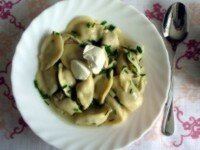
A plate of Pelmeni
The first real “local” dish that I ate when I first came to Kyrgyzstan was Pelmeni, which may not be a Central Asian dish, but come from Russia. Indeed they are sometimes referred to as “Russian Ravioli”.
They are small dumplings, (which is the name given to cooked dough balls), consisting of a thin unleavened dough casing wrapped around a filling which can be minced meat, fish, mushrooms or perhaps a mix of meat vegetables.
In fact, it’s not actually clear where they originate from. Some people think that they may have been introduced to the Muscovites by the Mongols, who found them an easy and quick and effective way to preserve meat during the long Siberian winter on their Western campaigns. Having been prepared they were frozen in the open air and could then be treated as preserved food – carried in sacks.
They then quickly became popular and spread throughout the Caucasus and Eastern Europe. Apparently similar dishes are found in other cuisines as well; Chinese, Kazakh, Korean, Mongolian, Nepalese. Tatar, Tibetan, Turkish and Uzbek.
Although commercially prepared frozen pelmeni can be found in supermarkets in Kyrgyzstan, many people still make them at home. The dough of domestically produced pelmeni tends to be thicker and coarser, less consistent, than that found in commercially produced products – which are normally considered as a form of “fast food” … but then, one source describes home made pelmeni as “cheap and tasty”, albeit “a royal pain in the bottom to make”. Fortunately there are special “pelmeni molds” to help the chef turn out dumplings at a fair pace.
To be honest, I’ve never made pelmeni myself, (although I have watched them being made) – I tend to buy the ready made frozen variety. It’s said that virtually every family has their own secret recipe for making Pelmeni, but the basic involves recipe the following ingredients: for the dough – flour, eggs, water and salt; for the filling – beef, pork, (the standard Siberian variety seems to involve a mix of the two meats), onion and seasonings according to taste, (salt, pepper and garlic …).
Dough
- one and a half cups flour
- two eggs
- half a cup of water
- half a teaspoonful of salt
Filling
- 250 grams of minced beef
- 250 grams of minced pork
- two medium sized onions, finely chopped
- a teaspoonful of salt
- halt a teaspoonful of black pepper
- garlic to taste
Method:
Dough: mix the flour, eggs, water and salt, knead the mixture then letting it stand for 30 minutes.
Filling: Mix the minced beef and pork, chopped onions, salt, pepper and garlic together.
Cut the dough into three equally sized pieces and roll each one into a cylinder, the diameter of a finger.
Cut each cylinder into pieces the size of a walnut, rolling each piece into a very thin flat circle with a diameter of about 5 centimeters. Put some of the ground meat mixture in the center of each circle (quite a lot, but not so much that you can’t seal up the dough), then fold the dough in half and join up the edges to seal them by pinching the corners together, (you should now have a ravioli-shaped “flying saucer”).
Cook the Pelmeni in boiling salted water or broth, (until they float and then for five to seven minutes).
Once cooked they are usually strained before serving, usually on soup plates, together with smetana, (sour cream), or melted butter. When I have Pelmeni at home, I sometimes use Mayonaise, vinegar or even ketchup as a sauce for topping – and I understand that in some places soy sauce is also used.
Sometimes, however, they are served in the broth in which they have been cooked.
As an alternative, once cooked, they can then be fried until they turn a golden brown … and that’s my standard choice for lunch when travelling up to Naryn … served.
Portions usually consist of anywhere between 15 and 30 pieces …
For the record: The word pelmeni is apparently derived from the Finno-Ugric for “ear bread”, which may well be a reference to the final appearance.


 Bishkek