Belka
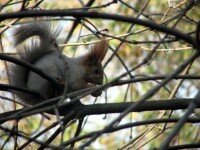
Squirrel in the trees … it’s actually a Red Squirrel even it appears to be grey
Bishkek may be a capital city, but the city center can sometimes be full of surprises.
The other day I was walking from my office down to the hotel, (it takes about 10 minutes), and I had just crossed Prospect Chui, (which is the main road through the city), and suddenly was brought to a stop – there standing on a branch was a Belka – a red squirrel … standing and staring at me. It was obviously used to the traffic because it just ignored the noise.
Squirrels are fairly common – they are found all over the world and are indigenous to the Americas, Eurasia and Africa … and they have been introduced to Australia. They are a form of rodent – mammals that are characterized by a pair of continuously growing incisor teeth that grow in both the upper and lower jaws which must be kept short by gnawing. They are closely related to chipmunks, marmots (including woodchucks),the mountain beaver, dormouse and prairie dogs.
Typically, they are small and slender animals with bushy tails and soft silky fur, short forelegs and longer hind legs. The paws may have four of five digits. They live for about six years.
Their diet consists of plant buds, nuts, seeds, cones, fruits, fungi, and greens … it needs to be rich in proteins, carbohydrates and fats but not cellulose because they cannot digest. Some, however, are known to also insects and other small anthropods.
Their colour varies but are often often grey and/or red … In Britain, the Eurasian Red squirrel was native and used to be found throughout the islands – but the introduction of the Eastern Grey Squirrel from America has led to a decline in their numbers … exiling them to remote areas. When I was growing up, the demise of the Red Squirrel was blamed on the Grey, but it is probably as much to do with the disappearance of suitable habitats as with the incursion of the American interloper.
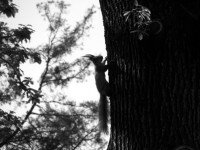
Lithe and expert climbers
Squirrels are lithe and expert climbers … and adapted well to a human environment – they are an example of “urban wildlife”. They are also inquisitive and persistent, often storing food in caches which they then dig up at later times when other food sources are scarce.
This often leads to them being seen as pests … along with the fact that they will gnaw through plastic, and even metal, to get at a food sources … sometimes even through electrical installations and they have been blamed for several power failures.
Here in Kyrgyzstan there are is one type of tree squirrel, (The Eurasian Red Squirrel), and a couple of species of ground squirrelsm (that live in burrows rather than in the trees: The Large-toothed Ground Squirrel and Tien Shan Ground Squirrel).
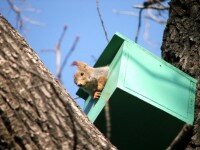
Squirrel checked into a birdhouse at the Silk Road Lodge
Probably the most commonly encountered in Northern Kyrgyzstan is the Eurasian Red Squirrel – which, as the name suggests, is common throughout the whole continent but, in fact, it is not indigenous to this area … It was introduced in this region as late as the 1950′s when, apparently, some 200 specimens were originally brought here from the Semipatalansk region. These animals are now to be found throughout Northern Kyrgyzstan and are a common sight in in Bishkek’s parks. It was one of these that caused me to stop on my way to the hotel … but we also have them in our yard and they have been seen in the hotel grounds. They haven’t yet found their way down to the walnut forests of Southern Kyrgyzstan, where they might well create havoc among the ancient relicts.
At between 19 and 23 centimeters long, it is slightly smaller than it’s the Eastern Grey. Although it is usually referred to as a Red Squirrel, the colour can vary – with regard to both the season and the location. It has developed a set of sharp curved claws which help it to climb trees. They are equally at home among both coniferous and deciduous trees. They are active all year round, but during the winter, (particularly in periods of severe weather), may sleep for several days at a time.
The Large-toothed Ground Squirrel – also known as the Yellow Ground Squirrel – is found in the North Western corner of the Chui oblast, where it lives in burrows that it digs in the low lying areas of agricultural land. A rather small animal, it grows to about 22 to 28 centimeters in length, with short ears, light yellow fur. It is active during the daytime … when it often stands outside the burrow, scanning the scenery. It hibernates though the Autumn and Winter months, (typically from the end of August though to March).
The Tien Shan Ground Squirrel is a native of the region and is found mainly in the Talas, Chatkal and Ferhgana valleys and around Lake Issyk Kul. It grows to about 20 centimeters long with a tail about 6 centimeters long. In summer they sport a grey or yellowish brown coat … which grows paler during the winter. It’s natural habitat is in pastureland where it digs tunnels with a number of entrances and eats grasses and other vegetation, but it is also known to eat insects and even small animals. It hibernates for six months of the year, starting in September.
.
I couldn’t let the occasion pass with including the famous clip of the squirrel obstacle course:
,
,






 Bishkek