Genghis Khan didn’t have it all his own way
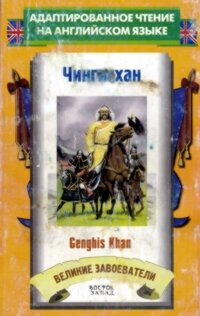
Chingis Khan by Jaconb Abbott
I don’t often write postcards about places “over the border” but I recently came across this story that I thought deserved a wider audience.
Some time ago I was in one of the bookshops here in Bishkek and checking out their stock of books in English, and I came across a series of “readers” … adaptations of English books specially designed to be read by people learning the language. In theory, the language is fairly simple and straight forward and the editors have selected on each p[age to translate into Russian in the margins to help people make sense of what they reading.
On of them was about Genghis Khan – the Mongol leader whose armies swept across Asia and threatened Europe at the turn of the twelfth and thirteenth centuries. It caught my eye as he is an important character in the story of Central Asia … and so I added it to the small pile of books that I thought might be worth buying.
To be honest, it stood, untouched, on my bookshelf for a long while but then I looking for something different to take on one of my regular trips to Naryn, I picked it up thinking, “it’ll be an easy read because it’s basically a children’s book.”
In a way, I was right … it was a fairly easy read … but interesting none the less because it put the “monstrous” character that I had grown up thinking him to be, (“God’s punishment for your sins”, as he himself put it), into a new light.
For the record: The book was written by Jacob Abbott – a prolific writer of 180 books – and the and the co-author or editor of another 30 or so: juvenile fiction, brief histories, biographies, religious books for the general reader, and a few works in popular science. He was a New Englander, born in Maine in 1803 and he died in 1879. This biography seems to be one of a whole series about famous people in history but I can’t find out when it was first published … the references I have found on the internet – such as in the Project Gutenburg all seem to refer to the Harper and Brothers edition published in 1901 – but carrying a copyright date, (in the name of Jacob’s four sons), of 1888.
If the general view we have Genghis Khan is of a blood thirsty warrior – that’s probably fair but only tells part of the story … at least in the version of the story as told by Abbott.
His sense of honour was such that when he was invited by one local Khan to join an alliance against another, he refused because he had established friendly trading relationships with the second … but in the event that he ever betrayed Genghis, then he would be happy to join forces with his erstwhile ally. As it happened, the Sultan did indeed betray, slaughtering a trade delegation and setting loose the Mongol hordes on their long campaign of vengeance which was to lead to the enlargement of an already impressive empire into what was to become the largest that the world has ever seen.
There is no doubt that Genghis Khan was ruthless – rulers in that time and place probably had to be … and it is true that he was unforgiving to those who opposed his will, but he was surprising tolerant of others and supportive to those who accepted his suzerainty.
One of the classic cases is that of Balusugin, which is just outside present day Tokmok in Kyrgyzstan. The citizens when faced with the advancing Mongol army surrendered and the inhabitants discovered that even if they lost a lot of their material possessions, they lived … the city was even renamed Gobalik – the Good City. Other cities tried to resist and paid dearly – Jul, (present day Bishkek) and Osh were apparently razed to the ground.
I am not sure where Abbott got his information – he goes into a fair amount of detail of some of the campaigns and there was one story that I thought was worth passing on concerning the town of Kojend, which was was about 300 miles (almost 500 kilometers) North of Samarkand, on the banks of the Amu Darya River – which flows into the Aral Sea. Although Abbott calls it Kojend – it is known elsewhere as Urgench, in present day Turkmenistan.
Genghis Khan had split his army into different forces and each went off after different objectives as his opponent, Shah Ala ad-Din Muhammad, had divided his forces and dispatched them to protect different cities instead of meeting them head on in open battle – convinced that the Mongols were not trained or well equipped for siege warfare. One, under the command of his son Junghi, approached Kojend from the North and Genghis and another of his generals approached from South. It was to prove to be the most difficult battle of the Mongol invasion … and the city fell only after the defenders put up a stout defense, fighting block for block. Mongolian casualties were higher than normal, due to the unaccustomed difficulty of adapting Mongolian tactics to city fighting … so perhaps the Shah had a point.
In command of the defenders was Timur Melek and he devised a plan of defence which included breaking up the roads leading to the city, destroying the bridges laying in vast supplies of food and hiding what couldn’t be transported into the city. That held up the advancing Mongol troops for a while but they were soon within firing distance of the walls for their catapults and other siege engines.
Timur Melek was busy during this time, preparing a small fleet of flat bottomed boats which also carried weapons for firing into the enemy camp, with cover offering protection for the troops inside.
Although the Mongol forces tried to enforce a siege, reinforcements for the city were able to navigate their way through the surrounding marshland … and the Mongols had to reinforce their own troops.
To divert attention away from the city itself, Timur Melek contrived to get the invaders to concentrate their attack on a small fortress he had built on an island in the middle of the river, which gave a command of the approaches to the city. So the main thrust of the attack shifted to the island … but the ground was not good and the siege engines were just a little but too far away to have any decisive effect … but in attempting to attack it, the Mongols soon exhausted their supply of ammunition – stones … and had to break off the attack whilst they were in search for more.
Instead of using the stones as ammunition for the catapults, however, they were used to create a jetty out into the river – towards the island so that his siege engines could get closer and be more effective. It was hard and dangerous work and cost a lot of lives … slowly, but surely, however, the jetty was extended and soon it became apparent that soon the Mongols would be able to launch an effective attack on the fortress.
Timur decided it was time to withdraw … and built more boats until he had a small armada of more than seventy at his disposal … each covered with a heavy awning and portholes for firing at the enemy.
When all was ready he launched a surprise attack on the wooden bridge that the Mongols had built and which blocked their escape route down river. He sent some of his precious boats loaded with combustible materials against it and succeeded in setting it ablaze. With the obstacle removed he launched the rest of his small fleet and made good his escape.
It wasn’t long before the Mongol set off in pursuit eventually catching up with the boats which clung desperately to the far shore hoping to stay out of range of the Mongol arrows and javelins … and a series of running battles took place until the boats were grounded on a sandbank. The soldiers disembarked and headed off in search of high ground and were able to beat off the initial attacks of their pursuers.
Resuming their retreat his ever decreasing force was continually harassed in running skirmishes by an equally decreasing band of pursuers until he eventually reached a camp of the Shah’s army.
In the meantime, some of the boats which had run aground in the river and been abandoned had been re-boarded and re-floated and made their way sedately down river to safety.
Meanwhile, the city was left without any form of defence and surrendered. As usual, the artisans were sent back to Mongolia, young women and children were given to the Mongol soldiers as slaves, and the rest of the population was massacred. The Persian scholar Juvayni states that 50,000 Mongol soldiers were given the task of executing twenty-four Urgench citizens each, which would mean that 1.2 million people were killed. While this is almost certainly an exaggeration, the sacking of Urgench is considered one of the bloodiest massacres in human history.
.
It’s a dramatic tale told in the best “Boy’s Own” tradition … which is a little out of kilter with the other accounts I have read … which refer to bitter house-to-house fighting in the city streets during the six month long siege. As I said, I don’t know what sources Abbott drew upon … and he was writing for a children’s audience.
It struck me, however, as an important reminder that even if the Mongol Horde did sweep across Asia and into Europe, carrying all in front of them … it wasn’t by any means a foregone conclusion and in some respects was a story full of, as Wellington was to say of the Battle of Waterloo, a series of “close run things”.
Perhaps we should think more on that and try to avoid history repeating itself …
.
I also sat and considered – which was the best approach, that of Balasagin … or that of Urgench … and what would I have done in those circumstances.
That’s also, “food for thought”
.


 Bishkek