Traditional musical instruments
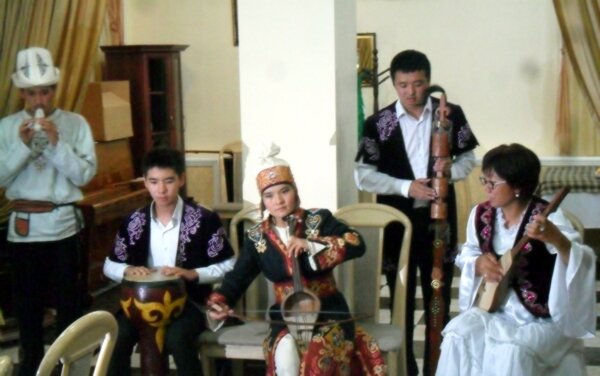
Last week we organized a concert by the musical group Jetigen for a group of tourists who were interested to see and hear a variety of musical instruments.
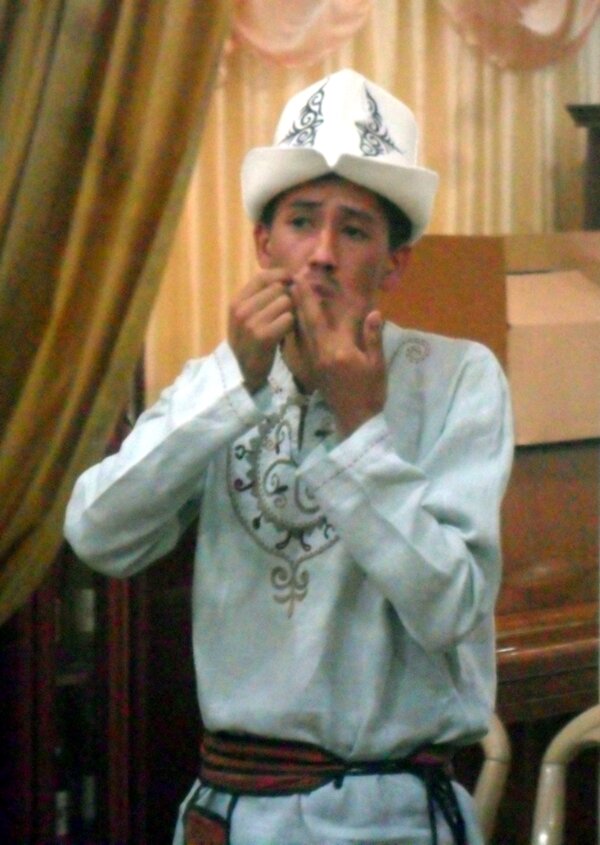
Because it is the beginning of the academic year, Aizada, (the Director of the Music School in which the group is based), brought a group of older students who performed on a number of traditional instruments: The Komuz and Temir Komuz of course, the Chopo Choor,Sybyzgy, Jygach ooz Komuz, Dobulbas and Asa–tayak.
.


.
A previous concert by a different ensemble
The Kyrgyz had several different types of traditional music; both vocal and instrumental. As with all cultures there were work songs, celebratory and ritual music. The themes embodied in the music and the sources of inspiration encompassed happiness and sorrow, love and courage, freedom and equity and the relationship the nomads enjoyed with the natural environment.
The main feature of the distinctive style of Kyrgyz music is said to be the images it conjures up in the mind. There is a very wide picturesque range: from heroics with dramatic (epic) effects, to the beauty of natural scenery (mountains, trees and streams) and domestic themes.
The most fascinating and interesting holidays were the times of the music competitions, such as the Aytish which pitted akyns, (bards), against each other in a form of impromptu composition and performance.
Although vocals are poplar in today’s repertoire, the most important place in Kyrgyz music probably belongs to instrumental music. All the inhabitants of a nomadic group – from children to the elderly – would gather together in order to listen to the master instrumentalist’s play.
Also, an instrumental ensemble was an essential element of military campaigns.
It was only when the Kyrgyz came under Russian influence that their traditional music was written down in any form, yet alone in musical notation. Prior to this, it was handed down from generation to generation “by ear”. Scholarly interest in the music of the region, however, started to appear in ethnological journals in the late 1880’s and “explorers” began to record in written form the music – songs and melodies. Samples of traditional Kyrgyz music were first recorded as early as in 1917, and in 1919 many performers of traditional music were invited to the capital, (modern-day Bishkek), to record samples of their art. From that time onwards there have been organized numerous festivals, “Olympiads”, concerts and scholarly conferences. Teaching aids, such as manuals to play traditional musical instruments, were published in both Russian and Kyrgyz.
It is sometimes said, however, that during the Soviet period many of the elements of traditional music were lost, (or at least adapted to European musical ideals), and that, as a result, traditions was distorted, that some genres, subjects, characters, names of both composers and performers were even forbidden. In addition, these traditional arts underwent the influence of Russian and European culture – and “popular” culture such as “variety shows”. Orchestras of reconstructed folk instruments replaced solo performers, and the introduction of music notation undermined the aural tradition of transmission from master to pupil. (Even today it is not uncommon to see traditional instruments used alongside modern and classical instruments – such as the accordion, violin, cello and others – drawing something from each to compliment the other.)
In the 1990’s, when Kyrgyzstan became an independent country, attention to the national identity and traditional heritage revived an interest in all fields of the arts. This has led to a resurgence of interest in traditional forms of music, and many new ensembles have emerged into the public arena.
Traditionally, the musical instruments of the nomadic Kyrgyz were simple affairs – made from materials which were readily available and easy to transport.
The two instruments most commonly associated with the Kyrgyz are:
- The Komuz -a three stringed instrument, similar to a “guitar”, “mandolin”, “ukulele”, or “banjo”.
- The Temir Komuz – the local version of the “Jews Harp”.
Other traditional instruments include:
Stringed instruments:
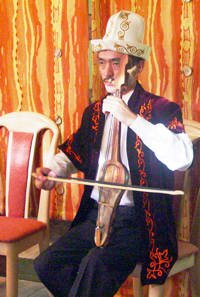 The Kyl Kyyak (or simply, Kyyak) – a string instrument usually made from apricot wood. It only has two strings and is played with a bow (called a dzhaa) rather than by plucking the stings. It is shaped like a scoop, with the lower half covered with camel skin. The strings are made from twisted horsehair, which is also used for the bow.Usually it is played in a sitting position, by holding it vertically and drawing the bow back and forth, horizontally, across the strings. Unlike playing the violin, the strings are not pressed against the fingerboard, but are merely touched lightly – resulting in a muffled, gentle, timbre.
Reed instruments:
- Jygach ooz komuz which is is similar to the temir komuz, except in that it is made from wood, and the sound produced from it can be louder than that of its metallic ‘relative’. A single piece of wood is cut to size, between 13 and 20cm long and about 2cm wide, and slits a cut into it lengthwise so that the central portion can serve a s a vibrating reed. At the end of the reed is a small hole which has a lace threaded through it. In order to play the instrument, the musician presses it against the lips and pulls on the lace. Although it is possible to vary the pitch and can produce a melodious sound, it is difficult to play smooth melodies on it, (mainly because of the stiffness of the reed), and so it is mainly used to provide rhythmic accompaniment in ensembles – although it often features as a solo instrument as well.
Wind instruments:
- Surnai – a traditional Kyrgyz national wind instrument with two cane pipes, a conical channel in which there are finger holes and ending in a bell. It can be between 40 and 65 cm long, with a mouthpiece of 4cm, the diameter of the bell is 5-6 cm. Along the length of the instruments are 6-8 finger holes. The sound is produced by the vibration of the double cane mouthpiece. It is made of from the wood of the apricot tree, mulberry, and copper (or tin). The cane represents a flattened stalk. The so-called cane surnai, or kamysh surnai, has a single cane, three-four finger holes, , and measures about 25 cm, with a bell of just 0.8 cm diameter.The sound of the surnai is dramatic, sharp with a nasal tone. Earlier, its relative loudness made it suitable for use as an alarm, to summon people on solemn or other ceremonies. Sometimes the surnai was included in military ensembles. By the present time, the surnai has practically ceased to exist, although it can still be found in some areas, particularly in the southern part of the Republic.
-
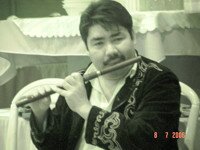
Sybyzgy
Sybyzgy – a wind instrument similar to the flute. It is common among the Turkic peoples although known by different names. The Kyrgyz variant is made of mulberry, apricot, kuuray (a type of herbaceous plants) and other types of wood. (If the instrument is made from copper, then it is called the jeznai.) It comprises a tube, about 50cm long, which is closed at one end and a blow hole at the other A number of finger holes (usually 6 or 7) are arranged along its length.
It has a vocal range of about three octaves, and produces a sound with an even timbre throughout this range. The flexibility of the instrument allows a skilled musician to perform diverse and complex melodies. According to the epic poem “Manas”, the sybyzgy was used in ensembles with instruments such as surnai, kernei, and do’ol.
- Choor – one of the most ancient of the traditional Kyrgyz instruments, resembling a flute. The word “choor” is a generic name and the instrument comes in many different varieties depending on the material they are made from. For example: the chogoino choor (from Thistle), the kamysh choor (from cane), the shilbi choor (from Honeysuckle), sary jygach choor (from Barberry), baltyrkan choor (from cow-parsnip and other similar plants) and the jez choor (from copper). (There is, however, another form of classification based on the design rather than the material used: traditional and modern.)They were mainly found in the southern regions of the country where they were used as a shepherd’s instrument. They were rarely encountered in the North, but the current rise of ethnographic folklore groups has led to a revival in its use. It is made a pipe, (usually made from a reed – but sometimes from metal), from 40 to 10cm long, with a uniform diameter and finger holes drilled along its length. Its range of notes can cover about one and a half octaves – but the timbre of the sounds produced can change according of the note” “rude and harsh” in the lower notes but “bright and transparent” in the upper register.A performer who plays the choor is called the Choorchu.
- Chopo Choor – another of the oldest of Kyrgyz traditional instruments. Originally a children’s toy, (hence it is not difficult to play), it has developed into an instrument with a fine timbre and in the hands of a master can produce haunting melodies. Originally it was found mainly in the rural areas in the south of the country and is known by various names such as chopo choor and ylai choor. It is made of clay – the name means “clay choor” – it can take almost any form. One of the most ancient examples, (in the collection of Professor S. Subanaliev), is made in the shape of a small sphere of white clay about 5 cm across.Basically, an enclosed vessel with a mouth piece and a number of playing holes arranged so that was possible to cover simultaneously with the lips and index fingers of both hands allowing the performer to vary the pitch of the notes produced. Traditionally there were only one or two finger holes and so the instrument was limited to a range of about four or five notes. Modern instruments have more and have a range of just over an octave. Different sizes of instruments provide different tonal ranges. The sound produced by a traditional chopo choor is simple with a bewitching, soft and deep timbre.The chopo choor can feature as a solo instrument or as part of an ensemble.
Brass instruments:
-
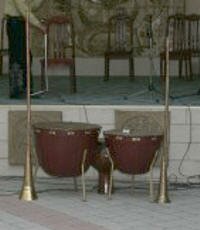
Two kerney and a pair of Do’ol drums
The Kerney – similar to a European Hunting horn. It was used during official ceremonies, such as the solemn departure of rulers, and it was used also in military campaigns, battles, etc. The repertoire for the kerney basically consisted of alarm signals and fanfares, such as: a call to defence in the face of an attack, a signal to attack, solemn fanfares announcing victory and similar purposes.
The sound produced by the kerney very is strong and loud, and is ideal for open spaces. It is especially well suited for alarm signals or ceremonial fanfares, sounding with its strong, shrill timbre. Unlike most Kyrgyz instruments, the Kerney has remained largely unchanged since ancient times, and still exists in its traditional form. indeed, it is one of the Kyrgyz wind musical instruments which, has not undergone any transformations to adapt it for use in modern day ensembles and orchestras, (another such instrument would be the surnai),
There are two kinds of kerney: the muyuz kerney (made from horn) and the jez kernei (made from copper or brass). They differ considerably. The muyuz kerney is the oldest and is produced from the bent horn of a mountain goat, therefore its length varies between 30-40 cm. There is no mouthpiece. The jez kernei looks like a long pipe between one and two meters in length and some have a mouthpiece, but not all. The diameter of a bell of the horn is about 20 cm. A special mouthpiece is used to enable the creation of a variety of sounds. There are no finger holes so it is more like a bugle than a trumpet, and is used for fanfares at local celebrations, national games, etc., and has also been incorporated into the repertoire as part of a folk music ensemble.
Percussion instruments:
-
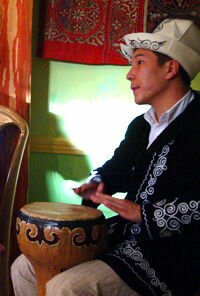
Doblebas
Dobulbas – a form of drum, with a wooden frame, about 50-70cm tall and 25-30cm in diameter, with a leather membrane tied around one of the ends. Over the years different shapes and styles of the instrument have developed and many folklore ensembles now employ one shaped like a pumpkin which can be grasped between the knees when playing. The different sizes produce notes of different pitches, but all of them are used to produce rhythmic patterns in support of melodies played on other instruments. The sound is produced by striking the leather membrane with the hands. In ancient times, the handle of a kamcha (horsewhip) may also have been used – but in modern times this is replaced by drumsticks with soft felt pads on the end. Like Kettle Drums, the range of sounds that can be produced is diverse, from a faint rustle to a something approaching a burst of thunder.
- Do’ol – a small “drum” resembling a helmet with a membrane of camel or ox hide stretched across the base, made from wood or metal. It can measure about 30cm in diameter and 20cm high. There are fittings for straps to be attached on the sides of the frame so that it can be hung from the saddle of a horse – and was used in festivals and when hunting. The sound was produced by hitting the membrane with a small tokmok – the kyrgyz word for “hammer”, but in this case it was a wooden stick with a thickened end.
- Jylaajynand Shaldyrak – chimes, or bells. Traditionally a jylaalyn was tied to the leg of an eagle, or hunting falcon, so that the Berkutchin could tell where his bird was. It might also be attached to adorn a woman’s headdress. In modern folk ensembles a number of them may be attached to a wooden frame – similar to a tambourine. As well as the familiar circular wooden frame, other shapes are sometimes found.
- Tai–tayak – similar to Spanish wooden castanets – although they are usually made from animal hooves. The hooves are attached together by the means of a shall leather strap. Rhythm is beaten by clapping the hooves together. The sound produced can be quite loud, and resembles the natural sound of the clatter of hooves.
-
Asa–tayak is made out of wood in the shape of baton. Bells and other iron objects are attached to this framework as additional sources of sounds that are generated by rocking or striking the sharp end of instrument on the ground.
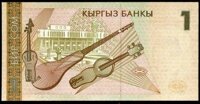
Musical instruments on the reverse of the one som banknote
.
The komuz and kyyak were featured on the reverse of the 1-som banknote – but, unfortunately, the note is no longer in circulation having been replaced by a coin.


 Bishkek