Moving away from home
I came across an interesting piece of research the other day. It is not new research – it dates back to 2008, but it has only just crossed my path.
It reported that, although most Americans have moved away from home to a new community at least once in their life … about 40% settle down and remain in the same community where they were born and although 20% have moved to a location within their own state – with only 40% have crossed the state boundary to set up a new home.
Oddly enough, this point has been explored in the popular TV series Glee where the characters have worried about their prospects of moving away to the “big city” – be it New York of Los Angeles, or being trapped in small town America, somewhere in Ohio.

The Pew Research Center …
The report was based on American census data and published by the Social and Demographic Trends project of the Pew Research Center – which studies behaviours and attitudes of Americans in key areas of their lives, (such as the family, community, health, finance, work and leisure), by conducting public opinion polls and analysis of social, economic and demographic data published by others … such as census data.
For the record: The Pew Research Center is an independent, nonpartisan American “think tank” based in Washington that conducts surveys into various social issues, and aims to inform, the public about attitudes and trends – not just in the US but around the world.
In recent weeks they have addressed attitudes related to civil rights – in response to the 50th anniversary of Martin Luther King’s famous “I have a dream” speech; public opinion about US aid given to Egypt given the turmoil that exists there; How teenagers manage their privacy when using their mobile apps; Broadband usage in the home; moral attitudes to abortion – an ever divisive issue in American politics; Spanish as an American language; the sale of the Washington Post newspaper; views on the possibility of living to 120 … or more; attitudes towards the enforcement of laws regulating the use and possession of marijuana; to give just a sample.
It was full of interesting points suggesting that most people put this down to economic prospects but Pew’s analysis suggested that it was more to do with geography and education … those living in the West, city dwellers and those with High school diplomas being more likely to move away than their counterparts in other sectors. They also suggested that families where both partners follow a career also find it more difficult to coordinate a move to a new location – the main reason people move (44% of the respondents citing this in the survey as their reason for moving).
As it happens, one of the more recent papers that they published suggests that a rising number of “young adults” (aged 18 to 31), in America continue to live in the parental home – that’s up by 4% since the turn of the century to 36%, which is the highest this particular statistic has been for some 40 years. That may not sound a lot – but it actually represents some 3.1 million young people.
To be fair, about a third of these are college students who may live in college for most of the year but are still considered to be resident at the parental home (… although students who enroll in college later have often already left home and so are classified differently).
Perhaps more significant was the fact that more than half of those under 25 are still living with their parents and women seem to strike out more than men in the same age group. The reasons suggested for this phenomenon included declining employment opportunities, rising college enrollment, and a decline in the take up a marriage.
In fact the graphic showing some of the figures dating back to 1968 show this far more dramatically.
If you are interested … I strongly suggest downloading the full reports … they make fascinating reading.
All of this got me thinking …
Although I consider that I moved out of the parental home at 18, according to the analysis above it wasn’t until I was twenty when I settled in Oxford. Malvern may have been in the West of the country but, in no way can it be counted as a big city. I did have the equivalent of an American high school diploma and went to University and most teachers in the UK are fairly mobile … so I found jobs in a market town outside Oxford before moving to North London … and, eventually, out here.
In fact, most of my family did move away from Malvern … my parents both came from fairly large families: my father being one of six children and my mother one of eight. When the died, however, they were virtually the last of their siblings to live in the town … although several cousins still lived in the surrounding district and, oddly enough, one has actually just moved to Malvern although he was born and grew up elsewhere.
Both families, however, originated from further afield … my father’s family from Nottinghamshire … and possibly Lincoln before that, whilst my mothers family came from somewhere in South Wales.
In fact this was an example of population movements that date back a long way – perhaps even to the days following the black death – when the old feudal social order made way for a much more mobile population. Even so, during the time times of the Tudors and Stuarts most people stayed close to home an few traveled far and wide … until the days of the Industrial Revolution when a process of urban drift began – depopulating villages as people moved to the cities for in search of employment in the new factories. It’s sometimes said that the reasons that many enrolled for the army during the First World War was to take advantage to travel and see the world as much as nationalism … but I am not so sure about that.
And … What about here in Kyrgyzstan?
The Kyrgyz are, or were, nomads … but they still have close ties with the land that they inhabit.
The traditional view is that the Kyrgyz probably originated in the northern Altai Mountains – in the Yenesei region of Siberia, (there are references to them in ancient Chinese texts and these were used for a justification of 2003 being declared the Year of Kyrgyz Statehood – marking 2200 years of their existence), but recent theories tend to suggest that these represented just some of the “forty tribes” that made up the Kyrgyz … and that, in fact, some of the other tribes were already resident in Central Asia.
A Kyrgyz Khanate stretched from the Yenesei River in the Eastern Tien Shan, but this was replaced by other Turkic empires, the Karakhanid, Mongol … Khokand and finally Russian and the Soviet Union. Each brought about a mix of nationalities, as did Kyrgyzstan’s position across the Great Silk Road.
This helped to create a fairly cosmopolitan community in what is now Kyrgyzstan – straddling as it did the Great Silk Road … and later attracting settlers from the Russian and Soviet empires, from the end of the nineteenth century and throughout the twentieth … although, it has to be admitted that not all of them in the Soviet period came here by choice … and that since Independence in 1991, a large number have returned to their nominal homeland.
There are sizable Kyrgyz communities in Afghanistan and Turkey. (The Kyrgyz of the Wakhan corridor (in Afghanistan) have, over the years, been granted considerable freedom by the various rulers of that country to organize themselves.)
There is also a large community of people in Siberia which identify with the Kyrgyz – live by similar customs and speak a similar language.
Apparently it was Kyrgyz nomads who showed Younghusband passes over the Pamir from Hunza. There is even an ancient Kyrgyz community settled in parts of Tibet.
There is also a tradition that says that long ago some of their ancestors crossed the Bering Land Bridge to become the forefathers of today’s Native Americans.
Following the events of 1916, large numbers of Kyrgyz left Kyrgyzstan and settled on the Chinese side of the border, just past Torugart in what is now the Kyrgyz Autonomous County, and although many returned after the 1917 revolution, not all of them did.
In recent years, however, some of the ethnic Kyrgyz have been returning “home” to the Kyrgyz Republic and recent reports suggest that some of the ethnic Kyrgyz in the Wakhan Corridor want to move back to their “historic homeland” and there is move to persuade the government to help them do so.
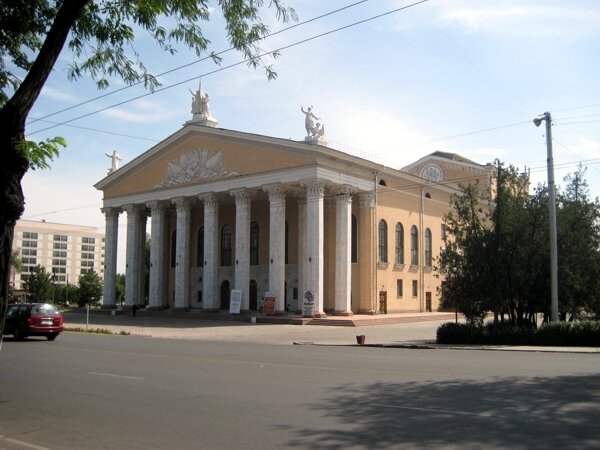
There has been a lot of comment recently about the effect of urban drift – the number of people coming from the regions to live, particularly in Bishkek. Following the Tulip Revolution in 2005, in particular, there were large numbers of Kyrgyz who moved to the capital from the south – and many, if not most, are still here. I have met quite a few who have since arranged for their parents and extended family to join them here in Bishkek.
Another interesting point is that, family ties are fairly strong among the Kyrgyz, (much stronger than in the West where the population is much more one of the “nuclear” rather than the “extended family”, and according to nomadic Kyrgyz tradition, the family of the youngest son will continue to live with his parents and inherit their yurt as their home. As in the West, however, living with the in-laws doesn’t always go down well with the new members of the family in a modern urban environment.




 Bishkek