Bekem Tish – Healthy Teeth
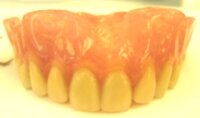
A set of dentures
When I first came here back in 1995, one of the first things that I noticed was the number of people who sported “gold teeth”. Believe me, it took some getting used to.
You still see some examples these days, but far fewer and they tend to be worn by members of the older generation. The use of ceramics for crowns is now much more common and people seem happier with the more “natural” look.
However, to be honest, it didn’t fill me with with confidence when I first had to pay a visit to a zubniy vrach, stomatolog or tish doktur – in other words … to the dentist, and to be frank, I have had more contact with dentists here than I would have preferred – either seeking treatment for myself, for the kids and even for tourists … but, really, I needn’t have worried.
According to a report by the World Health Organization, (WHO), published in 2011, in the soviet period, dental care services were divided into those provided at primary health care facilities, (clinics), and inpatient facilities such as the Dental hospital here in Bishkek. Nowadays, services are provided by both state run (public) and private clinics – which tend to be located in the capital and oblast centers. Patients have the choice of attending either the state run facilities or private practice – and another report (also published in 2011) suggests that the numbers of people attending the state facilities are declining.
The network of public facilities consist of some 37 specialist dental polyclinics and 97 dental surgeries which operate under the Family Group Practices and General Practitioner Centers, delivering services under the State guaranteed benefits package … which is quite limited covering:
- preventative work;
- biannual examinations of teeth and oral cavity of children in preschool facilities, pupils in secondary schools and pregnant women;
- oral health education to the population;
- urgent dental care to all citizens, including the required medication; and
- dental prosthetics (false teeth – dentures) and orthodontic prosthetics – free prosthetics (except those made from precious metals – e.g. gold) are available for certain categories of the population such as war veterans, survivors of the Chernobyl nuclear disaster and those with certain disabilities.
- Services to correct anomalies of tooth position, occlusion (the manner in which the upper and lower teeth come together when the mouth is closed) and jaw which are provided for free to children under 14 years of age.
Any services not covered by the package are paid for by the patient themselves.
(One of the reports suggests that “Currently, free dental care in public stomatological polyclinics is provided only to pensioners, people with disabilities and children”.)
.
A few years ago, I was approached by a travel agent based in Britain who was thinking of starting a new service – a sort of medical tourism, which is all the rage in some parts of the world as doctors and clinics offer treatments which cost less than similar treatments might cost abroad – even taking into account the cost of travel and accommodation. He was thinking of offering Dental Services to be provided here in Kyrgyzstan.
To be honest, my first thought was “What?” … but I could see his point. As he put it to me, only basic treatments are available “free of charge” on the National Health Service and many treatments are extremely expensive … I know that even eighteen years ago the cost of dental treatment in the UK was quite high – and I understand that it has soared since then. In addition, it can be very difficult to get onto a waiting list for treatment and many people are, he said, looking for alternatives.
I was still concerned … not about the level of treatment – most of the dentists that I have met here, (I won’t say all … but, then could I say that back in the UK? – probably not), are competent and I presumed that he would have vetted the choice of dentists that he planned to use so that he could be confident that they were indeed competent.
The main concern I felt was … language … I am sure that there must be some, but I wasn’t sure how many bilingual (English speaking) dentists there were in Bishkek … and to me, that seemed important. I remember the occasion when I was sitting in the Dentist’s chair with my mouth wide open and my eyes tightly shut, the dentist, (who was new to the practice), stopped the drill and asked me why I had screwed up my eyes … “Because I don’t really want to see what is going on,” I said. She asked if I was scared, and I answered something like I suppose so – it just isn’t comfortable. She stopped and then said in a matter of fact way that she thought it would be easier if I could see what was going on because then my mind wouldn’t be working in overdrive, fed by weird sounds and sensations. I thought, “That makes sense …” and decided to give it a go … and – she was right. It might have helped that she actually talked me through what she was going to do … what she was doing and what she had done.
As it happens, a lot of the dentists I have been to here have adopted a similar approach … and I think that the ones who didn’t simply refrained from doing so because they thought I wouldn’t understand what they saying … and, who knows, they may have been right!.
However, I asked myself, if I was a potential client, then how keen would I be to open my mouth and let someone loose on my dentures if I didn’t understand what he was saying and doing … no matter how good I was assured he was and the presence of an excellent interpreter?
Anyway, we talked about the possibility of Celestial Mountains acting as an agent handling services (apart from dental services – that is, accommodation, transport, activities when the clients weren’t actually being patients), here on the ground in Kyrgyzstan … but I don’t think he had had much success in drumming up potential business, so maybe my concerns had been correct.
One of the main criticisms I often see and hear about the medical services available here in here in Kyrgyzstan is the lack of modern equipment and medicines … but that situation is changing. Back in “the good old days”, when I first came here that may well have been true but there are now a large number of private dental clinics which have seen considerable investment – but that, of course means that they are more expensive than the ones run by the government.
Once, when I had reason to visit a state run clinic I was surprised that I was seen in a large room where there were several chairs – each with their own dentist and dental nurse in attendance … and it stuck me like being on a factory floor. Please don’t misunderstand me, although it didn’t appear as sparkling and shining white as I was used to back in Britain, it was perfectly clean and the staff were perfectly profession and competent.
The one difference that I noticed in the treatment that I received was that, back in Britain I would probably have been given a pain killing injection as a matter of course before drilling began but here, although I was asked, the implication was, “Don’t be silly – you won’t need it” … and I didn’t. That’s not to say that they wouldn’t administer an injection if they thought it was necessary and in a later session, when the dentist was addressing a particularly deep root canal, they did give me one – but not until they had asked me a host of questions about allergies and my previous experience with such treatments.
The main reason, it seems to me, that pain killing injections weren’t the normal course of events was simply one of cost. Here, only basic inspection is free of charge, and everything else is paid for by the patient … and they tend to be extremely cost conscious.
Indeed, the main problem with dental care here seems to me to be one of cost.
Although there are excellent dentists in the state sector, many have moved into the private sector and work in clinics which, as I said, have been the subject of considerable investment … with some of the most up to date equipment imported from the four corners of the world and offering a wide variety of treatments … hence the charges are considerably higher.
Well, today, (September 6th), the dental clinics in Bishkek are conducting a special campaign: “Bekem Tish“ or “Healthy Teeth”
According to the city’s chief dentist, Mirkazima Bashirova, the purpose of the action – prevention. After all, as the saying has it: “Prevention is better than cure”
Apparently, according to her, preventive dental care costs fifteen times less than curative treatment … and, of course, it leads to a decrease in the loss of teeth, especially in children and young people.
Everybody who goes to a dental clinic today will receive useful tips on:
- how to choose the right toothbrush and toothpaste
- how to brush their teeth
- how to care for their teeth and oral products for which they are useful.
In short, it is promised, the answer to all the questions of citizens about their teeth and dental care.




 Bishkek