Shorpo
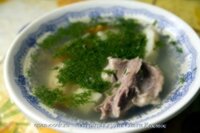
Shorpo
To be honest – Shorpo is not one of my favourite dishes … but it is a standard component on many menus in cafes and is often served up at lunch and at celebratory tois.
Shorpo is served as a “First course”, that is as a soup or appetizer before the main course is served.
It is one of a series of dishes that feature in national cuisines from the Balkans, through Eastern Europe and the Middle East to Central Asia … and even further into India, and is known variously as Chorba, ciorba, sherva, shorba, shorva, shurpam, sorpa, tshorba, and Xurpa.
In fact there are just as many different varieties here in Kyrgyzstan … my standard recipe book of Kyrgyz Cuisine has no less than six recipes for Shorpa … and at least one source suggests that the term may refer to basically any broth … but despite the differences in ingredients and some of the details of preparing the dish, bland or spicy, they all seem to boil down to the same thing … chunks of meat and vegetable immersed in a clear liquid bullion.
Maybe it is simply a reflection of personal “taste”, (no pun intended), but my preference to select something else from the menu isn’t anything to do with the taste, (as I said, there are many varieties, some of which are blander than others, with subtle herbal flavourings, while others can be much more spicy), but more to do with the ease of consuming it.
To me, Shorpo is basically a bullion with chunks of meat (usually “on the bone”) and pieces of vegetable (often large chunks – indeed some recipes I have seen call for the whole vegetable to used without being sliced or diced – fortunately), … both of which makes it difficult to eat. At a toi, diners will usually be handed a sharp knife with which to cut the meat from the bone and, presumably, the vegetables into smaller, bite size, pieces … but that doesn’t make me feel any more comfortable with the dish.
One of the reasons it seems to be so popular is that it is actually very easy to make:
Traditionally, the meat used in Shorpo is lamb – although Beef can be used.
A general recipe might call for:
- about 100 grams of meet per person, (although it is traditionally left on the bone, I would personally remove it from the bone and dice it into reasonable sized chunks);
- anywhere between about 100 and 250 grams of potato, (again, I would personally dice this into reasonable bite sized chunks);
- anywhere between 10 and 40 grams of carrots and onion, (some recipes seem to call for these to be cut into large pieces but others suggest that they can be cut more finely).
Different recipes call for:
- Tomato (between 10 and 100 grams),
- Sweet Peppers, (20 to 40 grams),
- garlic, or
- other vegetables … even peas – but, although I have occasionally seen mange tout on sale in the markets, I don’t think I have ever seen fresh peas on sale;
- and seasoning, (salt and pepper), spices (to the chef’s taste) and
… all the recipes required
- herbs for the final dressing before serving, (although recommendations as to which herbs are best were missing in most recipes … although one recipe did say ukrop – dill – adding, “but preferably many, many varied greens”, and another had a list – but the only one we recognized was kinza – coriander. The general opinion in the office was that Raikon was a form of red leafed Basil … but no-one recognized the term Dzhambil’).
Some recipes call for the meet to fried until golden brown and then the vegetables added and fried for a few minutes before being added to a pan of water, but other recipes ignore this step and simply call for the meat to boiled in the water to create the bullion. The recommended time for boiling the soup, over a low heat, seems to vary from recipe to recipe = from half an hour to two hours … but they all agree on the fact that although the ingredients should be cooked until they are soft, they should still maintain their form and not dissolve and break up in the water.
When the soup is ready, then herbs and seasoning can be added before serving.
Picture from: http://open-cook.ru





 Bishkek