80 – a sad statistic

80 - a sad statistic
One of the saddest pieces of news last week is that, so far this year, some 80 people have drowned Kyrgyzstan’s canals, rivers and lakes – including some 21 children – about 25%.
Unfortunately there was no information about the equivalent figures for previous years so it is not possible to put that statistic into any sort of context – however, 80 in eight months seems quite high to me for a country of just five and a half million people. That’s 10 a month – one for every three days.
In the United States, with a population sixty times greater, (about 317 million), it seems that drowning ranks fifth among the leading causes of death with about ten people drowning every day, (which is just 30 times higher than in Kyrgyzstan) … and, of these, two are children aged 14 or younger – or 20%. What is more, it has been estimated that for each death, there are up to 4 nonfatal “submersions” serious enough to result in hospitalization … and, to make matters worse, children who still require “cardiopulmonary resuscitation”, (CPR), when they arrive at the emergency department have a poor prognosis, with at least half of the survivors suffering significant neurological damage.
In Britain, where the population with a population of about 64 million, (twelve or thirteen times greater than that of Kyrgyzstan), in 2012 there was 371 deaths recorded from drowning – that is just over one a day (three times the rate in Kyrgyzstan) … with 18 being children under 14 – about 18% of the total.
As the MChS – the Ministry of Emergency Situations – notes Summer, the time for holidays, is a time when people enjoy relaxing by the waterside – and, indeed, most of those deaths, (66), have come in what they call “the swimming season”. It’s therefore important, they say, to learn the “rules of conduct on the water” – in Britain we call it “The Water Safety Code“. Here is a summary of the advice they have on their website:
Swimming:
Although swimming is a pleasant activity – it is important not to overdo it … as it is easy to catch a cold. How long someone can stay in the water varies on a number of factors such as both the air and the water temperatures, and the wind strength. The most favourable conditions for swimming is when it is clear with no wind – with an air temperature of at 25°C and water temperature of 18°C. Even then, they advise spending only a limited time in the water: about 6-87 minutes if the water is 18° C, 10-12 minutes if it is 20° C and upto 1`5 minutes if it is above 20° C.
It is NOT advisable to swim in temperatures of 15°C or less.
Whatever the temperature, they advise that if you feel a chill then you should immediately get out of the water and take a short but vigorous jog along the shore.
They also point out that it is best not to swim for about an hour and a half following a meal.
The choice of a safe place is also important … everyone, they say, should be aware of the features and dangers of places that are safe – and dangerous – for swimming. They recommend trying to select a location where there is equipment and the means where there is equipment and the means to prevent accidents … they don’t mention this, but I presume they also mean in order to offer assistance in the event of an accident … in other words (my words, that is) it is best to avoid deserted, unattended, locations.
Indeed, they say that children should not swim unattended – only in the presence of adults and that they should be taught about how to behave in the water and the necessary precautions.
In children’s camps, they actually recommend that the swimming is not only supervised but controlled to ensure that children do not stay in the water for too long.
Before the beginning of the summer season, the resorts and lagers around Lake Issyk Kul should inspect the waters, and clear away any dangerous objects. There should also be a medical (First Aid) post, umbrellas and/or canopies for protection from the sun.
The point about the provision of shade is to prevent the body from overheating … which can lead tio nausea, vomiting, headaches, weakness, shallow and rapid breathing … and going suddenly into cold water can lead to cold shock
Special areas should be designated for diving – and people should not dive from other places because of the risk of there being submerged logs, rocks or driftwood.
No-one should swim in swampy areas where there is algae or slime.
The advise against the use of flotation devices – inflatable mattresses, car tyres and the like, as they can be easily damaged leaving the swimmer in deep water – out of their depth.
Accidents:
Accidents can result from all sorts of situations:
- not being aware of the risks
- inability to recover and escape after getting into difficulty
- swimmers over extending themselves by swimming for too long – exhaustion
- swimming in a storm
- swimming in a state of intoxication
- the person not being able to swim and getting out of their depth
- hypothermia setting in
- cramps setting in
- bursts or punctures of inflatable means of support
- lack of supervision
- hooliganism
- hitting an unexpected object … especially when diving or jumping
- a shock to the body when hitting the water when diving or jumping into the water – especially from a height
- … and so on
Boating:
In the event of falling in the water, it is important to try and remain calm … not to panic … and avoid sudden movements. Breathe deeply and try to assume a vertical position whilst trying to keep the air in your lungs for as long as possible.
Cramps:
“Cramps”, (painful, involuntary seizures or muscle contractions) – which can be simply “embarrassing when they occur on dry land … but can be seriously debilitating and frightening when someone is in the water.
If the cramp occurs
- in the thigh muscle – then the leg should be bent at the knee and the heel of the palm should be pressed against the source of the pain
- in the hand – then the fingers should be flexed and relaxed in a dramatic and emphasized fashion . the seimmer should lie horizontally working with the other hand under water
- in the abdominal muscles- then the knees should be pulled up to the stomach
- in the calf muscles – then the leg should be lifted above the surface of the water and stretched vigorously
Administering First Aid:
If someone has “drowned”, (or as the Americans put it, “submersed”), the first thing to do is to get them out of the water … raise their head above the water and keep it there until reaching the shore, where their condition can be properly assessed.
If they are conscious, then they should be wiped dry and carried to a warm room where they should be placed on a board or blanket and not on the cold ground … again it’s a question of controlling the loss of temperature. Here, they can drink hot tea or coffee. (To be honest, that point surprised me a little).
If they the person is, (or has been), unconscious, then a doctor should be called … and, if they are still unconscious, artificial respiration should be applied. This should include alternately laying the victim on his stomach and squeezing the side of his chest as well as putting him on his back and trying to pump air into his lungs. It’s important, they say, to continue this as one of the most common mistakes, apparently, is to cease efforts too soon.
All of this seems sensible, good advice … but in my searching the internet I came across a number of other “codes” which also contained what seemed good advice … my favourite was this one from the Hillingdon Swimming Club:
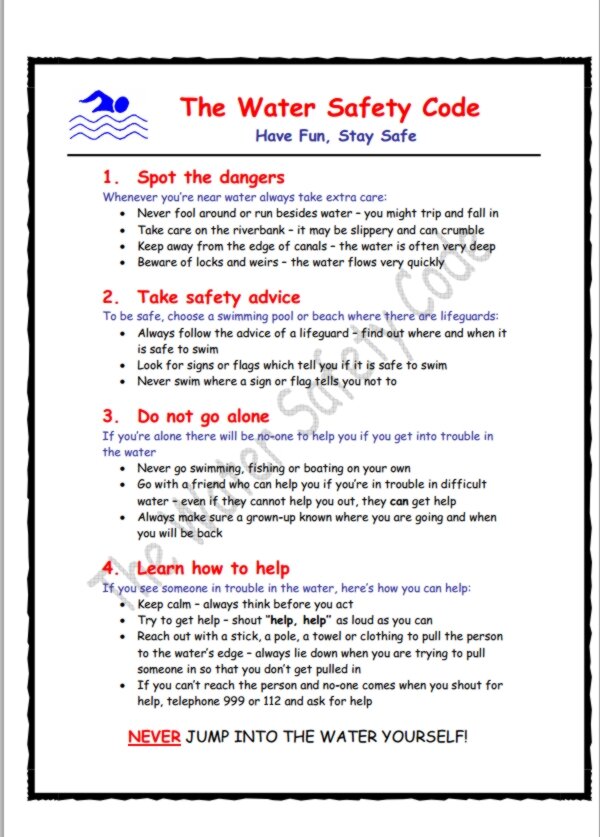
The Water Safety Code from Hillingdon Swimming Club (London)
Most of the advice is pretty general and would apply anywhere … even here in Kyrgyzstan – although the telephone numbers in the fourth point would have to be adapted to local conditions.
As it says: Have Fun but Stay Safe!



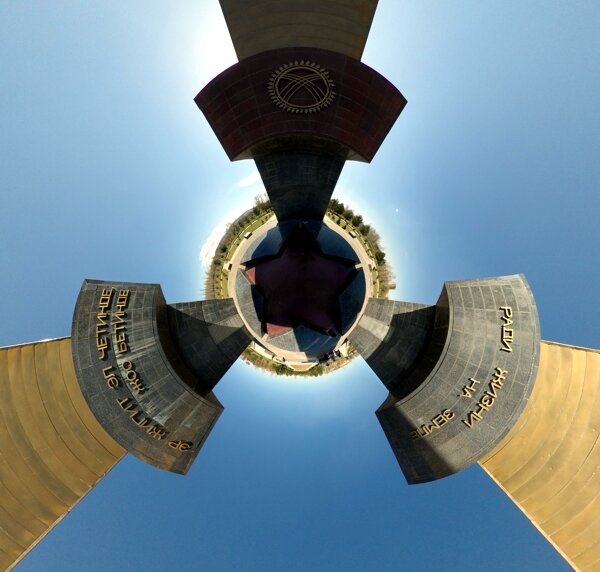
 Bishkek