The Red Headed League
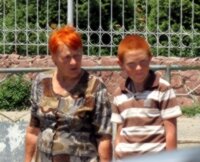
Not exactly a common sight in Kyrgyzstan, Red hair can make heads turn, but it could have been so different if ancient records are to be believed
As I listened to the Global News podcast from the BBC, I wasn’t sure if I could believe what I was hearing … in Edinburgh, the capital of Scotland, a Gay Canadian comedian was leading a Ginger Pride Parade as part of the Fringe … it has to be a joke, I thought … but no, even though it might well have been an instrument for promoting his show, Ginger Nation, at the Edinburgh Festival, apparently it also had a serious point. (You can hear the report here.)
Apparently, there aren’t that many redheads in the world; they make up only about 1 or 2 percent of the population, but I was very surprised to hear that Scotland is home to about 19% of all the world’s redheads – and apparently they represent some 13% of the population of Scotland.
It seems that it can be difficult being born with red hair … children are subject to taunts, (or being called names such as Irn Bru! Carrot top! Ginger minger! Duracell! and the like), leading to a sense of isolation and of being discriminated against … not to mention a skin sensitivity that leads to intensive sunburning. There was even some coverage f a family forced to move home as a result of the bullying, ridicule and even physical violence that they suffered – all on account of their red hair.
For the record: Red hair is inherited – the result of a genetic mutation in a chromosome, and can be passed on to children even if neither parent has red hair … provide they both carry the appropriate genetic code which they have in turn inherited from their ancestors.
As far as I am aware, there is no such thing as a International Day for Redheads … although I am sure that will come as a lot of Minority Groups are now adopting such a day to celebrate their otherness, to give support to members of their community and raise awareness of the issues that affect them in the wider population.
As it happens, however, there Redhead Day: a Dutch summer festival that takes place each first weekend of September in the city of Breda, in the Netherlands … and this year that falls on August 31st and September 1st.
Although there are some, “Redheads” are not exactly a common sight in Kyrgyzstan, and so they can be a cause for people to turn their heads … in Asia, it is always consider impolite to “stand and stare”.
As it happens, if the ancient chronicles are to be believed, this might not always have been the case. Chinese Chronicles dating from the second century BC describe the Genkun or Jiankuna people, which have been identified as the ancestors of the Kyrgyz, as a tall people, “red-haired with fair complexion and green (blue) eyes”. It’s said, (for example on the website of the Kyrgyz embassy to the USA and Canada), that there are some Muslim sources dating from the seventh to the 12th centuries that also support this.
Looking at the Kyrgyz of today this sometimes seems as an incredible anomaly – as they tend to have a dark complexion, (especially those that have spent the summer months on a jailoo tending their livestock), and sporting straight jet back hair.
In texts which date from the Tang dynasty, the Genkun or Jiankun who had dark hair and eyes were identified as descendants of the Chinese General Li Ling.
To be fair, (no pun intended), the Kyrgyz like most nationalities are a fairly heterogeneous group displaying a wide variety of characteristics, probably as a result of occasional inter-marriages with peoples from other ethnicities with whom they came into contact – either because their territory straddled across the routes of the Great Silk Road, or the various empires that came and went.
Certainly, this question has raised several heated and detailed debates on internet forums
.
Interestingly, one of the legends about the origin of the Kyrgyz tells about their ancestor from whom they were descended: Kyzyl Taigan, (Red Dog – or Red Wolf).
The daughter of a local khan was in the habit of taking long walks in the company of 40 maidens, (servants). On one occasion they returned home to discover that their ail, (village), had been attacked and ravaged by a band of enemies. So complete was the devastation that in all the village and they found only one creature still alive: a red dog. The princess and her 40 maidservants become mothers, (in a company where there was only one male – the red dog … hence he is considered the ancestor of the peoples). The 40 maidens, (or kyrk-kyz), began to be called Kyrgyz.
Incidentally, a cult of the Heavenly Dog was widespread between the ancient peoples in and surrounding China.
The generally accepted theory of the origin of the Kyrgyz holds that the Kyrgyz that appear in the Chinese records were from the northern Altai Mountains – where the trees grew so tall “that an arrow could not reach their peaks”. A Kyrgyz Khanate stretched from the Yenesei River in the Eastern Tien Shan, (which was later superseded by other Turkic empires: the Karakhanid, the Mongol, Chagatal, … Khokand and finally by the Russians and the Soviet Union).
Among Kyrgyz historians there seems to be a modern trend which, whilst accepting this traditional view, suggests that this was only one group of Kyrgyz.
Kyrgyz traditional tells of forty tribes … although I have seen lists which have different numbers … and some of those tribes, (for example, the Azyk, Bugu, Cherik and Sary Bagysh), may well have migrated from Yenesei with the collapse of the Kyrgyz Khanate, others were already resident here in what is now Kyrgyzstan, drawn from the ancient Sakas, (Sythians), and Usuns.
Ethnically, the Kyrgyz tend to resemble somewhat the Mongols or Chinese, while the Uzbeks and the Uighurs, (the latter live mainly in China), resemble more the people of Turkey.
There used to be some confusion in identifying the Kyrgyz, themselves, and the Kazakhs. This is because the Kazakhs, (a larger nationality), were often referred to as “Kyrgyz”, (some suggest that this was to avoid confusing them with the “Cossacks”), whilst the Kyrgyz themselves were often referred to as “Kara-Kyrgyz” (= “Black Kyrgyz”) to distinguish them.
The Kazakhs were nomadic pastoralists who herded animals on the steppes – and it is sometimes said that the Kyrgyz were nomads who wandered from place to place vertically whilst the Kazakhs were nomads who wandered from place to place horizontally.




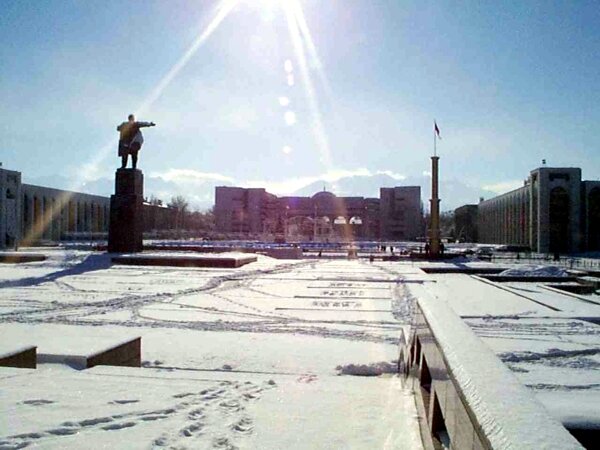
 Bishkek