Panfilov Park
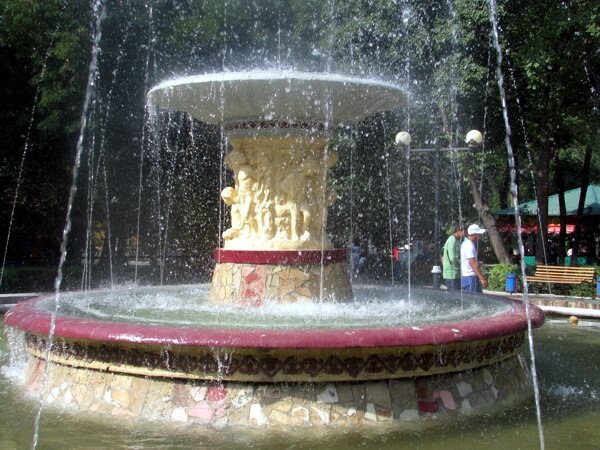
Fountain at the center of Panfilov Park
Panfilov Park in Bishkek stands on the site of what was once an orchard, planted in 1879 by the botanist, horticulturist, archaeologist and educator, Aleksei Fetisov, who was largely responsible for creating Bishkek’s reputation as a Green City.
Shortly after arriving in Bishkek, he set about planting the first city garden and orchard – which is now the park behind the White House. In it’s heyday it housed over 100,000 specimens and a 1913 guidebook to all of Russia reported that “The sight to see in all the city is the municipal garden”.
In 1889 Fetisov founded a horticultural school, based in the grounds, giving lectures to the local Kyrgyz youth, using the gardens as both a laboratory and a classroom until his death. The school continued in operation until 1919, most of the plants having been killed of in the bitter frosts of 1916 and 1918.
As a result, in 1924-5, the Soviet authorities transformed it into a park of Rest and Culture, although only some of the land was used for it. It was called “Red Star Park” because of the pattern made by its network of pathways – which is clearly visible even today from aerial photographs:
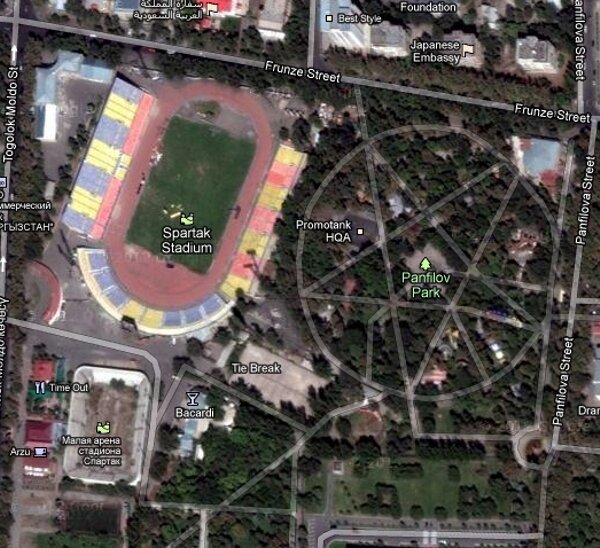
Spartak Stadium and Panfilov Park
In 1938, part of the park was given over to the construction of a sports complex – now the Spartak Arena, (also known as the Dolena Omurzakov Stadium).
In 1942 it was reconstructed and renamed in honour of the war hero, Ivan Vasilyevich Panfilov, whose statue can be found at the Eastern end of the park, behind the White House.
The park is filled with cafes, amusement rides for children and a ferris wheel. In 1949 a small fountain was constructed in the center of the park. Over the years it has been painted several times, and now sports a coat of yellow and blue … as a sign of friendship with the people of Ukraine.

- The Ghost Train ride
- An amusement ride
- The Ferris Wheel
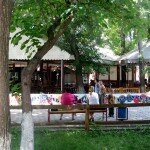
- Cafe
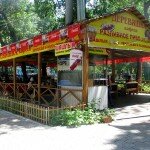
- Cafe
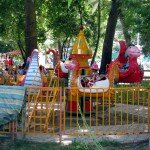
- An amusement ride
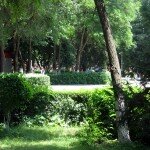
- One of the “stellar” paths
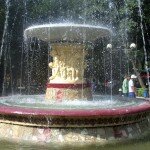
- Fountain at the center of Panfilov Park
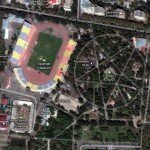
- Spartak Stadium and Panfilov Park


 Bishkek