Hearts of Oak
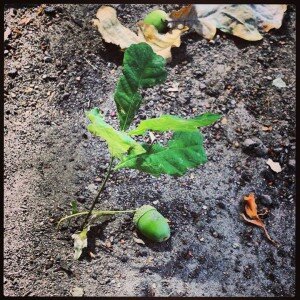
"Life will win. Subsidence caused a sinkhole in the pavement. I've walked past everyday. Now, it has filled with silt, and an acorn took root. We might be doomed, but life will continue long after we're gone." Kate Sampsell-Willmann
Its always good to see new life blossoming … which was why a photograph from Kate Sampsell-Willmann on Facebook caught my eye earlier this week.
It wasn’t a photo of an infant in swaddling clothes, nor of a cuddly kitten or a gamboling lamb … but of an acorn that had fallen to the ground and taken root … producing a fine twig sporting bright green leaves.
It was a particularly poignant photograph given the fact that the oak trees in Bishkek are currently suffering under the influence of pests such as the Oak Sawfly and the American White Butterfly, turning the leaves prematurely yellow and giving the city a distinctly Autum hue.
For the record: The oak is a tree in the Quercus family which consists of some 600-odd distinct species. The feature spirally arranged leaved with distinctive lobed, or serrated edges. It produces seeds in the form of nuts, called acorns, housed in a cup like structure called a cupule.
The timber produced from the oak is a sturdy hardwood – prized by the Vikings for their longboats and was used widely in the construction of wooden ships – hence the famous English song “Hearts of Oak” … which continues “are our ships …”. It is also favoured by builders over the centuries as a source of wood paneling, and also by furniture makers. Oak barrels are used in making wine because they have a high Tannin content which helps to give the wine a special taste, and the bark of the Oak tree is often used for the corks of wine bottles – it also has medicinal qualities.
The leaves, however, have toxic qualities as a result of their high Tannin content and are poisonous to cattle, horses, sheep and goats … although not pigs and a variety of wildlife scavengers, which relish a diet of acorns.
Unfortunately many species of Oak tree around the world are under threat of extinction in the wild – often as a result of human activity, but they also face a variety of pests and diseases: Sudden Oak Death which, as the name implies, can kill a tree within a very short space of time; Oak wilt which is caused by a fungus similar to that which causes Dutch Elm Disease that caused havoc in the UK in the late 1960′s, devastating the local Elm population and, according to some, changing the shape of the English landscape; wood boring beetles and root rot … and not forgetting lepidoptera like the American White Butterfly and the Gypsy moth.
In Britain, apparently there is a new “mystery illness”. which has been dubbed Acute Oak Decline, and which is attacking many Oak trees causing them to “bleed” and seems to kill a tree within about four years after it becomes infected. The British government is so concerned that they are spending over a million pounds on a research project that has been described as a race against time to stop the spread of the disease. Some scientists think that a beetle is the cause the disease and others are trying to identify a bacteria found on infected trees that may be linked to the disease.
Here in Bishkek the Oak Trees are showing signs of premature aging … leaves turning yellow and an Autumnal Brown even though it is only the start of summer.
In fact, the issue was raised by the City Authorities about two years ago. As a result, last year an experimental program of treatment was undertaken and a special commission drew up a plan for more extensive work including spraying trees in the city with insecticide and setting special traps to eliminate the suspected culprits behind the phenomena …
Kyrgyzstan, however, doesn’t have a million pounds to spend on such a project and it’s not clear how effective the measures that have been adopted will prove to be … One agronomist pointed out that shortly after spraying, the larvae observed on some of the leaves had already progressed to the caterpillar stage of their development, suggesting that the treatment has in fact failed.
Some of the criticisms can be summarized as “too little, too late“. Some specialists have pointed out, for example, that the treatment needs to be adopted further afield than just city-wide … throughout the whole of the Chui oblast. In terms of timing … there have also been comments that treatment was not administered in time. (At the hotel, for example, we have one such affected tree and when we asked a contractor about treatment, we were told that it should have been done in March – and it is now probably best to leave it until next Spring.)
On the other hand, a spokesman from Zelenstroi, (the city’s Parks Department), said that “the problem has become much less”, pointing to greater levels of treatment and suggesting that the areas where the diseases are focused are smaller than they used to be.
It is recognized however, that a “one off” treatment will not solve the problem … it will take at least two or three years.




 Bishkek