Easter in Kyrgyzstan
The list of official holidays in Kyrgyzstan is an eclectic mix of secular celebrations (such as New Year), the commemoration of national events (such as Independence Day and Constitution Day), holidays held over from the days of the Soviet Union (such as Army Day, International Women’s Day, May Day, Victory Day and the anniversary of the October Revolution), and a variety of religious festivals (Zoroastrian – Norus, Christian – Orthodox Christmas, Islamic – Orozo Ait and Kurman Ait).
Although most of the Kyrgyz consider themselves as, (at least nominally), Muslim, Christmas is recognized as an official holiday – as a sign of respect and recognition of Orthodox Christianity being the second major religious confession within the country. The other major Christian festival, Easter, does not count as an official holiday – but in places where there is a large Russian population, it is still marked in the traditional manner … but in a more private and subdued manner.
The Date: The Orthodox Church still follows a modified version of the Julian Calendar and as a result Christmas falls on January 7th – not December 25th as is usual in the West. Easter also falls, (usually), on a different date than is celebrated in the West. Because Easter is associated with the Jewish festival of Passover – which in turn is based on the Jewish, lunar, calendar it is a “moveable” feast … the date changes every year.
In the West, the date of Easter can fall at any time between March 22nd and April 25th, whereas the date of Orthodox Easter can vary between April 4th and May 8th.
The early church developed a way of calculating this date – and the two traditions basically use two different methods. In the Western Catholic and Protestant traditions it falls on the Sunday after the first full moon following the Spring Equinox, whereas in the Eastern Orthodox tradition it occurs one week after the Jewish Passover. In most years the resulting dates do not coincide, although occasionally (as in 2004 and 2007) they did.
The lead up to Easter: As in the West, the period before Easter has a special significance and is marked by fasting, although, probably, only the most devout Orthodox Christians adhere strictly to the dietary restrictions against the consumption of meat, eggs, sweets … called “Lent” in the West and “Velikiy Post” in the Orthodox tradition.
In the West this period of Lent begins some 40 days before Easter. In preparation for the period of fasting, the household prepares special dishes such as pancakes – to exhaust their stocks of foodstuffs which are forbidden during Lent. The last day before Lent begins is called variously known as ”Fat Tuesday” or “Shrove Tuesday” or “Mardi Gras” – a name often associated with extravagant festivities and parades. (Lent, itself, properly begins on the next day “Ash Wednesday”.) In the Russian Orthodox tradition there is a similar moment called “Maslenitsa” – but this can last for a week rather than just one day.
Apart from the dietary restrictions, in the past there were other prohibitions, (for example: in the first week of “Post” theatrical performances and musical concerts were forbidden).
As in the West, the last week of “Post” is known as Holy Week – marking the last week of Jesus’ life following his entry into Jerusalem. In Orthodox churches special ceremonies take place to consecrate branches of willow which represent the palm fronds that were laid on the route of his triumphal entry into the city. Many Orthodox believers collect willow branches to put by the icons in their home until the next “Willow Sunday”.
“Pascha” – Easter: In the Western tradition, the main Easter celebrations last for just one day – Easter Sunday. In the Orthodox tradition, they last a week.
Events begin with a church service which starts on Saturday night (commemorating the placing of Jesus in the tomb) and continues through to the morning. Attendance is usually quite high – more than on a usual Sunday, and often there a gathering of young people. Immediately after midnight – and possibly for the next several days - people greet each other with the refrain:
Kristos Voskres! – Christ is Risen
Voistinu Voskres! – He is Risen indeed!
accompanied by an exchange of three kisses on the cheeks – and an exchange of eggs.
Inside the Orthodox churches, the “Holy Gates” from the main part of the church to the sanctuary remain open to symbolize that the gates to Heaven have been opened by Jesus’ death.
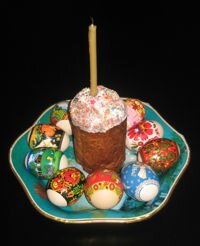
Straight after the service a celebratory meal may be held – now that the consumption of eggs, meat and other forbidden foods are now permitted once again. A wide variety of special Easter cakes are baked, such as “Kulich” and a special “pashka” cheesecake - or curd … Kulich is a tall round cake from a form of short-pastry, usually with a cross of pastry placed on the top. It is important that it is tall, (risen). The kulich is cut into layers rather than slices, (sectors of a circle) or lengthwise
However, the main symbol of Easter are Easter Eggs.
Easter Eggs: It is sometimes said that Easter eggs are a symbol of birth carried over from pagan traditions – to represent the Spring birth of new life. There is another tradition that suggests that Mary Magdalene presented a red egg to the Emperor Tiberius as a gift – with the words: “Christ has Risen!”. The colour red is to symbolize blood – the blood of Jesus which was shed on the cross.
In the west, Easter Eggs are a seasonable form of confectionary … chocolate, and often with special fillings. In the Russian Orthodox church, however, the concept of the “painted egg” has been preserved. Coloured eggs are an ancient tradition known as far afield as in ancient Greece, Rome and China. In Russian Orthodox tradition there are two main types: “pisanki” – which are richly ornamented in several colours, and “krahsenki” (“painted” or “dyed”) - which are just a single colour with no decoration.
The eggs are boiled together with onion peels for about 30 minutes. The eventual colour and intensity will depend on the colour of the onion peel and the amount of onion used – and can vary from bright red to deep brown. It is important that the eggs should be at room temperature, and if they have been taken from the refrigerator, they should be left to stand for about half an hour to ensure that they have reached the right temperature. To prevent the eggshell from cracking, salt is added to the water.
- One form of decoration is to create a specked effect. This is achieved by wetting the egg and placing it in dry rice, then wrapping them in gauze which is held in place by tying a thread around it. This allows the rice to stick to the eggshell and shield it from the natural dye being absorbed;
- Another effect can be achieved by taking the dyed egg, drying it on a cloth and then painting it with sunflower oil – creating a gloss or shine
- It is possible to buy stickers with traditional patterns or stickers which can be applied. Some are in the form of a tube of plastic which shrink-fit to the shape and size of the egg in the boiling water.
A popular “game” that may be played – especially in a home with young children - involves everyone taking an egg. One person holds theirs whilst a second person hits it with theirs. One of the eggs will break, and the person with the unbroken egg is considered the winner of that round. Another person, then hits it with their egg … and the process continues until only one egg remains – which is declared the ultimate winner.
Decorated eggs were also created in ceramic, wood and other materials. In 1884, Tsar Alexander III commissioned the jeweller Karl Faberge to create a special Easter present for his wife – and this was the first of the renowned Faberge Eggs.
After Easter: The Tuesday in the week after the week of Easter celebrations is known as “Roditelskoye Dehn” – Parent’s Day. On this day people go to the cemetery to visit the graves of their deceased parents and relatives.
In Kyrgyzstan:
Unlike Christmas, Easter is not an official holiday, although the President usually issues a proclamation congratulating the Christian community on the occasion. The Orthodox churches tend to be crowded by the faithful for a series of services which may start at Midnight on Saturday evening.
Ethnic Russians will often decorate eggs, bake Kulich and exchange them with family, friends and neighbours.




 Bishkek