An Easter in Bishkek
A few years ago, in 2005, the Malvern Gazette ran a story about the Tulip Revolution here in Kyrgyzstan. It might seem a bit odd that a local newspaper in Britain ran a story about events here in Central Asia, even if they did result in the fall of the government, the president of the Republic fleeing into self imposed exile, and rioting crowds running through the streets looting shops. There was, of course, a local “hook” for the story – and that was: Me. As the events unfolded I took the opportunity to write to friends and family at home and abroad, basically to reassure them that I was OK, and the events they were seeing on CNN and BBC, whilst they were unpleasant to live through, were not that bad and could have been a lot worse. One of these emails got into the hands of my aunt who duly passed it on to the local newspaper and the editor thought it was worth of a story … it was a short while after the events so maybe he had a quiet week. Anyway, the story ran under a headline something like: “What a way to spend Good Friday.”
It was only when I saw this that I realized that the revolution had happened over the Easter weekend. If I had been at home, of course, I couldn’t have missed it: the school holidays, special programming on the, television and so on. Not to mention the church services, although it has been a long time since I attended these. As John, a Catholic friend of mine, insists on telling me: Easter is the biggest festival in the Christian calendar … and I suppose he has a point, although Christmas seems to hog the limelight. (It’s the only festival in the calendar that the Jehovah’s Witnesses mark – although they ignore the dictats of the Council of Nicea in 325 and celebrate it at the same time as the Jewish Passover.) Here, however, Easter tends to pass me by.
Back in Britain, Easter is a public holiday, which is understandable considering Christianity, (in the form of the Anglican church), is the established religion of the country … even if the Anglicans, themselves, constitute only a minority of the population. Here in Kyrgyzstan, on the other hand, although the country is technically a secular state, the majority of the Kyrgyz themselves are nominally Muslim. There is a large Russian community and they tend to be Orthodox, if they profess any faith at all. Despite this, Kyrgyzstan has a number of religious festivals that have been adopted as Public holidays. Although Orthodox Christmas is one of those public holidays, Easter isn’t. (For a brief summary, see the page: Holidays.)
In recent years, however, because some of our staff are Orthodox Christians, I have become more aware of Easter. Two years ago, for example, Tatiana, (our accountant), and Liza, (my Office Manager), decided to keep “post” (that is, they fasted for Lent – the forty days before Easter).
This year year the Orthodox and Western, (Catholic and Protestant Easter), fall on the same weekend – which doesn’t happen every year and we decided to mark the festival. There were two reasons for this. First of all, John is here and decided that he would like to see how the Orthodox celebrate Easter … and secondly, the baseball kids told me that, despite the fact that they are also Orthodox, they had never celebrated Easter because it was too expensive and they couldn’t afford it.
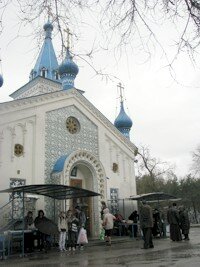
So we enquired about the services in the Cathedral. On Good Friday there were two: one at two o’clock commemorating Jesus being taken down from the cross and another at four. The following day, Saturday, there were another two: at five o’clock and again at ten o’clock in the evening. This latter service lasted until midnight and was followed immediately by a celebratory mass which lasted until three o’clock in the morning.
I had a friend – I say “had” because, unfortunately, he died earlier this year – who always made a point of attending that service … which I always a little amusing because he was not really devout. Apparently his mother is Russian and had him christened in his childhood, however, his father was a Tatar – a Muslim.
Then on the Sunday there were services at eight in the morning and again at four in the afternoon.
John and I decided that we weren’t too keen on a three hour service at midnight … and as I had to think about the children we we decided instead on the Saturday evening.
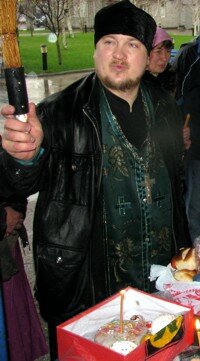
The day began with making preparations. I am not very good at baking, so I decided to buy “Kulich”, (a special cake baked only at Easter) and “Bulochki”, (buns). (For more details – see: Easter in Kyrgyzstan). On the other hand we did boil and colour some eggs.
The day also began with bright sunshine, but as it progressed, the sky became overcast and eventually rain began to fall. We took our Kulich and eggs, and once we got to the church bought candles to light, and went into the church.
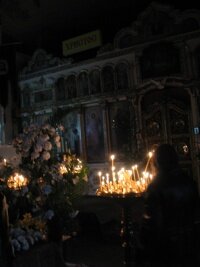
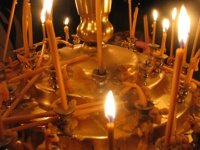
Orthodox services are not quite as formal as those I was used to, with my Methodist background. People tend to come and go, pray and light candles, with the formalities being enacted almost independently. The prayers and so forth are far more personal than in a Western service in which the congregation play a more participatory role. We stood before the icons and the “shroud” which symbolized the one in which Jesus’ body was wrapped when taken down from the cross, contemplating the Easter story and lighting our candles as symbols of our prayers. Finally, we emerged and joined the queues so that our Kulich and eggs could be blessed by the priest, then donated some of them to the growing collection which was being amassed for a local children’s home. In a way, it’s a bit like Halloween, in that it is important to treat visitors and children to these eggs, cakes and buns. Indeed, as I stood outside the church waiting for the others, a “babushka”, (literally “grandmother … but the word is generally used as an affectionate term for any old lady), stopped and insisted on treating me to some eggs and buns that she had just had blessed.
Tatiana and Liza then handed in their “prayer lists”, naming those people they wanted to be included in prayers the following day.
It was then time to leave, and we went to a local cafe where we watched the reportage on television of the arrival of the sacred flame at the Church of the Holy Sepulcher in Jerusalem. Flames from that fire will be transported to orthodox communities around the world over the next week and ours will arrive here on Friday.
The weekend continued and on Sunday guests arrived and were treated to the Kulich, bulochki and eggs. I was a little embarrassed to discover that our eggs were only “soft boiled” and so a little runny. That is something we’ll have pay greater attention to next year.
Back home in Britain, our Easter Eggs tend be made from chocolate rather than hard boiled chicken’s eggs. There aren’t any such chocolate Easter eggs here unfortunately. When I first came here fifteen years ago, it was possible to find Cadbury’s Cream Eggs – one of my favourite sweets – but, although they were very popular, they seem to have disappeared from the shops in recent years. It is possible, however, to find Kinder Eggs … milk chocolate eggs with little toys inside … and so I bought a tray of them for the children as a special treat.
It’s not over yet, however. Whereas, in the lead up to Easter, people went to the cemetery to tidy up the graves of their deceased relatives and friends … nine days after Easter, (that is the Tuesday in the following week), is known as “Roditelskoye Dehn” – Parent’s Day – when people go, once more, to the cemetery to visit the graves. There will be more eggs and Kulich to prepare.
So passed my real first experience of an Orthodox Easter celebration, after fifteen years … it was an interesting experience, and certainly a lot more sedate and peaceful than the Easter that I experienced five years ago.





 Bishkek