A night at the Opera
I remember on my first visit to Bishkek, back in 1994, wandering through the city center and being brought up short, surprised to hear a soprano practicing her scales as we passed some classical edifice.
Tony turned to me and asked why I was surprised … “You are not in a cultural wilderness you know.”
I didn’t think that we were … it was just that it was so unexpected … Opera is nowhere near traditional Kyrgyz Music which was all I had seen at that point and it seemed so incongruous at the time. I learned that the classical edifice we were passing was the Theater of Opera and Ballet. Tony pulled out a fife som banknote and showed the drawing on the back. I turned the note over and saw the portrait of Bubusara – the Kyrgyz Ballerina.
The theatre is, in fact, a fine building. One of my favourites in Bishkek. Inside is a bit cavernous and can be cold – but it was renovated recently and the ceiling paintings depicting the Kyrgyz as part of the Commonwealth of nations that comprised the Soviet Union are fine examples of Soviet Art and well worth a visit.
Now, to be perfectly honest, I am no great fan of either Opera of Ballet. In my youth, my exposure to both had been extremely limited. As one of only three pupils taking C.S.E. music, I had “studied” one or two pieces and remember being taken to a performance of The Barber of Seville … which is classified as an “operetta”, but that was about it.
For some reason I preferred ballet to opera, especially modern ballet. I sometimes went to see the London Contemporary Dance Theater, and I once went to Covent Garden to see a performance of the Nutcracker. Opera, on the other hand, was also associated with films of the 1630′s, 40′s and 50′s, with long incomprehensible arias sung by fat ladies who seemed to have little or no connection with the world in which I was growing up. I could never understand why people would suddenly stop talking normally and burst into song.
Despite this, I wasn’t opposed to musicals per se. At school we used to put on performances of Gilbert and Sullivan operettas, (for example: The Mikado, The Pirates of Penzance and HMS Pinafore), and as a result I had a developed a liking for these comic operas, and for many years I could sing (or warble) the whole of the finale of the First Act of The Mikado … “With aspect stern and gloomy stride, we come to learn how you decide. Don’t hesitate your choice to name, a dreadful fate you’ll suffer all the same … “. I could do all the parts: the chorus, Nanki Poo, even that of the soprano Yum Yum. It was my “party piece”. These operettas, however, don’t come close to the real “high brow” stuff – not even the Yeoman of the Guard, which is probably the nearest that the pair got to writing a “real” opera. Apparently, Sir Arthur Sullivan was a talented composer and taken quite seriously in his time, and he loathed the the works of his collaboration with William S. Gilbert, so it is ironic that he is known chiefly for them. I have to admit that I have never really taken to his more “serious” compositions, but I have only ever heard one or two of his other works.
My brother also took part in a performance of West Side Story … playing one of the Puerto Ricans in the Sharks … and I found that I quite enjoyed it. I also liked modern shows like Grease, The Rocky Horror Picture Show, The Little Shop of Horrors, Return to the Forbidden Planet, and the range of musicals by the modern Gilbert and Sullivan, Tim Rice and Andrew Lloyd Webber … Joseph and the Amazing Technicolour Dreamcoat, Jesus Christ Superstar, Evita (I was surprised how much I enjoyed Madonna’s performance in the film) … even if they all seemed to so similar. I also enjoyed Webber’s Cats, based on the poems of T. S. Elliot, and The Phantom of the Opera.
My favourite musical of all time, however, must be Les Miserables. Several of my friends had been to see it in London and raved about it. I was not impressed however, as I remembered reading an abridged version of it as a child and finding it very tough going. A friend’s mother came down to London and I was persuaded to go along with them to see a performance. I was “bowled over” by it and my copy of the tape of the Tenth Anniversary concert in the Albert Hall – with the finale where 17 Jean Valjeans from around the world perform, each singing a potion in their own languages – has almost worn out.
My general disinterest in Opera persisted until I came here. I had a friend, Misha, who was the son of our interpreter, who would occasionally invite me to the theatre. I would thank him for the invitation, but declined the offer. As I explained to him, the performances would all be in Russian and at that time my Russian was not that good – and I think I might still have difficulty today. If it had been a performance of Shakespeare’s Romeo and Juliet then perhaps it might be interesting to see it, because, at least, I would know the play and be able to “follow the action”. On the other hand, most of the plays being performed were totally unknown to me and it would be more like hard work trying to follow the plot than entertainment – and I was bound to miss the finer points in the dialogue.
Then, one day, Misha invited me to the opera. Without really thinking about it, I started my usual speech, thanking him for thinking of me and the invitation, but I was going to decline because … and then it struck me. The opera wouldn’t necessarily be in Russian, it might well be in Italian, or French, or whatever, and the dialogue wasn’t as important as the music. So, I accepted the invitation. It was a great evening and I was really impressed. For a small country, with a population of only five million, most of whom live in the countryside, in small villages, where opera and ballet don’t really form part of the traditional culture, I was quite surprised at how good the performances were. I’m not saying that they would equate with something at the Paris Opera, or Milan, the Coliseum or Carnegie Hall, but it wasn’t bad and, I felt, something that could easily have been successfully staged in a regional theater in the UK. Anyway, that was the start of something big.
For a year or so went to almost every performance at the theatre. Now, don’t misunderstand me … there weren’t that many performances to attend. The season only lasts for a few months, and there are only two or three performances a week, usually at the weekend: Friday, Saturday and Sunday. Unlike back home, they usually start quite early – about five o’clock. In fact, I once went to greet one of our first groups of tourists and one couple said that they would quite like to “grab a show” and asked about performances of an opera or ballet. I had to point out that, I was sorry but: “no chance”. It was already six o’clock, on a weekday at the height of summer – i.e. out of season.
To be perfectly honest, now that I have seen virtually the whole repertoire, it’s been some time since I’ve back.
A few weeks ago, however, I received a notice about a performance of Mozart’s Magic Flute … and, as I have never seen it, I agreed with a couple of other ex-pats to go along. We turned up nice and early and had a drink in the bar, ordering another for the interval. Then, as the bell rang, we made our way into the auditorium and found our seats. As usual, the theater was not full, which is sad in some ways because the performers put so much effort into their work and clearly derive pleasure. Because I have never seen it before, I didn’t know the story line and I hadn’t had time to look it beforehand. Because it’s a fairly new addition to the company’s repertoire, there were no programmes, with a synopsis of the plot, on sale. To make it worse, as it was all in Russian and I found it hard to follow, but I had to try and explain what was happening to my compatriots who don’t know much Russian.
Still, it was an enjoyable evening … followed by dinner, (and drinks), in a local hostellery.


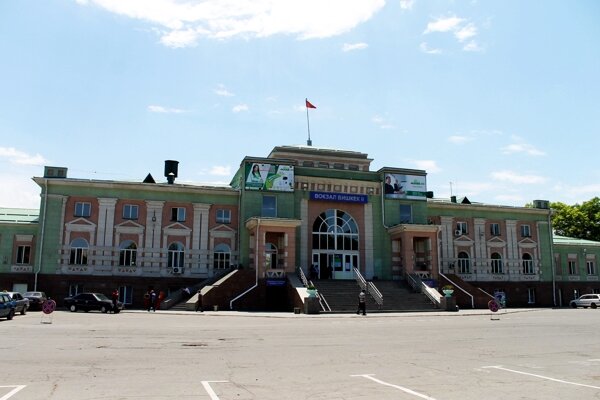


 Bishkek