Taking a Weekend Break

TGIF - Off for a Weekend Break
Harold Wilson is supposed to have said that “a week is a long time in politics” – although no-one seems to know exactly when or where … indeed, when he was asked by Nigel Rees, (a writer and broadcaster who is best known for devising and hosting the long-running panel game “Quote… Unquote“), Wilson was unable to remember when, or even if, he had uttered the phrase.
Apparently, Rees suggests the words were probably said in 1964 shortly after Wilson became prime minister. There is also a reference to Wilson once saying that “forty-eight hours is a long time in politics” at a party conference in 1960.
A week is a unit of time – equal to seven days … although there have been experiments with, for example, five-day and ten-day weeks. Two of the most notable were:
- after the French Revolution, between 1793 and 1802, when there was an attempt to introduce a Decimal Calendar – based on a ten-day week … with nine working days and one rest day, and
- in the Soviet Union between 1929 and 1931, which introduced a a five day week, with 72 weeks in the year – with 5 additional “holidays” to make the year a total of 365 days. In 1931, they introduced a six-day week with every sixth day being a non-working or “rest day”.
It is thought that the choice of seven days is linked to the phases of the moon – a lunar cycle last lasting just over twenty nine days. There are also religious connotations … in the book of Genesis, for example, god creates “the heavens and earth” in six days and then rests on the seventh – the Sabbath. In the Ten Commandments, the fourth exhorts resting on the “seventh day”.
The seven day week, however, was not exclusively Hebrew, it was also adopted in societies as varied as Imperial China, Japan, and in Hindu India and Imperial Rome after the introduction of the Julian Calendar.
The idea of extending rest period to from just a single day – the Lord’s Day – to two days, thus creating the “weekend”, seems to have begun in by the owners of a Cotton Mill who had a number of Jewish employees and sought to allow them the same ability to commemorate their “day of Rest” as their Christian colleagues. It was formalized by Henry Ford who is credited as creating the production line system of manufacturing – creating the first automobile that middle class Americans could afford. In 1922 he introduced a six day working week – each day lasting eight hours, making a 48 hour working week. Then in 1926 this was reduced to a five day working week – making the 40 hour working week which has now become standard in most of the world – including here in Kyrgyzstan.
In 1929 the Amalgamated Clothing Workers of America was the first union to demand a five-day work week and receive it. Later, President Franklin Roosevelt signed the Fair Labor Standards Act of 1938, which established the five-day, 40-hour workweek as a standard for many workers.
Different countries operate different systems … officially, Finland defines full time employment occupying just a 32 hour working week; Denmark operates a 37 hour working week; Israel a 43 hour working week; Chile a 45 hour working week and Columbia a 48 hour working week. These hours can be spread over a five or six day working week although in Austria and some other countries Friday is generally a “half day”.
Even in countries which operate a six day working week, people often take a second, unofficial, day off. In seventeenth century England, for example, there seems to have been a common practice for employees to take Monday off – a practice which referred to by the term “Saint Monday”.
In Islamic countries, Friday is defined as the Day of Prayer or day of rest, but the five day working week has been adopted by many of the countries where the majority of the population are Muslim – but some have chosen a Thursday-Friday “weekend” and others a Friday-Saturday “weekend”.
In Britain, most of the public holidays fall on a Monday – making a three-day or “long weekend” and people often choose to extend their weekend by taking either a Friday or a Monday off as well taking the opportunity to take a Weekend Break.
I have written before about taking a Weekend Break, (or as they seem to be known in the States, a Weekend Getaway).
Here in Kyrgyzstan
The idea of a “Weekend Break” is to provide a short itinerary … of say three days … which could easily fit into a weekend. Starting on Friday, travel to your chosen destination, spend Saturday exploring it, and returning to base on Sunday. (But it doesn’t actually have to be over a weekend.)
Celestial Mountains offers have several such options, for example:
- Lake Son Kul
- Cholpon Ata and the Northern shore of Lake Issyk Kul
- Bokonbaeva and the Southern shore of Lake Issyk Kul
- Chon Kemin
- Naryn
- Talas – the homeland of Manas
Not only can the tours be taken on other days, they can be customized and combined as the basis of a longer tour.
Here is a sample: …
Day 1: Friday:
Meet in Bishkek. Transfer to Kochkor
The Orto-Tokoi reservoir on the river Chui alongside the main road between Naryn and Issyk-Kul has azure waters and makes a pleasant picnic spot, but the water level varies with the seasons.
The market town of Kochkor is an ideal place for getting feel for the life of rural Kyrgyzstan, simply “soaking up the atmosphere” by walking along the main street that runs through the town; or spending some time in the main square which seems to be a hive of activity at all the day, (every day); or visiting the colourful market or the cemetery – with its eclectic collection of memorials – or the Regional Museum – with over 5000 exhibits in its nine rooms, (including a fine yurt, a collection of traditional Kyrgyz crafts and exhibits about local ‘soviet heroes). There are numerous homestays offering accommodation with a local family and Kochkor serves as a base for exploring the many surrounding jailoo, mountain meadows used to pasture flocks in the summertime – including Lake Son Kul.
Evening Meal and overnight in a homestay.
Day 2: Saturday:
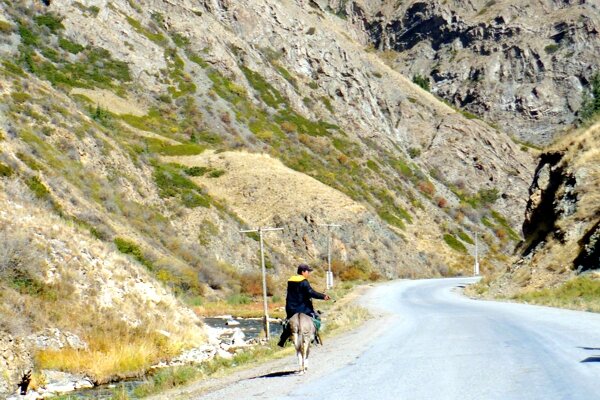
Transfer from Kochkor to Naryn … via Son Kul or Eki Naryn
Ece Naryn : Thirty kilometers to the East of Naryn is Ece-Naryn (“Two Naryns” – it is where two Naryn rivers meet). Here there is a pine covered valley and wildlife park. There is a National Park for the protection of wildlife – mountain goats, rams, deer, wild boar, bears and snow leopards, and two Botanical reserves. Archaeologists have unearthed remains of ancient settlements nearby. From Ece-Naryn (in a good vehicle) you can follow the valley of the Little Naryn River to Lake Issyk-Kul or back to Sary-Bulak and the main Bishkek Road. There is also a route which passes the hot springs of Jiilu Suu, along the Uchemchek river, (which is also known as the Ashuuluu Tyube river), and crosses the Tosor pass (3893m.).
Lake Son Kul, (the name means, The Last Lake), lies at 3016 meters above sea level in the Central Tien Shan mountains on a treeless plateau ringed by lush mountain meadows, (which make excellent summer pastures for the nomadic Kyrgyz and their livestock), and craggy mountain peaks. The beauty of the lake has enraptured both locals and tourists alike. There is a story that when one of the local Khans, Ormon Khan, saw it for the first time he imposed a fine of forty horses, (no small sum – then or now), on the local tribe because they had hidden such a miracle from him!
Picnic Lunch en route
Evening Meal and overnight at a guesthouse.
Day 3: Sunday
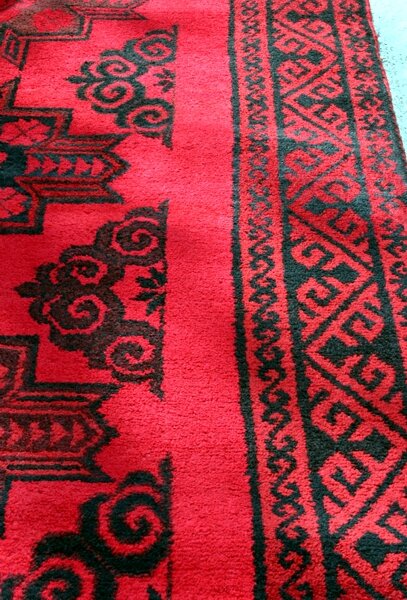
Return to Bishkek … over the Dolon Pass to Kochkor, where there will be a demonstration of the traditional craft of making felt carpets, (Ala Kiyiz and Shyrdaks) .
The Dolon Pass, at 3025 m, the highest point on the main Bishkek-Naryn Road. The caravans either side of the pass house workers who man the road maintenance depot here, and in winter they help dig cars out of the snow. A seemingly desolate mountain pass – and each summer yurts and tents of the shepherds can be seen here.
Felt is a traditional material used by Kyrgyz craftsmen and women over the centuries, There are many stories about its origins, for example, telling of travelers putting wool into their shoes and then, at the end of their journey, discovering that the woolen fibres had matted together into a single sheet fabric. In a time honoured process that has changed little over the centuries, (if at all), raw wall is washed and brushed clean and then laid out on a mat made from long straws of Chiy grass, which is then soaked and rolled up into a cylinder and tied to keep it firm. The whole family will gather and help as the roulette is then rolled, pressed, kicked and dragged behind a horse until the fibres are compressed and packed together into a single sheet. The wool can be dyed in different colours, and combined to make patterns as in the traditional Ala Kiyiz carpets. Sheets of coloured felt can also be cut into shapes which are then stitched together as in the traditional Shyrdak.





 Bishkek