Sanatoria
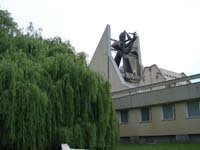
In Soviet times the shores of Lake Issyk Kul were home to over a hundred Sanatoria, most of them clustered around Cholpon Ata on the Northern Shore – although some returning Cosmonauts were brought to a sanatoria at Tamga on the Southern shore. Many were established by trade unions or some other organization, (for example the National Bank of Uzbekistan), and those that were established by organizations based in other republics of the USSR, (which are now separate countries), have provided the government with a few problems concerning ownership especially as The Land Code forbids forbids foreigners from owning land.
Following independence these sanatoria still operate and offer treatment – most of them all year round, not just during the summer season.
Sanatoria are not found just around Lake Issyk Kul, they were established in a number of areas to take advantage of the curative properties of mineral springs, the clear mountain air and even a salt mine.
Courses of treatment provided by in-house medical staff usually last for 20 days, although it is possible to just to stay overnight, however it can be difficult to find places in the height of the season.
Some of the facilities in some of the sanatoria might be fairly basic – but some of them have undergone or are undergoing renovations.
The company Prokurort run a number of sanatoria including:
Djalal-Abad: five kilometres from the town of Djalal Abad, 975 meters a.s.l. on the river Kogart. Summer temperatures can reach 35 to 40 degrees, and the mountain steppe climate is not very humid. The resort offers mineral waters and mud baths, massage and physical exercise.
Goluboy Issyk Kul: in Cholpon Ata . A variety of treatments include mud couches, and mineral water baths utilizing the salt water from the lake.
Issyk-Ata: Seventy seven kilometres from Bishkek, nestled at a height of 1775 meters a.s.l. in the Issyk Ata valley which cuts into the Kyrgyz Range which runs south of the city. The slopes of the mountains have numerous alpine meadows and in the vicinity of the resort are fruit and decorative trees. The waters have attracted visitors for many centuries and this used to be a place of pilgrimage and in the nineteenth century villagers expressed their gratitude for the healing properties of the water by smearing onto a large rock which has an inscription on the Buddha on it which dates from the tenth century. The Tibetan inscription is on the face of a boulder with an eagle sculpture on top. Unfortunately, contemporary, modern, graffiti now joins it. Nearby, it is said, was the home of an Uzbek shamaness, famous for her healing powers, who led a hermit’s life here until the 1950’s, after her husband and son were both killed as Basmachi rebels. Turkic nomads worshipped the springs and early Russian colonists used to take the cure here – when the only accommodation was local yurts. The Soviets built the first permanent building here as early as 1928. The upper reaches of the valley are covered in rich vegetation and are home to herds of horses.
Jety Oguz: In the Jety Oguz valley, thirty two kilometres from the town of Karakol, at a height of 2200 meters a.s.l. in a mountain gorge, surrounded by Tian Shan Fir trees on the mountain slopes, with the Jety Orguz river flowing through the grounds and facing the magnificent red sandstone “Seven Bulls” rock formation from which the canyon takes its name.
Kyrgyzstan: Twenty six kilometres from Bishkek, at 1450 meters a.s.l., and picturesque views over the Ala Archa river.
Dzergalan: Eight kilometres North of Karakol, at a height of 1624 meters a.s.l., on the left bank of the river of the same name, (which is the largest river flowing into Lake Issyk Kul).
The same company also run:
The Ala-Too rest house, situated in a 100 hectare cape on the Northern shore of Lake Issyk Kul.
The Cholpon Ata rest house, in Cholpon Ata which caters for families with children between 4 and 15.
The Osh rest house, situated in a park of the mountain river Ak-Bura.
The Arslan Bob Boarding House, sixty kilometers from Djalal-Abad, in the village of Arslan Bob, surrounded by a forest of shrubs, fruit and nut trees and caters for families.
Other Sanatoria include:
Tyoplie Klyuchi: at a height of 1800 meters a.s.l. in the Alamedin valley just thirty-five kilometers South of the capital Bishkek. There is a bathhouse with naturally, radon, heated water – and a complex of cottages further up the road, which was opened in 1984 by the then Ministry of Power. Beyond the complex the vista opens out into a beautiful alpine valley – ideal for a day trip out from the city – and there is a trekking route over the mountains. (Take the advice of the doctors and restrict swimming in the pool to no more than about 10 minutes.)
The Issyk Kul Sanatoria: otherwise known as the Avrora (built to simulate the ship from which the Russian Revolution was launched), in the village of Bulan Sogotuu, twenty kilometers East of Cholpon Ata. Once the haunt of Presidents and dignitaries (it is still a Presidential Residence) it retains some of its prestige as the premier resort of the lake.
Cholpon Ata – in the heart of the town – also serves as a presidential residence.
Kyrgyskoe Vzmoriye – “Kyrgyz Seaside” – in Bosteri on the Northern shore of Lake Issyk Kul, ten kilometers from Cholpon Ata – one of the largest sanatoria with a wide variety of facilities.
Chong Tuz: about twenty five kilometers to the West of Kochkor. Based around a salt mine established in Soviet times to extract the mineral. The mine still works and salt is produced not just for use in Kyrgyzstan – but is also exported. You won’t find it on your table, however, as the rock salt is usually given to farm animals as a food supplement. Also, during the Soviet period many people would come here for treatment for Asthma and allergies. Apparently, spending time in the atmosphere inside the salt mine is thought to be very beneficial. A course of treatment involves staying in the mine for 10 hours a day for 16 days. Now run as a family concern, there is also a treatment centre in Bishkek.





 Bishkek