Radonitsa
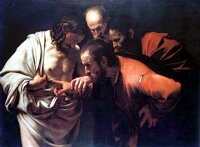
Carravaggio: The Incredulity of Saint Thomas
In the Orthodox Church, every day of the week is dedicated to the memory of certain events, holidays, and dedicated to one or more of the saints. According to Orthodox Tradition, this is St. Thomas’ Week.
The name refers to the incident in the John’s Gospel when, following his crucifixion and Resurrection, Jesus appears to his followers in a room behind locked doors – showed them the wounds in his hands and his side and discussed . One of their number, Thomas, was not present and when he heard the news he expressed his doubts, saying that he would believe only when he saw them for himself, put his fingers in the wounds nails in Jesus’ hands and his hand into the spear wound in his side. Eight days later Jesus makes a second appearance and Thomas is convinced, (although the implication is that he didn’t, the evangelist doesn’t tell us whether Thomas did actually touch the wounds as Caravaggio depicts in his The Incredulity of St. Thomas).
By tradition the Tuesday in St. Thomas’ Week is known as Roditelskoye Dehn – Parents’ Day, also known as Radonitsa, a Day of Rejoicing … and Commemoration of the Dead.
It is said that, etymologically, the word Radonitsa comes from the word Radost, (joy or happiness), rather than from the word Roditeliy, (relatives), and emphasizes that Christians are should not concentrate on thoughts and feelings arising from the death of their loved ones but, on the contrary, rejoice in their birth to another life, (eternal life), remembering the victory over death won by the resurrection.
Indeed, according to Orthodox tradition, there are other days known as Roditelskie dehn – each falling on a Saturday; this year on:
- March 9th – in Maslonitsa week – the week before Lent
- March 30th - the Saturday of the second week of Lent (the Great Fast)
- April 6th – the Saturday in the third week of Lent
- April 13th – the Saturday in the fourth week of Lent
- June 22nd – the Saturday before Pentecost – Trinity Sunday
- November 2nd – Demetrius Saturday
- Also, according to some lists, on October 12th – Pokrovsk Saturday – (Pokrovsk – the feast of the Festival of the Virgin Mary – which commemorates the appearance of the Virgin Mary in a church in Constantinople in 910AD – it is always celebrated on October 14th – October 1`st according to the Julian Calendar – … )
After a week of events and services to celebrate Easter, (known as Bright Week), when funerals, visits to the cemetery and special prayers for the deceased are not permitted – this is the first opportunity following the holiday. (Actually, the first opportunity falls on the Monday – and in parts of South Western Russia and the Ukraine, Radonitsa is indeed commemorated on the Monday – but as many Orthodox monasteries also Fast on Mondays as well as on Wednesdays and Fridays the feast is often celebrated on Tuesday)
Russians head off to the cemetery to remember their deceased relatives. Often, families have been to tidy the graves in the week before the holiday so all is already clean and tidy … and on this day they take food with them which they spread on decorated scarves and share with their dead relatives … and by tradition they also place a coloured egg on the graves as a symbol of the resurrection. Often others will be invited to share a snack and alms are given to the poor. There are no special prayers included in the liturgy for the day but priests will visit the cemetery and bless Orthodox graves and visitors.
The tradition is very old and St. John Chrysostom, (in the fourth century), tells us that it was celebrated in the Christian communities since before his time.
In pre-Revolutionary Russia, bars remained closed and alcoholic beverages were not sold so that the joy people felt would be because of the Resurrection, and not an artificial joy brought on by alcohol.
Traditions die hard – even after seventy years of communism … during the Soviet period, the official attitude towards religion meant that the day became a secular Memorial Day, (and probably being responsible for the association with roditeliy – parents), although over the last twenty years the traditions of Radonitsa have themselves been resurrected.
There’s another reason why Radonitsa is also a “happy day” – at least for some – in that it marks the beginning of the “wedding season”. If, during the Easter celebration, no funerals are allowed as one is supposed to be concentrating on the Resurrection, so weddings are not permitted during Lent. This is the first day after the great Fast and Easter celebrations when people can get married.





 Bishkek