A charm for pain and woe.
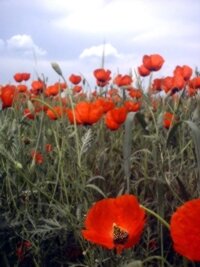
Poppies in a field
The other day I was talking to the owner of one of the local bookshops and in the course of the conversation I happened to mention that I was looking for a book on Kyrgyz legends. He called me the next day and said that he had checked and that they had one in stock. I happened to be busy so it was a couple of days before I managed to get to the shop. Unfortunately, I was told that it had already been sold and they weren’t sure when they would get another copy.
I was about to turn around and walk away when I another book caught my eye and I decided to pick up a copy: Rasteniya Kyrgyzstana – Plants of Kyrgyzstan.
It’s a small book – pocket sized – printed on glossy paper with a description, (in Russian), and two colour photographs on 100 different plants, divided into categories according to the altitude zones in which they are found. I felt, however, that the title is a little misleading as it seems to be entirely about flowering plants – no trees or fungi, no herbs or grasses and no agricultural crops.
However. I don’t think that should detract from its usefulness as an identification guide for “plant spotters” – at least for those who know Russian. The teacher in me said that it would also be a useful, (if expensive), addition to a school library.
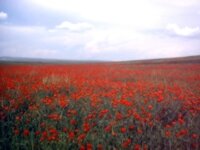
A red blanket of poppies
As I was flicking through the entries, I was reminded of my trip up to Naryn at the end of May 1998, when we going to open the Celestial Mountains Guesthouse, (which opened its doors on 1st June).
As we left Bishkek and drove along the Chui valley towards Issyk Kul, we saw a lot of flowers growing in the verges and fields on either side of the road. At one point, on the hillside opposite, the slope was covered red with poppies … as one of the others in the vehicle commented, it looked “as if the hills were bleeding”.
Poppies grow wild here in Kyrgyzstan and views of the wild poppy fields are common subject for photographs.
Poppies are a flowering plant that belong to the family Papaveriacae with bright attractive and strikingly colourful flowers which, (despite the usual association with the colour red), be be of almost any colour and may carry other markings.
They are grown for ornamental reasons, but some varieties are also edible and grown for food, whilst others are grown as a source of opium, (which can be used as a powerful medicinal analgesic … but also used as a narcotic in recreational drugs).
For the record: Opium is derived from the unripe seed capsules of the opium poppy. Many painkillers are derived from opium, including morphine and codeine.
The illegal narcotic heroin is a derivative of morphine.
They can grow tall, as much as 4 feet tall – well over a meter. The flowers can have 4, 5 or six petals and attract bees for pollination. After the flower sheds its petals a seed pod forms.
Poppies also have a considerable history as a symbol of sleep, peace … and death.
Whereas the Red Carnation is a symbol of remembrance for the fallen in war, back in Europe, it is the poppy – spoecifically the red flowers of the Corn Poppy – the “trench war” battlefields of the First World War took place in the poppy fields of Northern France.
The book contains four examples of Papaveriacae that grow here:
- Glaucium elegans Fisch. et C.A.Mey – found at lower altitudes (between 900m and 1200m) with relatively dry climates, where the summers temperatures may be high (on average about 28ºC) and not severe in winter, (averaging about -6ºC). They can grow to about 30cm tall bearing flowers with multicoloured petals, (Black in the center, red and yellow at the edge), about 5cm across. Although they are found throughout Central Asia, China and Iran, here in Kyrgyzstan they grow in the Central Tien Shan, on the Northern Slopes of the Kyrgyz Krebet and in the Ferghana Valley.
- Glaucium squamigerum Kar. et Kir - found at medium altitudes (between 1200m and 2200m) with climates where the summers temperatures may be high (on average about 28ºC) and not severe in winter, (averaging about -8ºC). It prefers stony ground and can grow to height of anywhere between 10 and 40 cm, bearing a yellow flower, (about 4cm in diameter), with all yellow stamen. They are found throughout Central Asia, (including all regions of Kyrgyzstan), and in China.
- Papaver tianshanicum M. Pop - found at higher altitudes, (from about 2000m to 3500m) with relatively dry climates, where the summers temperatures may be cool, (on average about 11-18ºC) and cold in winter, (averaging about -10ºC). It can grow to a height of about 15cm and bears a bright yellow flower. It can be encountered throughout Central Asia and, in Kyrgyzstan, in the Central Tien Shan.
- Roemeria refracta DC – found at lower altitudes (between 900m and 1200m) with relatively dry climates, where the summers temperatures may be warm (on average about 18ºC) and not severe in winter, (averaging about -6ºC). They grow to about 40cm tall bearing bright red flowers measuring about 5cm across, with a number of black stamen topped by yellow tips rising in the center. The grow throughout Central Asia, the Caucasus, Iran and China and in Kyrgyzstan can be found in the Chui Valley, (along the Kyrgyz Krebet and in the basins of both the Chon and Kichi Kemin rivers), as well as the Chatkal, Talas and Ferghana valleys.
In the 1930s there was legal opium production in both Kazakhstan, (to the Southeast of Lake Balkhash) and Kyrgyzstan, (in the Tien Shan and Alatau mountain ranges), and, apparently, Kyrgyzstan was once one of the world’s largest suppliers of the opium poppy – legally. According to one source, from the 1940s to the mid-1970s, it supplied up to 16 percent of the global market. The Soviets, however, banned poppy cultivation in 1973, voluntarily destroying the poppy fields and stopped the production of raw opium.
Some illicit cultivation, however, continued but on a small scale. Most was grown in “house gardens” in isolated regions, (in the Aksu, Djety Oguz and Issyk Ata districts).
In recent years there have been a number of reports of the discovery of illegal poppy plantations. In 2009, for example, a plantation of something like 2300 plants was discovered (and destroyed) in a village on the outskirts of Bishkek. Apparently it was the first such discovery for some ten years – although there have been cases involving the cultivation of cannabis. Later the same year, another was discovered in the Issyk Kul region.
It has been suggested, however, that the wild poppies “blooming along dilapidated Kyrgyz roads” hint at a resource that could help drag the country out of poverty.
Shortly after Independence, the government rejected proposals to legalize the cultivation of opium poppy seeds for the production of painkillers. The plan called for a trial planting on about 500 acres, but President Akaev vetoed the proposal on the grounds that growing the seeds would “do more harm than good”.
Then, in the 2010 Presidential election, one of the candidates proposed the legalization of opium cultivation for the pharmaceutical and cosmetics industries. Although he was unsuccessful in his bid for office, the proposal received a lot of debate.
_________________________
I sing the Poppy! The frail snowy weed!
The flower of Mercy! that within its heart
Doth keep a drop serene for human need,
A drowsy balm for every bitter smart.
For happy hours the Rose will idly blow–
The Poppy hath a charm for pain and woe.
.(Mary A. Barr)




 Bishkek