Yudakhin
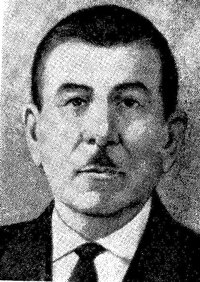 Like most nationalities and languages, the Kyrgyz also have a wide range of proverbs and sayings, and a collection of 1000 such phrases was published in 1999 by the Slavonic University in Bishkek, based on the collection made by the academician K. K. Yudakhin, (1890-1975), in over 40 years of research.
Konstantin Kuzmich was born into a small farming family on 15th May, 1890, in St Petersburg … although I have seen reports saying 31st March in Omsk, Russia.
However, “although he was born a Russian,” according to one of the characters in the short story Explaining Manas, by Musa Murataliev “he was really a Kyrgyz at heart”.
His family moved to Aulie Ata (later Dzambul – now Taraz), in what is now Southern Kazakhstan. There, his father soon found work in charge of the local mail post.
Amongst his earliest memories was being read the works of Pushkin by his parents. One particular passage, describing the “mail clerk”, (and, in particular, the effect it had on his father), was instrumental in shaping the young boy’s interest in languages.
By the age of six, he had already read the whole of Pushkin’s works and knew all the fairy tales by heart. By the age of 10 he had mastered several languages – including Russian, Kazakh, Kyrgyz and Uzbek. As he grew up, he helped his father with his work, meeting visitors, taking care of guests and writing reports.
According to one account, he graduated from the Faculty of History and Philology and the Oriental Studies at the University in St. Petersburg, (specializing in classical philology and Georgian and Armenian) … but according to another, after finishing school he graduated from the local institute and became a teacher in a remote village. Here he took a great interest in the local dialects and this soon became an overriding passion.
He was studying Uighur in Eastern Turkestan at the outbreak of the First World War, and in 1921 he entered the Oriental Institute of Turkestan, with his researches arousing a lot of interest amongst professions from far afield, which led to invitations to St. Petersburg and then Moscow.
In 1927 he published the first modern Russian-Uzbek dictionary, which carried notes on folklore, historical and cultural topics. In Moscow, in 1940, he published the first Kyrgyz-Russian dictionary – and like the precious publication this had a wealth of additional information about dialects, proverbs, expressions as well as about Kyrgyz history and traditions. He has also compiled a bilingual dictionary for the Uighur language.
From 1928 to 1936, he was engaged in the development of new international alphabets for the peoples of the USSR and was the author of many works on linguistics.
Moving, during the Second World War, to Kyrgyzstan, he continued his studies – and translated works by Shakespeare and Pushkin into Kyrgyz, as well as translating the Manas Epic into Russian. As late as 1967, another dictionary was published – but he wasn’t satisfied with it because it contained only 40,000 words – he wanted to include another 25,000.
He was also, a collector of photographs and some of his collection some of which are preserved in the Peter the Great Museum of Anthropology and Ethnography of the Russian Academy of Sciences.
His work was recognized in many ways, being elected as a member of both the Uzbek and Kyrgyz SSRs, and receiving several awards including the Order of Lenin, two other orders, and various medals.
He died, aged 85, on 22nd March, 1975.
The book quotes the proverbs in Kyrgyz then gives a translation – or equivalent proverb – in Russian. Some of the sayings may be universally recognizable, such as “You reap what you sow”, but for some more unusual examples of Kyrgyz wit and wisdom, consider the following proverbs and sayings:
- A bird trusts itself, a dog trusts its master
- A clever man is able to teach you civility
- A friend looks at your eyes, an enemy looks at your feet
- A good man never spares his efforts to help, a bad one never even gives his hand if you fall down
- A good wife is half of happiness in your life
- A horse is a man’s wings
- A man grows old, but his courage doesn’t
- A wise man isn’t the one who has lived the longest, but the one who has travelled the most
- Cheap mutton has no fat
- Don’t let your horse run beside a pacer
- Govern your horse carefully or you will become a pedestrian
- If your right hand is angry, hold it back with your left
- It is better to die like a hero than live like a coward
- Knowledge builds up, ignorance destroys
- The earth is a small place for fugitives
- If you fall off a horse, it will bend its mane to help you, if you fall off a donkey it will kick you with its hooves
- Those who do not know the past will not see the future





 Bishkek