The Good Book – in Kyrgyz
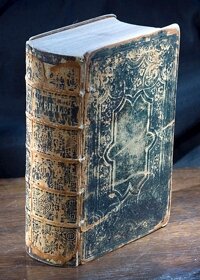
Family Bible - Photo: David Ball: www.davidball.net
Language is not static but changes with usage over the period of time with new words being coined, whilst other are “borrowed” from foreign languages. Some words are replaced or simply dropped from common usage and others are transformed and given new meanings. Thanks particularly to the internet, we are going through a period of rapid change at the moment.
It was on May 2nd, 1611, a new book was published in Britain that was in many ways to shape the English Language as we know it today – the King James version of the Bible – sometimes known as the Authorized Version – although there are no records of it ever having been “authorized” by any particular body – but that could be because the appropriate records were lost in a fire some seven or eight years later.
It’s known as the King James Version because it was commissioned by King James I of England, (and VI of Scotland), who came to the throne in 1603. In January the following year he convened a conference where the need for a new, authoritative English version of the Bible was raised as there were perceived “problems” with the existing ones: Tyndale’s Bible, the Great Bible of Henry VIII. The Geneva Bible written by Protestant scholars who had fled to that Swiss city to escape the reintroduction of Roman Catholicism when Mary I came to the throne and the Douay-Rheims version of the New Testament.
(In fact, it wasn’t an entirely new idea … but had been raise at the General Assembly of the Church of Scotland in Fife as early as 1601.)
The scholars started work, dividing the book into a number of sections and themselves into six committees – each one tackling a different section … and by the end of 1608 they had all completed their work. In January 1609, the process of reviewing the resulting texts began and it was some time before it was sent for printing.
In theory it was to be printed by the King’s Printer – but the logistics and financing of such an undertaking were such that he subcontracted part of the work to two other printers … which led to a number of interesting differences between different parts of the work. This was before there was any “standardized” system of spelling and printers also felt at liberty to make certain amendments as part of the typesetting so there was no uniform style or spelling – something which would not be tolerated today.
It was actually quite a controversial text – the leading Hebrew scholar of the day – who had not, for some reason – been included in the translation was scathing about the translation, and it took many years for it to be universally adopted throughout the English speaking world.
I can understand that. The other day, for example, I was going through one of my cupboards and I came across a book I thought I had lost – possibly, I thought, having lent it to someone who had not returned it. It’s not a small book and I am a bit surprised that I hadn’t come across it before and as it was a Prize that I had been awarded in my final year at school I was particularly pleased to have found it again. It was my copy of the New English Bible … published in 1971. Another authoritative scholarly translation, supposedly bringing the “good buck” into a format that would be more meaningful in the modern, twentieth century world.
Some of its passages always struck me as clumsy but that is probably because, up until that point, we had almost all used the King James Version which, as I said, had helped to shape the English language that we now use. Many familiar words and phrases were missing or paraphrased in an unfamiliar fashion that felt awkward.
Although this specific copy has a particular “sentimental” value – being part of my youth, I can’t say that I am that enamoured with the translation. In many ways I preferred comfort of familiarity that the King James version gives. Indeed, the King James Version has much that can be considered poetic, and it has given us many phrases and idioms that have passed into everyday parlance, however, I have to admit that other parts can also seem archaic and difficult to understand … and I wouldn’t go as far as to agree with the old dyed-in-the-wool evangelist who is supposed to have said “If the King James Version was good enough for Saint Paul … then it’s good enough for me!”
In many respects I preferred the Revised Standard Version … or the completely different style of the “Living Bible” which seemed to be the result of a completely reworking of the text rather than simply “tinkering” with it
When I saw that the anniversary of the King James’ Version was today, I began thinking about the Kyrgyz Bible. I know it exists – I have seen copies … but I began to wonder about it.
Although Kyrgyzstan is a secular country, the majority of Kyrgyz consider themselves to be Muslims, (with some still claiming to be Tengrists). Most of the Christian community are Russian Orthodox – and clearly Bibles in Russian are available. Although the Orthodox Church doesn’t seem to be particularly militant when it comes to evangelizing amongst the Kyrgyz, (preferring to minister to the faithful and work within their own “Slavic” community), I have seen some Kyrgyz amongst the congregation when I have visited the Orthodox Cathedral here in Bishkek.
The Protestant churches, however, do try to reach out to the Kyrgyz population, and they, it would seem, need materials in Kyrgyz. As it happens, some of them work in Russian and others in different languages. One congregation, for example, has a Korean pastor who works in Korean – with simultaneous translation being provided by a member of the church. Others work in English, especially those attended by members of the ex-pat community … when I first came here, it was common for young students to attend, in order to get practice in speaking English. The Catholic Church holds services in both Russian and English.
Several of the evangelical communities worldwide have websites encouraging people to “pray for our Kyrgyz brethren”, and some mention the need for literature such as Bibles and Testaments in Kyrgyz.
The community that seems to do the most when it comes to producing materials in Kyrgyz are the Jehovah’s Witnesses who produce their magazines in both Russian and Kyrgyz. I have not seen a Kyrgyz version of the New World Translation of the Bible, but I am told that there is one.
As it happens, it seems that there are three main translations of the Bible in Kyrgyz … one is complete and the others are “works in progress”.
In addition, it was reported back in the 1990′s that a poet called Ernest Turunov has apparently translated the Koran and the New Testament into Kyrgyz. It seems that his translation of the Koran caused controversy because he didn’t know Arabic and worked from a Russian version which led to criticism that he had distorted the sacred text with poor grammar and syntax, (which sounds familiar), and, (more seriously) by giving an “excessively free interpretation” of it. He started work on his New Testament before learning that the Institute for Bible Translation, (based in Stokholm), already had a project underway – which is now complete. To make matters worse, when he started work on his New Testament, he is reported to have said, contrasting it with the Koran, that it was like the difference between “darkness and light” which infuriated local Muslims who issued threats against his life … but apparently they haven’t been carried out.
The first of the complete translations, published in 2004, was based on a one hundred year old Russian version of the Bible, (called the Synodal translation – work began on the translation in 1813 but the complete translation was published only in 1876). This version is criticized as being poor in terms of its grammar and style – but despite that it is the one that is most commonly used. The criticism seems to stem from scholars, linguists and literary critics, rather than the believers themselves – who, are accustomed to simply using the literature, (like “the bumble bee, that is unconcerned about the laws of physics and aerodynamics that dictate it should never get off the ground … and just goes ahead and flies”). This version is available on the internet here and here, although only in discrete parts that have to be displayed on the screen rather than as a complete file that can be downloaded. The Pacific Coast Slavic Baptist Association have both the Old and New Testaments as pdf files on their website which can be downloaded.
The incomplete translations include a version of the New Testament, published in 2005, which can be found here - with each chapter being selected and then displayed on screen separately. (Although the drop down list at the top of the page suggests that the old testament is available, all I seemed to be able to get was text from the New Testament.)
There is also incomplete translation which is a “paraphrase” version produced by an individual which – like the Living Bible that I mentioned above – is intended for evangelical use and is more dynamic. This last version is supposed to be over half completed and excerpts of what has been completed are also available on the internet, again as discrete “books” … but in this case that is probably understandable as there are still several sections to be completed.
The idea that it is possible to have different versions of the Bible, each intended for a different purpose – for example, liturgical, research and evangelical – may seem strange to some people, especially those of a more fundamentalist tendency. However, it seems to me logical – but that’s probably my situationalist, existentialist background coming to the fore.






 Bishkek