Customs and Duty Free
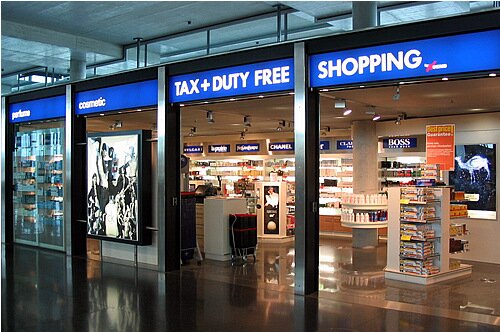
The Duty Free Shop in Zurich
Late last week there were a couple of interesting stories connected with the development of Manas Airport here in Bishkek. One of them reported that the Airport operating company planned to open a Duty Free Zone, “at the European level”.
As it happens,. there is already a Duty Free Shop in the International Departures lounge at the airport but, to be honest, I am not sure what is meant by the phrase “at the European level”.
However, the airport has set itself the ambitious target of becoming the “Best Duty Free in the CIS” by the beginning of 2014 … so they are going to have to get a move on as there is only just over half a year left. It’s estimated that it will require about five million dollars of investment to fulfill this aim … no small sum!
In fact, the airport are looking to Turkey to help them achieve their goal both at Manas and at the international airport in Osh. The Turks apparently are involved in the operation of Duty Free Zones in a number of airports around the world – including the Ata Turk airport, Istanbul’s main airport.
For the record: Duty-free shops are retail outlets that are exempt from the payment of certain local or national taxes and duties, as the goods they sell are bought by travelers who will take them out of the country.
The world’s first Duty Free shop was established at Shannon Airport in Ireland in order to provide a service for Trans-Atlantic airline passengers travelling between Europe and North America, whose flights stopped at the airport for refuelling. It was an immediate success and has been copied worldwide.
There are local variations governed by local legislation and regulations which govern which products can be sold as “duty-free”; how they can be sold, (for example at the airport, seaport, at the border between two adjoining immigration and customs posts, on board ship or plane, or possibly in specially designated stores in country – with special documentation); and the process of calculating the duty or refund the duty component of the prices.
Indeed, the fact that the goods on sale are exempt from excise duty or other taxes does not mean that they represent “bargains” as the price charged will be influenced by a number of other factors, in particular the competition.
Also, not all purchases from a Duty Free facility will actually be exempt of all taxes, as one of those regulations will establish the level of “duty free allowances” which someone is allowed to bring into the country, (for example a liter of spirits), and anything over this limit will still attract the same duties and taxes as on the other side of the border.
Some countries also have “inwards duty free facilities”, where arriving passengers can purchase duty free items immediately before going through customs. This not only saves the inconvenience of having to carry these items around the world but also solves some of the security problems associated with such establishments.
Talking about “the European Level”, I suppose that we should note that Duty Free Shops were actually abolished in Europe in 1999 for those travel within the EU, (the European Union), although they were retained for travelers whose final destination is outside the EU.
As one of the factors affecting prices – and hence sales, which means the profitability of the Duty Free Shop, is the range of goods on sale, and the number of different competing outlets. Most international airports are much bigger than Manas and so can “carry” more shops … thus increasing the attractiveness of the Duty Free Shopping experience. Perhaps this is what is what is meant by the phrase at “the European level”. However, to have a greater number of outlets and increase the range of goods on sale, there will need to be a greater throughout of passengers to make these shops viable.
If, however, the planned conversion of Manas into an international hub, and an “Open Skies” policy is adopted, then it is possible that we will see a greater number of flights, more passengers and more sales … making the provision of Duty Free Shopping facilities an interesting investment opportunity.
For the record: The duty free concessions (allowances) which are designed to apply for goods brought into the country for either personal use or for use by members of the traveller’s family. As such the list of goods includes things like TVs, fridges, carpets, crystal wear etc. If the customs official thinks that the goods are intended for sale, they can impose duties.
The following goods may be imported into Kyrgyzstan without incurring customs duty:-
- 200 cigarettes – if you are over 16, (incidentally, there is no mention in the current list of cigars or other tobacco products!);
- 2 liters of alcoholic beverages – if you are over 21;
- Gifts and goods for personal use up to an equivalent value of US$500 and up to a weight limit of 50 kg.
The rules used to specify a limited amount of perfume – but this is not in the current list.
There are limits on the amount of jewellery.
The full list also mentions clothes made of leather and fur.
Prohibited imports listed in the rules include:
- weapons, ammunition and explosives,
- narcotics and drug paraphernalia,
- pornography or other published material deemed harmful to state interests and
- any item prohibited elsewhere in Kyrgyz legislation
Prohibited exports include: The same as prohibited imports, plus
- Military uniforms,
- Annulled securities, state loan certificates, lottery tickets, etc.
- works of art and antiques (unless permission has been granted by the Ministry of Culture – see Registering Souvenirs below),
- Animal skins and trophies such as saiga horns, Siberian stag and red deer antlers (unless on organised hunting trip – in which case permission can be granted).


 Bishkek