War Memorials
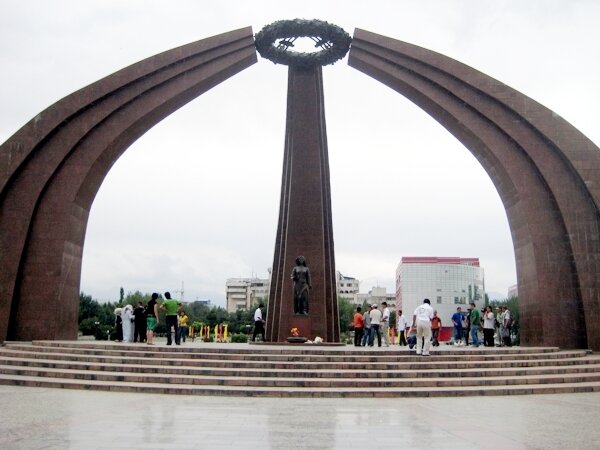
Victory Monument - Bishkek
In the center of Bishkek there is a large square dedicated to the victory over Fascism in the Great Patriotic War, (the Second World War). The Square was constructed in 1984 in order to mark the 40th anniversary, (the following year), of the end of the war which devastated the Soviet Union.
In the center of the large open space, is a large marble triumphal arch, (a symbol of victory), fashioned in a representation of a yurt formed by three arched pillars supporting aloft a tuunduk, (the circular frame which forms the apex of a yurt forming a ventilation hole in the rook of a yurt and symbolizes the Kyrgyz, and was chosen as the central image for the country’s flag), fashioned in the form of a funeral wreath.
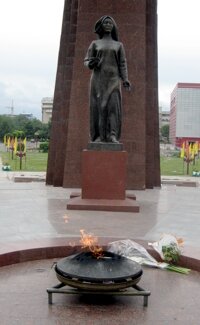
Kyrgyz motherhood standing over the eternal flame
Underneath cast, in bronze cast by the monumental sculptor Sadykov, is a statue of a woman, (a mother), standing over the eternal flame, waiting for her son who will never return home from the war.
At the Northern end of the square, the approaching pathway is flanked by two sets of figures: to the left is a composition by the sculptor Anikushin depicting two soldiers, (one carrying a machine gun and the other a stand for the weapon and a box of ammunition), and the other by Sadykov featuring two soldiers and two children representing hope for the future.
The dates, 1941-1945, represent the entry of the conflict are inscribed on slabs at this “gateway” to the park. (June 1941 saw the launch of Operation Barbarosa – the German invasion of the Soviet Union, and 1945 the fall of Berlin and surrender of the Germans to the Allied forces.)
It is one of the sites frequently visited by newlyweds as part of their progulka, (promenade), where they lay flowers in memory of and in respect for those who fell during the conflict.
The monument stands on the site of the former Town Market, which was demolished and moved to the other side of the city, (to the present Osh Bazaar), in order to make way for the construction of the square. Earlier, it had been the site of the town’s Central Mosque and there have been calls for the land to be returned to the faithful, but another site has been designated for a replacement to be built.
Although this is the main war memorial for both the city and the country, there are others. In Bishkek, for example, there are statues of Panfilov, to the soldiers of Komsomol at the junction of Prospect Chui and Molodaya Gvardia, (The avenue of the Young Gaurds), and the neighbouring avenue of Heroes.
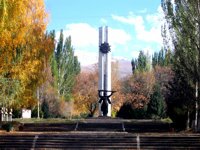
The War Memorial in Karakol
As in many countries, memorials were commissioned in many towns and villages throughout the country, some elaborate, such as:
- the one in Karakol consists of two white columns with red stars above them and a sculpture of “Mother Russia”, and bears 1300 names. (In the park in Karakol, there is also an alley of busts of “Heroes of the Soviet Union”, similar to the one in Bishkek.) … and
- the one in Kochkor, which takes the form of a small square with a statue of a soldier and youth flanked by frescoes depicting soldiers, and others are more plain.
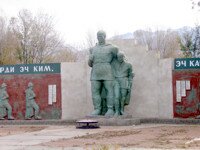
Kochkor War Memorial
The memorial in the village of Chelpek, to the south of Karakol, for example is simply an aluminium plaque depicting a soldier with a rifle and some 350 names. Not all the memorials contain lists of the fallen, however, and the one in Ak Suu, (sometimes called Teplokluchenka), near Karakol, (depicting a soldier with a red flag standing in front of columns, made out of red stone), bears no names, only the dates 1941-1945.
Inscriptions on many memorials are obviously intended to be inspiring. The ones in Cholpon Ata and Osh both read: “No-one is forgotten – Nothing is forgotten”.
_________________________
There are memorials erected to the fallen in other conflicts as well, most notably to those of the Civil War, the war in Afghanistan and the Batken incursions, (and also here).
In Bishkek, the Red Guards Memorial to those who lost their lives in the Civil War is in Oak Park. A red granite obelisk stands over the common grave of the Bolshevik casualties of the 1918 Belovodsk uprising.
On December 6th, 1918, in the small village of Belovodsk about 30 kilometres West of Bishkek, a counter-revolution broke out with the capture of the post office and large tracts of the surrounding countryside were quickly captured. The Bolshevik hold on the region was under serious threat. The rebels marched on Bishkek and an eight day battle ensued. Reinforcements arrived from Almaty under the command of Yakov Nikiforovich Logvinenko and the counter-revolution was defeated. The burial took place on New Years Day, 1919, – the first anniversary of the Bolsheviks seizing power in Bishkek. When he died in 1933, Logvinenko was also buried here. The canons once stood in one of the Mansions in the centre of Bishkek, but after the revolution they were taken to a museum in St. Petersburg – to be returned when the monument was constructed in 1960, replacing an earlier simple wooden marker, and an “eternal” flame lit, (the gas was turned off in 1994 but it is sometimes relit, for example on the Victory Day holiday – May 9th). The text translates as “Eternal glory to the fallen who fought for the power of the soviets.” This is another site visited by newlyweds.
There is also the memorial to the Martyrs of the Revolution – in Revolution Square at the intersection of Prospect Chui-Sovietskaya. The main figure is Urkuya Salieva (1910-1934), and early socialist organizer in Southern Kyrgyzstan – apparently murdered by “rich peasants”. Around her are the “awakening” proletariat. The monument was erected in 1978 by Sadykov … and was awarded the All Union Lenin Prize.
The memorial to those who fell in Afghanistan is in Ataturk Park. Beneath the two soldiers the inscription reads “People, Don’t forget the lessons of the past”.

The Batken Memorial in Bishkek
That dedicated to the The Heroes of Batken is on Kievskaya on the corner with Logvinenko, outside the Ministry of Defence building. This memorial depicting three Kyrgyz soldiers – in traditional rather than modern dress.
The city of Balykchy, at the Western end of Lake Issyjk Kul, also has a collection of memorials:
- On the right hand side of the main road to Cholpon Ata is a memorial to the dead of the Second World War erected in 1975– comprising of two figures on a small plinth – a woman holding to herself a small boy.
- On the street “40 years of the Kyrgyz SSR” is another war memorial, this time to the fallen in the Afghan war. This takes the form of a T-54 tank on a ramp made out of red granite – and there is a small wall containing the names of the fallen soldiers. It is the only monument to the fallen in this war to be found in the Issyk Kul oblast.
- On the left hand side of the road to Cholpon Ata lies a third memorial – the fallen in the Batken conflict with Islamic militants of 1998 – comprising an “eternal flame” and soldiers helmet and with a tablet containing the names of the fallen soldiers. Once again, it is the only memorial to the fallen in this conflict in the Issyk Kul oblast.
_________________________
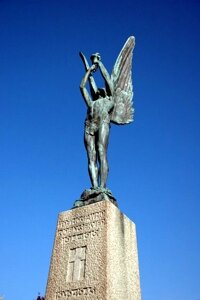
Malvern - The war memorial
As an aside:
As it happens, one of the strongest memories of my hometown, Malvern, is of the War Memorial in the grounds of the town Library: The bronze statue depicting the image of a winged angel holding aloft a lighted torch, standing on a concrete plinth bearing a simple inscription.
I am not sure why the image remains so strong in my mind … whether it was the green stains on the weathered metal, the striking image of the angel or the names of the fallen inscribed … I remember searching them for the names of relatives …





 Bishkek