The Som
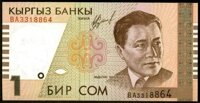
The Kyrgyz national currency, the Som was introduced on May 10th, 1993.
The word “som” in Russian is the name of a fish – a catfish – but in Turkic languages such as Kyrgyz, it comes from the word meaning “pure” and was used to refer to coins made from “pure” gold from before the Russian expansion into the region, (as was the sum – the name given to its currency by Uzbekistan).
The Soviet rouble banknotes used to have their nominal values printed on them in 16 languages – including the Kyrgyz – “som”.
Because it was unexpected, the introduction of the new currency plunged Kyrgyzstan into a crisis with its neighbours, (especially Kazakhstan and Uzbekistan), which at that time were still in the “ruble zone”. Shortly after, however, the other countries of Central Asia also introduced their own currencies.
In May 1995 the som became fully convertible and can be freely exchanged for the currency of other countries. The National Bank of Kyrgyzstan sets exchange rates against major currencies every day. When it was introduced, the exchange rate was set at 4 som to the US dollar. At the end of 1999 it was almost 46 to the US dollar and in 2001 about 48 to the US dollar.
Originally all the som notes were the same size (about 13.5cm x 6.5 cm), and had the same design. On the front was a picture of the statue of Manas on his horse outside the Philharmonia in Bishkek, and on the back was a picture of the Manas Mausoleum in Talas. The colour and the numbers differentiated them. At first there were three notes, 1, 5 and 20 som.
Because the 1 som and the 20 som notes were similar in colour, there was sometimes confusion, and so a new, smaller, 1 som note was introduced. Newly designed notes are sometimes introduced incorporating security features to prevent forgeries. It is still possible to find several different versions of some of the different notes in circulation.
On one side of the notes is a portrait of a famous Kyrgyz person, and on the other some images relating to the person – a place. There are also traditional Kyrgyz patterns built into the design. There are nine denominations of som banknotes: 1 – brown; 5 – blue; 10 – green; 20 – brown and yellow; 50 – pink; 100 – brown/green/black, (there is now a new version coloured blue) and the larger notes introduced in 2000 : 200 – ochre, 500 – pink, 1000 – grey and then, in 2009, the 5000 som note – green.
Each issue of a new bank note incorporates new security measures in order to prevent forgery. For example, in addition to the traditional use of special paper, the size and colour of the banknote, and the serial number, the newer banknotes include features such as :watermarks, security threads, embossed characters and images, holographic images and the use of special metallic and iridescent inks .
.
Originally there were no coins in circulation. However, a number of special commemorative coins made from gold and silver have issued from time to time as collectables, (they have the status of legal tender – but are worth considerably more than their face value). For example, to commemorate:
- the millennium of the national epic “Manas”
- the 3rd millennium of the city of Osh
- the 10th anniversary of the independence of the Kyrgyz Republic – 2001
- International Year of Mountains
- the 10 years of the national currency
- the “Genesis of Kyrgyz statehood”
- the 60th anniversary of victory in the Great Patriotic War
- “Kyrgyzstan on the Great Silk Road”
- the Shanghai Cooperation Organization
Coins with face values of 1, 3 and 5 som were introduced into circulation in 2008.
.
The som is divided into 100 tyiyn. You can think of tyiyn as “small change” – actually, the Kyrgyz used to call any small change (even that of other countries) tyiyn and the name is used in Kazakhstan, and Uzbekistan as well. Originally, there were three denominations of banknotes … 50 tyiyn – blue; 10 tyiyn – green and 1 tyiyn – pink, but these were replaced by coins in 2008.
The tyiyn banknotes were smaller (about 9cm x 7.5cm) and like the original som banknotes share the same design, being differentiated by colour and numbers denoting their value. On one side of the note is an eagle in flight and on the other is the image taken from the flag (of a tunduk within a sunburst of 40 flames) within a traditional Kyrgyz pattern representing rams horns and flowers.
Coins with face values of 10 and 50 tiyin were introduced into circulation in 2008. Special coins made of brass with a face value of 1 tiyin were also introduced at the same time as collectible items.



 Bishkek