The most boring day in history ?
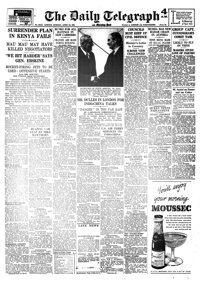 I would like to be able to say, as Maurice Chevalier sings to Hermione Gingold in the old song has from Gigi … “Ah, yes, I remember it well.” Unfortunately, I was only just over a year old and, good though my memory is … I have no recollections at all of that momentous Sunday: 11th April, 1954.
Did I say it was a “momentous” day? Well, according to some scholars running a computer analytical program called “True Knowledge” – which sounds a bit like HAL in 2001 or Skynet in the Terminator movies – it was very special in that virtually nothing of any real importance happened on that day.
There was a General election in Belgium, (for the record, it was the country’s fourth post war election – the “Catholics” apparently lost), a Turkish academic was born and a footballer who played for Oldham Athlectic and Notts County died … but, according to the software engineer who designed True Knowledge , that was about it … no key news events, births of deaths of famous people:
Nobody significant died that day, no major events apparently occurred and, although a typical day in the 20th century has many notable people being born, for some reason that day had only one who might make that claim – Abdullah Atalar, a Turkish academic.
The irony is, though, that – having done the calculation – the day is interesting for being exceptionally boring. Unless, that is, you are Abdullah Atalar.
True knowledge had been fed over 300 million facts about people, places, business and events since 1900 and then analysed them looking for connections and assigning scores … and the day which returned the lowest score was … Sunday, 1tth April, 1954 … making it, as a host of newspaper stories informed us, ”the most boring day in history” – at least since 19oo.
That provides us with an interesting paradox … a bit like a “Catch 22″ … because it is “the most boring day in history”, which is an interesting fact in itself … this, surely, robs it of it’s title and claim to fame.
If I had been a littl bit older and able to make sense of the newspapers the following day … then I probably wouldn’t have realized what notoriety the day was going to have thrust upon it at some point in the future … their editors had space to fill … and fill it they did. There might have been a little hint in that, in a way, it was a bit like the “silly season” which strikes newspapers during the month of August each year and so lightweight, or “silly” stories emerge on to the front pages that wouldn’t have seen the light of day on almost any other day of the year.
The front cover of the New York Post, for example, featured a photograph of two police officers attending a conference on Juvenile Deliquency; Britain’s Daily mail features a story about the queen standing at a Garden Party in Ceylon, (nowadays, known as Sri Lanka), whilst the guests sat – and how a man had been refused entry to a laundry, where he wanted to do his weekly washing, because it was a “Women Only” establishment.
It’s wasn’t like Friday 18th April, 1930, (which happened that year to be Good Friday), when the presenter on the BBC’s radio news bulletin at 6:30pm announced to the world, “Good evening. Today is Good Friday. There is no news.“, after which some piano music was played until the scheduled end of the bulletin when programming returned to the normal schedule.
You can’t imagine that sort of thing happening today … although someone posted to this video to youtube …
When I first saw this, I thought it was a “skit” put together for a comedy programme … or a charity event like Red Nose Day, but apparently it is a montage created by editing together lots of individual moments when reporters are waiting for the continuity signal.
On the other hand, the interruption and suspension of normal broadcasting schedules, transmitting music rather than the scheduled programmes is not all that uncommon. Apparently, that sort of thing was quite common in the former Soviet Union … although it was usually a performance of Swan Lake rather than piano music. It was taken as a sign that something important was “going down” and an announcement was imminent – for example, about the death of Leonid Brezhnev. Back in August 1991, during the abortive Moscow coup, local TV stations here in Bishkek played Swan Lake until Askar Akaev appeared on television and told everyone what was happening.
However, my favourite titbit about this day in history is the Peanuts cartoon by Charles M. Schultz that was published that Sunday:
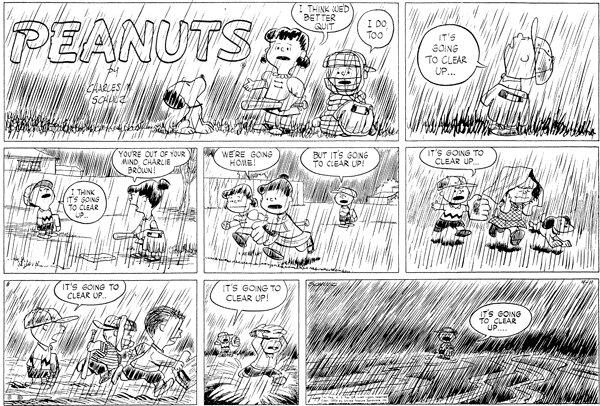
"It's going to clear up ..."
It’s a fairly early strip, with Snoopy still very much the dog, rather than the character and master of disguise that we were, later, to become familiar with … but it establishes as a baseball fanatic who doesn’t just play the game but is obsessed by it. On the one hand, we may feel sorry for himm all alone at the end in the driving rain … and, let’s be honest, it’s his own fault … but, on the other hand, I can’t help but admire his persistence and especially his optimism.
Ah, yes … and here’s the song from Gigi:
PS – I know that, despite my feeble attempt in the reference to the attempted coup in Moscow of August 1991, this postcard has nothing to do with Kyrgyzstan … sorry about that!, but I hope you enjoyed it all the same!





 Bishkek