Some photos from a bygone age
The post on Kloop
Earlier this week I came across an interesting post containing photos from an expedition to the Enilchek Glacier in 1900, which I thought might be of interest to others.
The expedition was mounted by Prince Scipione Borghese, the tenth Pince of Sulomona. (His full name was Luigi Marcantonio Francesco Rodolfo Scipione Borghes, but he is usually known as simply Sciopione Borghese.)
For the record: Borghese is best known for winning the Peking to Paris race in 1907, (although most of the actual driving was probably done by his chauffeur, Ettore Guizardi), a distance of over 9000 kilometers. Borghese’s car was so technically superior to the others that he was so confident of winning that he even undertook a detaour from Moscow to St. Petersburg for a dinner.
The idea behind the race, according to the challenge published in the French newspaper. Le Matin, was to prove “that as long as a man has a car, he can do anything and go anywhere“, which was quite a challenge as there were no road maps of much of the territory they would pass though – indeed, there were no roads. The stage from Peking to Lake Baikal had only ever been traveled by horse. Camels had to be used to ship fuel to staging posts along much of the route.
Only five teams took up the challenge, (three French, one Dutch and the Italian team led by Scipione Bogrhese) and although the organizing committee cancelled it, they decided to go ahead anyway. Each team consisted of a journalist and a passenger.
There were no rules apart from that the first car to arrive in Paris would win a Magnum of Champagne.
Before this, however, he was already famous as a traveler, explorer, diplomat, politician – he was a member of the Italian parliament from 1904 to 1913, and as a mountain climber. (He also fought in the First World War – but that was later.)
As the photographs show, the race wasn’t his first visit to Central Asia. In 1900, together with the Swiss mountaineer Matthias Zurbriggen and fellow Italian Jules Brocherel.
For the record: Zurbriggen was one of the leading mountaineers of his day, climbing, (and making many notable “first ascents”), throughout the Alps, South America, the Himalayas and New Zealand – where the Zurbriggen Ridge on Mount Cook – Aoraki - is named after him, being the first person to climb it in March 1895. He only missed the honour of the first to climb the mountain by three months … beaten by a team of locals who were determined to beat a non-New Zealander to the summit
Brocherel was an ethnologist – studying and comparing the populations of the world – and a specialist on Alpine culture. He had already acquired considerable experience covering climatology, glaciology, botany and hydrography and written a book on mountaineering. As such he was a natural candidate as a “scientific officer” when Borghese was planning for the expedition to trace the cartography of the Tien Shan and scale some of the highest peaks.
The three of them travelled across what is now Northern Kyrgyzstan to Karakol and then up to the Enilchek glacier – making notes … and taking photographs. Their expedition was one of the first to carefully document the life of the people in what was a remote and largely unknown region.
Brocherel’s reports and photographs appeared in some of the most important magazines of the time. They were also featured in a book published in 2002 to commemorate the International Year of the Mountains.
Some of the photos were scanned by the kloop staff and are fascinating: photos of the camp, some landscape, crossing a river, a grave and local people in traditional costume including the elechek, (a sort of turban worn by adult Kyrgyz women). They are well worth a look … although I couldn’t help wondering what others might also show us …
- The post on Kloop
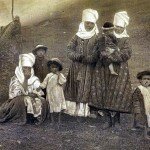
- Kyrgyz women from rich families.
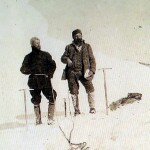
- Prince Borghese (left) and Mark Zurbriggen in the village of Ak-Moinok in northern Kyrgyzstan.
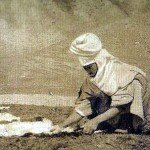
- Woman handles fleece.
The post appeared on the internet portal kloop.kg.
For the record: Kloop.kg was launched in June 2007 and consists of two main services: journalism and a blogging platform by Bektour Iskender and Rinat Tuhvatshin. I The original idea was to bring all the features for free, which means there are no paid skins, and no paid plugins – it was established with funding provided by the Dutch-based Hivos Foundation.
Articles are written by young journalists, mostly University High School students between the ages of 15 and 25. The Kloop Media Foundation runs training courses to help them with issues such as Balance, Accuracy and Joubalistic Ethics.
Currently there are more than 3000 blogs on Kloop, which makes it one of the three biggest blogging platforms in Kyrgyzstan.
Blog pages are supported in Russian, Kyrgyz, Uzbek, Tajik and English.
This post is one of a series containing archive photographs that they have started to post. Others in the series have included:
- Old photopgraphs of Karakol – Старые фотографии Каракола
- Old photographs of the Northern Shore of Lake Issyk Kul – Старые фотографии северного побережья Иссык-Куля





 Bishkek