Happy Birthday Vincent
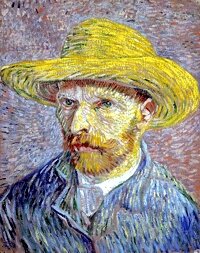
Self Portrait
Vincent van Gogh was a Dutch painter, (born on 30 March, 1853) who was one of the most influential figures in twentieth century art, but by the time he died at the age of 37 in 1890, by some accounts at l;east, he hadn’t sold a single picture. His work was then known to only a handful of people and appreciated by fewer still.
To be honest, it took me quite a while to learn to appreciate it.
“When I was a lad …” as Gilbert and Sullivan put it, I was never particularly good at drawing and Art was one of the least enjoyable lessons at school. I was happy to drop the subject when it came to choosing options for the final two years of compulsory education.
I always tried to draw and paint stylized landscapes as I had difficulty drawing people … and, for that matter, still do. My first and only only success was for an exam piece when we were given the theme “Caught“. I painted a scene from a cricket match with a fielder jumping high in the air, arm extended above his head with a red cricket ball clasped in his palm. Most of the picture was a simple green expanse representing the pitch, and in the foreground was a player dressed all in white was facing the other way which meant that, at least, I didn’t have to try and depict a face.
Although I had managed to drop the subject at school, I couldn’t escape Art altogether … as a student teacher we had a subject called AMEP, (Art, Maths, English and Physical Education), so that we could use them both to improve our teaching … and also teach basic techniques. On one of my teaching practices they noticed this and so I was given an Art class to teach for six weeks. I was not particularly happy about that but what could I do? Teachers are supposed to be “experts” in what they teach and one of the best ways to teach a subject is by example, so I had to come up with something that didn’t expose my lack of talent.
Those six lessons had a profound influence on me … when talking to a fellow student, (an art major), about the dilemma facing me she asked me why I wasn’t keen on Art … I explained and she suggested that we go to some Art Galleries and simply try looking at pictures … which means a lot more complicated than simply “looking at pictures” … so that I could really appreciate the skill of the artist … after all, I knew from personal experience that it’s not easy to create a depiction.
In the end, I thought I was being extremely crafty by selecting “straight lines” as a theme. I scoured art books to find pictures that could be depicted using straight lines – waves lapping on a shore, futuristic city scapes with soaring skyscrapers, the clear cut forms of Bauhaus design … and so on … if people needed to be depicted, then there were LS Lowry’s “stick men” which could provide inspiration – or the depiction of the “Saint”.
Shortly after that, a friend of mine who managed a poster shop in Oxford, asked me to help him out as a shop assistant at weekends. It was here that I first encountered Vincent … and was enthralled.
I have always felt that the primitive brush strokes and bright colours that Vincent loved to use would have been excellent for painting a fireworks display … or many of the scenes, (landscapes, markets, city scenes, portraits …), encountered in Kyrgyzstan on a bright summer’s day … and the days have been getting brighter. There’s still the odd overcast day and we even had a heavy hailstorm on Tuesday … but generally it is beginning to feel as if the tourism season, lambing and those lazy hazy days of summer are not too far away.
And that’s the way it should be here in the Northern hemisphere … after all Easter is upon us. I suppose it’s fair to remind everyone that the two revolutions in 2005 and 2010 took place just before Good Friday … so, I have to admit, I kept a close eye on the news just in case I was likely to have yet another bout of dejá vu … but, fortunately, everything has been quiet … that is, … until Friday night.
The trial of the deputies charged with storming the White House, (the parliament building), and “attempting to overthrow the government” during a rally for the nationalization of Kumto at the beginning of October last year, has finally come to an end with the deputies saying that they were sure the judges would return a fair verdict.
The rallies in their support have been continuing – but, although there was one outside the courtroom in Bishkek, the others were mainly confined to their heartland down in the South. As is usual, there were conflicting claims as to how many people turned up – from 2000 to 15000. At the beginning of the week, the organizers were reported as saying that the assembly would set up a “people’s authority” at the local level in the event that their demands are not met. They issued a resolution with eight “demands” – but when I read it, it seemed to me that half of them were simply statements rather than demands.
Only one of the points referred to the deputies – others were related to catching and punishing those responsible for plundering the country in the two revolutions, dealing with the Kumtor situation and so on.
As it happens, President Atambaev went on an official visit to Djalal Abad and appeared before the crowd … saying that he could not interfere in the trial and, interestingly, revealing that he gone to the prosecutor’s office to answer questions and allegations raised by the deputies. He also stressed that what Kyrgyzstan needed was stability if the country is develop. I know that the world is changing – and we are far from the Divine Right of Kings as espoused by King James I – but I can’t help wondering how many of the world’s presidents would go and address such a rally being held in support of their opponents – or submit to an interview on charges of corruption. Oh, some, of course … but not many.
Referring to the Kumtor situation, he said that a line had been drawn and everything would be done according to the law over the next three months. On the other hand, the Economy Ministry has said that Nationalization was out of the question.
In the meantime, there is little other news about Kumtor – although they have issued a statement to the effect that they have made contributions of over USD128 million to the Kyrgyz budget during 2012 and total payments made in Kyrgyzstan, (including taxes, fees for refining, payments to local suppliers for the supply of goods and services, payment for infrastructure, welfare, etc.), exceeded 298 million dollars. In fact, during the period of the company’s operation, (from 1994 to 2012), they claim that payments in Kyrgyzstan have exceeded two billion dollars.
During the hearing there was a rally outside the courtroom with somewhere between 300 and 700 supporters, different news agencies giving different figures. According to a spokesman from the Ministry of the Interior, enough officers policing it to ensure public order – he denied that there were water cannon or that there extra security measures around the White House.
Well, the verdicts eventually came in … it took well over an hour to be read out … guilty. Two of the defendants were each sentenced to one and a half years in prison but as they have already been incarcerated in the holding cells at the security service – where one day counts as two – for six months, they effectively have another six months to serve. The other was sentenced a year in prison so, technically, he has almost served his time already. A number of other people were also in the dock, bodyguards, a driver and personal assistant – and they were all sentenced to a year’s imprisonment as well.
As it happens, the sentences are quite lenient – they could have be sentenced to up to 10 years. Despite this, no-one seems to be particularly happy at the outcome. Some in the public gallery, supporters of the three threw bottles and tried to get to the judge … preventing the prisoners from being removed for a time, but eventually the courtroom was cleared. In the meantime, Tashiev, (one of the defendants), denied his guilt, saying it was a political decision and accusing the judge of lacking the courage and conscience to acquit them, and the lawyers announced that they were going to appeal to a higher court.
Because of their conviction the Deputies now lose their seats in the parliament which, because Kyrgyzstan operates a list system, will no be passed to other members of their party, Ata Jurt.
Another verdict was handed down this week – this time on Maxim Bakiev who was tried in absentia as he is somewhere in Britain awaiting extradition hearings … extradition to the States that is, although the authorities here would love to get him back here. He was found guilty of abuse of power and corruption – which, I suppose, doesn’t really come as a surprise – and the judges handed down a sentence of 25 years imprisonment, deprived of the right to hold certain government posts (for three years !), and confiscation of his property … not that there seems to be much chance of him actually having to serve it, although the prosecutor’s office say they are going to keep trying to extradite him.
Talking of extradition … one small story suggested that if complicity in corruption over the Kumtor agreements can be shown in the upcoming investigations, then the Prosecutors will seek his extradition as well.
Another interesting turn of events has been a debate in the parliament prohibiting the carrying of firearms by deputies, and their advisers, etc. in the parliament building itself. The law on the status of deputies allows them to possess service weapons, just like the police – and some of them do. It was revealed that there 58 deputies that have between them 154 registered weapons – including four of the women deputies according the the shocked reporters. People are expected to hand over their mobile phones when they enter the building, complained one deputy emulating Wyatt Earp and Doc Holiday, so why shouldn’t we ask people to hand over their weapons. One of their opponents, however, retorted that he had the necessary permits and could carry his weapon in the supermarket – so why not in the parliament building. Perhaps the most interesting comment I saw on this during the week was: “What are they scared of?”
As it happens, I think that they do have something to worry about. Apart from potential revolutions, they have been a number of prominent, high profile killings over the years – including the murder of several deputies.
One thing they be afraid of is terrorism – and one form of terrorism is, of course, the “bomb scare”. Well, the deputies have been discussing an increase the penalties for making false reports about planned terrorist acts … increasing the fine from 3000 som to 5000 and possibly imposing a three year prison sentence. I suppose that might deter the odd schoolkid from phoning in a bomb scare in order to avoid a test, but is seems to pale into insignificance in the event of a serious terrorist group wanting to cause havoc and mayhem without having to go to the trouble and risk of having to actually manufacture and plant a bomb.
Another thing they seem to be worried about is TB – tuberculosis. There’s been a publicity campaign here in Bishkek recently with exhibitions and testings and it has emerged that many of the homeless and convicts are infected. Last year there was a proposal to compel with the disease to attend treatment – and having them arrested if they refused and now there a new proposed to imprison people for passing the disease onto other people.
On the economic front, one worrying development was the decision of Commerzbank in German to close the accounts of Kyrgyz Banks and to refuse to act as an Intermediary Bank for international transfers. I don’t for certain, but that seems pretty serious to me. Apart from revelling in the seemier side of the story – based as it is on the fortunes of Maxim Bakiev’s Asia Universal Bank – the local press appeared to brush the report off by saying that for the ordinary businessman, it might have little more import than having to tell their customers about new routing information so that they can receive payments.
I am not so sure it is that simple. It could just have been a practical decision, having lost money with the collapse of AUB, but symbolically it seems potentially as bad a sign as having credit rating downgraded from AAA to AAB … look how countries have reacted to that situation.
It also seemed odd that the Germans took so long to implement such a decision … especially as Kyrgyzstan seems to be making some headway in imp[roving its status when it comes to combating corruption. I mentioned some weeks ago that Kyrgyzstan had been placed onto the “grey lilst” or the Financial Action Task Force on Money Laundering, (FATF), becuase it hadn’t brought its legislation into line with their regulations. This would have meant being placed under greater scrutiny and tighter control, but at the request of no less than China, India, Russia and the International Monetary Fund, the decision to downgrade the country was put off until the end of May.
Work is certainly under way to improve the situation in the country … and it’s in the country’s interest not only in terms of maintaining its image in the international arena … there are still strong hopes, (if not expectations), of repatriating some of the wealth plundered in the two revolutions. As part of the on-going campaign, OSCE are considering allocating a million of dollars towards the process.
Kyrgyzstan has also managed to improve its standing in the Open Budget Index – which is published every two years and judges the whole of the budgetary process for public finances. In 2012, Kyrgyzstan obtained a score of 20% and although that doesn’t sound very good and there is obvious room for improvement … it is still quite impressive bearing in mind that the equivalent scores in the last two indexes were 15% (in 2010) and just 8% (in 2008). So Kyrgyzstan must be doing something right.
According to the Economist Intelligence Unit’s Democracy Index, which ranks 167 countries based on expert analysis and public opinion polls, all the countries of Central Asia were named as “authoritarian regimes” – except Kyrgyzstan. Only 25 of the countries were deemed to be “full democracies”, with 45 being ranked as “flawed democracies” – with some pretty surprising inclusions such as France, Italy, and the Baltic countries. Kyrgyzstan was ranked with 36 other countries in the category “Hybrid regimes” but that was a lot better than the 51 other states (including Russia, Belarus, Azerbaijan, Kazakhstan, Tajikistan, Uzbekistan and Turkmenistan, along with Cuba, Afghanistan, Iran, North Korea, China, Vietnam, Eritrea … and so on). So Kyrgyzstan must be doing something right.
Mind you, the news that the shadow economy rep[resents something like 42% of GDP is not exactly a positive sign.
It’s always been said that quite a bit of that is represented by the textiles industry – sewing garments and so forth. Although there some sewing workshops, it seems that many of the people working in this cottage industry do so from home or small workshops that are not officially registered, Over the years the government has tried to solve this problem and a few years ago claimed to making some headway with it. Well, now it turns out that the textiles industry represents Kyrgyzstan’s third biggest export industry, behind Gold and agriculture and food processing – worth USD156 million in 2012.
Amongst the other economic statistics was the news that Kyrgyzstan imported some 80000 tons of meat last year, (worth some three billion som – or almost six and a half million dollars), mainly from the US, Brazil and Canada. I know that it is said how the Kyrgyz love meat … but the fact this represents some 42% of the country’s GDP was somewhat surprising. (Another example of the mysterious 42 – Douglas Adams would be proud!) What caught my eye, however, was the comment that this represents a twentyfold increase since 1995 – when I first came to Kyrgyzstan. It was frustrating, however, that there wasn’t any more analysis as to the background … the value of meat imp[orts had increased by a factor of twenty, but what about the volume / weight – was that more, less, or about the same as 18 years ago?, was it a result of the influence of inflation? and what had happened to home produced meat? – has that increased or fallen? … has meat consumption in the country increased (it should have done as the population has – but what about per person?). Oh, how frustrating headline statistics are!
On the international front, there been yet more articles about the new Great Game and the intentions of the players in the modern Great Game – Russia, the US and China. Nobody seems to have come out of the analysis unscathed. One commentator suggests that Russia and the US are fueling tensions between the different countries in Central Asia … over water, power and arms shipments. Both have military interests in different countries in the region and, of course, economic interests. Russia is planning to restructure or write off huge debts for Kyrgyzstan, and the NATO countries are talking of leaving military equipment in Uzbekistan … (incidentally, the Kyrgyz have decided that NATO shipments through Kyrgyzstan will have to be inspected).
I mentioned last week that the Bishkek authorities were starting their road repairs as the Spring weather got underway … and the PR department seem to have been working overtime with a host of “photo reports” of bulldozers and road gangs ripping up the old asphalt and damaged kerbs and replacing them with brand new surfaces.
The Drama surrounding the Russian Drama Theater, (incongruously named after the famous Kyrgyz author Chinghiz Aitmatov), continues to develop. The latest development, following a fire, disputes about the posters not being in Kyrgyz, (it’s a Russian Theater – they perform in Russian) and not having the right permission for outdoor, advertisements, now the authorities are demanding that the bar and restaurants based in the building close as fire and health hazards.
The Russians are getting a bit upset by the threat that the Kyrgyz might stop the re-transmission of one of the most popular of the Russian TV channels. Someone spotted that Kyrgyzstan has been paying a lot more for the rights to transmit the signal than was in the budget and called for this end.
I normally comment on some of the more interesting statistics that get published throughout the week, and although I have already referred to some of them, these also caught my eye:
- Squatters currently occupy over 5500 hectares of agricultural land in Kyrgyzstan, some with houses built on them for 10 or even 15 years.
- Up until March 1st, there were 656 people registered as HIV positive in Bishkek … 469 men and 187 women. There were 96 people diagnosed with AIDS … but what was odd was that this reported as comprising 74 men and 34 women … and 261 people receiving treatment designed to preserve health and prevent the spread of disease including 12 children and 54 people who had come from other parts of Kyrgyzstan.
- Last year there were 23528 abortions
 performed in Kyrgyzstan, which amounts to 15.4 per 1000 live births. The figure apparently shows an increase on the previous year because some “mini-abortions” (performed in the earliest weeks of pregnancy) were included but weren’t in the past. The bit I really liked about this story was the admission that “the data “is not completely reliable.”" !
Perhaps the strangest story of the week came as the working day on Friday came to a close … a Deputy Minister had been sacked. The end came almost as his appointment last year, but the manner in which the announcement was made seemed very peculiar … there wasn’t one. The press seem to have learned about it from the staff working in the Ministry and the first reports said that the reason was unkn0wn. Of course, my mind – and I suspect everybody else’s, too – started working overtime … what could possibly have led to this? Shortly afterwards the Ministry’s Press Office reported that it was a result of a gender imbalance in the team at the Ministry, and “his” replacement will be a “her”. So he was supposedly dismissed, because he’s a man(?!) According to reports on the news agencies, it wasn’t exactly that simple … and then the Cabinet Office reported that there were several issues including a lack of expertise in the given area of responsibility … As Alice cried: “Curiouser and curiouser!” Well, having long been an activist, he is no stranger to controversy and will no doubt he is well equipped to cope with this one.
Anyway, I have exceeded my word limit for this postcard – again! – and I have to go off to Naryn so, all that remains now is for me to wish Vincent a Happy Birthday, and everyone else a quiet, peaceful and Happy Easter! …
_______________________________________
Postcard from Bishkek: the weekly postcard that I send out as an email also gets posted on the website ianbek.kg each week – and there are other postcards which don’t get sent out. This week, for example, there has been the following postcards:
- A place to lay your head … - Accommodation options in Kyrgyzstan – 24/03/13
- Lady Day - Happy New Year! … Again??? … what’s going on? – 25/03/13
- Semyenovka and Grigorievka - Two mountain valleys in Kyrgyzstan – 26/03/13
- Photographing the Pyramids - Some thoughts about the ethics of taking photographs – 27/03/13
- Potholes - The state of Bishkek’s roads – 28/03/13
- The use of coins in traditional jewelry - They are not just for decoration … they had practical and mystical value as well – 29/03/13
It is possible to follow me on Facebook, (where I have specific pages for Celestial Mountains and ianbek … and also links.kg, Kyrgyz Diary and Kyrgyzstan Visitki), and also on twitter, (@Bishkekpostcard and @celestialMTC ).





 Bishkek
I have always been a fan of Vincent VG. At uni I took a course in the philosophy of art as part of my Philosophy major and decided to try to analyse what I actually liked about Vincent and how much of his personal story was tied to his paintings and what I saw in them. I eventually decided (after 5000 words)decided I couldn’t decide and that the two were inextricably linked – art is subjective, emotional and the menaing can be what the viewer rather than what the artist creates.
One of my happiest travel memories is of being in Amsterdam and staying at the Youth Hostel. A former ‘resident’ had bought an open museum ticket which as valid for sometime; when she left Amsterdam she pinned it to the noticeboard. Consequently, most of the females borrowed it during their stay and pinned it back on the noticeboard when they had used it. Having the ticket meant I could go to the Van Gogh museum several times instead of just the one time I would have been able to afford if I had had to pay for the entry ticket. A happy experience, or several happy experiences really.
My Year 8s have been studying a unit on Asia for the past eight weeks. One day I we watched the webcam of downtown Bishkek along with a film of the window cleaners on the Burj Khalif – I love the internet! What did teachers do before?!