Driving in Kyrgyzstan
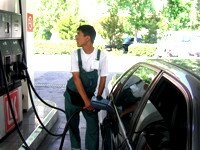
Fill her up ...
This was written a few years ago and is based on an answer to an enquiry we received by email from someone who was planning to bring their own vehicle to Kyrgyzstan.
As such it is written in the first person. It is not meant to be definitive advice or exhaustive. Make sure you have all the right registration documents – we suggest you contact the embassy to check what is required. If the vehicle is in transit (i.e. you will leave Kyrgyzstan in it) there should be no customs duties etc. If the driver is not the registered owner of the vehicle (or the owner is not one of the passengers) then he will need authorization to drive – a “doverennost“.
You will also need an international driver’s licence.
In addition, by law in Kyrgyzstan, every vehicle is supposed to carry:
- A First Aid Kit
- A fire extinguisher
- An “Emergency Triangle” which can be placed as a warning sign in the event of an incident (accident or breakdown) to warn oncoming drivers”Wheel stops”, (2), to place under the wheels on a slope to prevent it rolling in the event of break failure.
- A tow-rope: (3m or 5m)
We also recommend that drivers carry a small shovel – especially in winter if travelling in areas where there is likely to be snow – and spare bulbs for the lights, indicators etc. You will need to make sure that you have tools and suitable spares (it can sometimes be difficult to find spares – especially out of the main cities) and to know where the “jack” and “spare wheel” are, and bring a spare set of light bulbs with you.
In the event of a puncture – it is possible to have the tyre repaired. A tyre-repair shop is called a “Vulcanizatziya“, and these can be found throughout the country … in some cities many of them work 24-hours – “Krugloosutochnaya“.
You should also remember to bring a spare set of keys with you.
The use of seat belts is compulsory for the driver and, if they are fitted in the vehicle, also for the passengers – so make sure that everyone “belts-up”. Crash helmets are not compulsory, for motorcyclists of those riding scooters, but for your own safety you should still use one.
Technically, in Bishkek, and Osh you have to register the vehicle with the traffic police.
Vehicles in the Kyrgyz Republic are supposed to have been inspected for, and have a certificate of, roadworthiness – “techosmotre“.
Make sure that your International plate is clearly visible.
The use of lights when not in a settlement, (or built-up areas), became compulsory in 2009 – and in fact, many drivers now drive with their lights switched on even in the cities.
Insurance used to be “voluntary” and although a law has been passed making it compulsory, arrangements for the implementation of the law have not yet been put into place, (as at the time of writing, August 2009). However, drivers are sometimes asked at the border to produce their insurance documents. You should make sure that you have suitable cover, that it covers you whilst driving in Kyrgyzstan, and in the event of an accident you should inform your insurers immediately.
Of course, you should take additional care when driving on unfamiliar roads: drive “defensively” and “expect the unexpected”; avoid driving when tired, (taking regular breaks on long journeys); don’t use your mobile phone when the driving; don’t overload the vehicle and make sure that you can see out of the rear window, and that mirrors are not obscured, (especially if you are in a right hand drive vehicle).
If you drive a vehicle in Kyrgyzstan then expect to be stopped by the traffic police (GAI or MAI – the State Auto Inspection). They will be standing at the roadside and may point at you with a red or white truncheon. They may want:
- to check your documents, (you will need your driver’s license – preferably an international one – possibly your passport and the registration document for the vehicle – and if it is not your vehicle then you will need an official document from the owner giving you permission to drive it.);
- to see if you have been drinking, technically, there is a zero limit. Although there are “breathalysers”, you will probably be asked to breath into a paper cone, or the GAI will simply smell your breath. If the GAI think that you have been drinking they can ask you to go to a hospital for analysis – and can confiscate your license and impound your vehicle,
- or they may want to give you a fine (a “shtraf“) – and they can be quite inventive for finding reasons for issuing a fine – such as :
-
- speeding,not observing the road signs,
- having a minor error in the documentation (maybe the document was filled in using a blue pen but signed with a black one!!!),
- failing to carry a fire extinguisher,
- failing to have a First Aid kit,
- having no light illuminating your rear number plate,
- having too many people on the back seat,
- having a dirty car (seriously, this can happen in Bishkek),
- or evenwearing a dirty shirt!!! (this is not an offence in itself – but one GAI thought that this was a sure sign that the driver had been drinking).
Fines are paid “on the spot” and there should be, but rarely is, a receipt. It is possible for the GAI to confiscate your license, (although they should give you a replacement – valid for three days), or to impound the vehicle.
The speed limit in built-up areas is 60 km/hour, elsewhere it is 90 km/hour – but there are places where different figures are displayed on road-signs. In rural areas it is not always obvious where villages start and end – don’t assume that because there are no houses immediately obvious that you not in a “built up area” – keep an eye open for village name signs and treat them as “60 km/hour” signs.
When estimating travelling times between two points – it is best to estimate on travelling at a speed of 60km/h. For example: from Bishkek to Cholpon Ata, it is about 240km … so estimate on 4 hours – although the road conditions are good and it is possible to do it three hours, it is probably best not to rely on this. Of course, the more stops you make, (photo-stops, toilet breaks, for meals, etc.), this will add to journey times.
In Bishkek, traffic humps, or “sleeping policemen”, are located by schools.
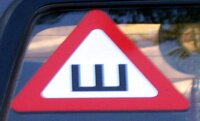
An example of a Learner plate
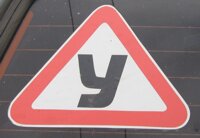
An example of a Learner plate
The sign to indicate that a vehicle is being driven by a ”Learner” driver is a letter “y” in a red triangle, or a “|_|_|” in a red triangle.
If you see a motorcade coming towards you with lights flashing – pull over to the side of the road until the motorcade has passed by.
At traffic lights – a green arrow means that traffic can proceed in that direction … don’t think that a green light (without any arrows) means that anyone can proceed – if there is an arrow pointing in the direction you want to take then you must wait for the green arrow. The sequence will be Green – Flashing Green – Yellow – Red.
Don’t park overnight in the street – unless you want your car broken into, or stolen. Use a car park, preferably one with a fence, it is worth paying the small fee involved.
Petrol in rural areas is likely to be 75 octane, or 86 (more rarely), and if you are very lucky you may find 93 or 95 – but don’t rely on it. Diesel may also be hard to find. In the petrol station – especially if there is no electricity – be prepared to pay something to the child or attendant who (literally) pumps the fuel for you.
A press report (March 2002) noted that the traffic police reported a lot of violations of traffic rules by both drivers and pedestrians. They said that the situation on the roads could be classified as “alarming”. Apparently 25% of road accidents were blamed on pedestrians – who, unlike drivers, bear no responsibility for violations of traffic rules. Cited as another cause of concern, was the behaviour of the drivers of “marshrutka” mini-buses in the city, who often stop to pick-up or put down passengers at inappropriate points.
In 2005, the Economist Pocket World in Figures listed Kyrgyzstan amongst “the 20 worst countries in the world for traffic accidents”. The full list was:
Malawi, Rwanda, South Korea, Costa Rica, Kenya, India, Honduras, Egypt, Sri Lanka, Portugal, Morocco, Turkey, Hong Kong, Japan, Kyrgyzstan, Colombia, Latvia, Italy, Canada and the Czech Republic.
We are often asked if it is possible to arrange “self-drive” vehicle hire. Although Hertz “Rent-a-Car” had a franchise in Bishkek – and you can still find references to it on the internet – it has closed. There is a new enterprise which claims to be offering a self-drive rental service … but it is not part of a major chain and is based in Bishkek.
__________________________________________
Update:
Many Brits unprepared for driving abroad
23rd June 2013
A new poll has revealed that one in five British travellers fails to do any research about driving rules overseas or practice abroad before taking a self-drive trip
The results come from a poll of over 3,000 Brits by TripAdvisor. Around 21% admitted that when it comes to driving in another country on holiday, they have never researched the rules of the road.
More at: http://www.wanderlust.co.uk/magazine/news/many-brits-dont-research-before-driving-abroad


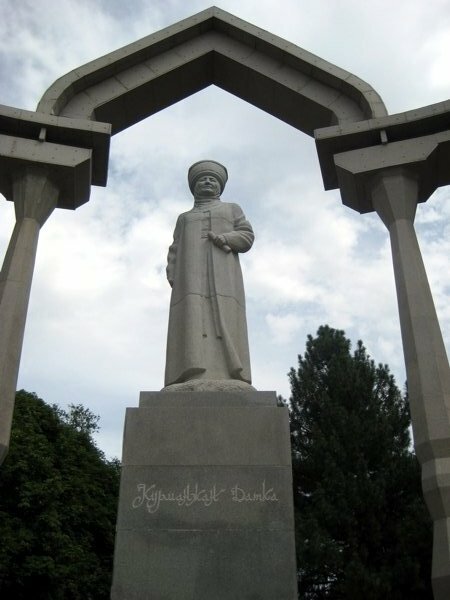

 Bishkek