School museums
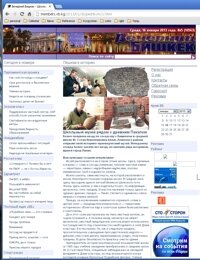
The article in Vecherniye Bishkek - in Russian
When I was teaching Computing, in the computer room we had a large display cabinet and the kids called if “The Museum”.
They gave it that name because in it we put a display of calculating devices over the years, clay tablets (which we had made in the Art department) showing Sumerian calculations; an abacus, (but nothing like the large ones used here by accountants until quite recently); a set of Napier’s Bones and a book of his Logarithmic Tables; a Slide Rule; Paper Tape and Punched Cards; Keyboards; A Cathode Ray Tube; a Light Pen; a Cheque book with cheques showing codes printed in Magnetic Ink; Goods from a shop sporting a Bar Code and a Bar Code Reader; Credit Cards with Magnetic Stripes; Electronic Valves; Transistors; a slice of Silicon and Silicon Chips; some early microcomputers … and nearby was a teletype … and so on.
It wasn’t just a static display. Every now and again I would open the cabinet and take something out to pass round the class to demonstrate a point in the lesson.
I was proud of that “museum” … but I doubt if it is still there.
I was reminded of it a few years ago when I visited the town of Talas in Northern Kyrgyzstan. I had gone to visit to see how we could incorporate it into tour programmes … and I have to say that I liked it very much. Talas lies in a wide valley stretching down from the Otmok Pass (over to the Suusamyr plain) and opens out onto the Kazakh steppes. I felt very much at home there, and it reminded a lot of rural southern Europe, but that may have been something to do with the time of year when I visited it.
There are quite a few good reasons for visiting Talas … apart from the scenery, including the beautiful Besh Tash, (Five Stones), valley just outside the city – which I think can rival the likes of Ala Archa and Djety Oguz … ever turn of the road opening up a new a different vista; the homes of Chinghiz Aitmatov, (Sheker), and Theodore Hertzen, (Leninopol); the strange rock formations of Aral, the site of the monumental Battle of Talas, (which is actually just over the border in Kazakhstan) … and so on … it is also the homeland of the legendary Kyrgyz Hero Manas … and his Mausoleum and a Museum complex.
As an aside: When I met with the then Deputy Governor, she was surprised when I said that many people in the West had never heard of Talas – “But we are famous all over the World,” she protested, “as the motherland of Manas.” I tried to be tactful in pointing out that “most people in the West have never heard of Manas, either” … in fact the only reason I knew anything about Manas was probably because I lived here.
I had a similar problem recently over Chinghiz Aitmatov. Someone was pointing out how many visitors Stratford upon Avon received each year … all because of one man. Surely, Sheker, with it’s connections to Chinghiz Aitmatov, could become the Stratford of Central Asia … I tried to point out that, even though he is a great writer – and I do like his work – there is a long way to go before he becomes he acquires a stature equivalent to Shakespeare’s.
Despite the attractions, however, it doesn’t feature on many tour itineraries. The reason is quite simple – access. The main route used by locals at that time – and still today, is via Kazakhstan – and, for foreigners, that raises lots of visa questions … even today. The other route is over two high mountain passes, the Too Ashu pass over the Kyrgyz range to the Suusamyr plain and then the Otmok Pass down into the Talas valley itself. Although the road is quite good it can be blocked at certain times of the year … and it may mean travelling “there and back” along the same road, which most tourists don’t like doing.
One of the highlights of my visit, however, wasn’t the Manas Mausoleum or the splendours of Besh Tash … I had asked if theere was a regional museum that I could see and my guide had arranged for me to visit one of the local schools.
That surprised me at first … but then it was explained to me that apart from the Museum dedicated to Manas this was the closest that they had in the city to a local Museum. The retired teacher in charge told me that it had been set up as a school project by one of the teachers many years ago and children brought in objects which made up the majority of the exhibits.
It was housed in what obviously a reasonably sized classroom at one time but was then filled with what looked like Dexion shelving, piled high with cardboard boxes containing the artifacts. It seemed to be a storeroom from which materials would then be withdrawn for a period to create a classroom display as and when needed. There were rocks from the neighbouring hills to show the geology of the area; stuffed animals as examples of the local flora and fauna – including some well preserved specimens in spirit of things like a two headed rabbit; maps and books; pictures and photos. The current project at that time was about the Global Village, (my phrase, not hers):”Where do we get our products from?”. The children brought in packages and then checked to see where the contents originated, and they were then posted on a huge map of the world. Hearing that I was from Britain, she took great pleasure in pointing to the Islands off the Atlantic where there were three of four packages already pasted up. I was surprised by how much of the world was already spoken for … packets of soap, pasta, vodka, and so on.
This chain of thought was brought to the forefront of my mind by a recent article in the Vecherniy Bishkek, (Evening Bishkek), newspaper. It was about the school Museum in Novopokrovka, a small village in the Issyk Ata region just outside Bishkek.
Over the years, the small collection housed on the second floor of the school building has included jugs and other vessels, (some dating from the 7th and 8th centuries), flat smooth stones, ornaments and grave markers with inscriptions, fragments of clay pipes and ironwork.
The village lies on, or near, the ancient Silk Road city of Pakap – one of five towns in the immediate neighbourhood. Although at one time it seems to have been a sizable and vibrant settlement, virtually nothing remains after the ravages of time, (and presumably the Mongol hordes), not to mention the agrarian revolution of collective farming.
Over fifty yaers ago, however, the chairman of the local collective farm, conscious of the local heritage, built a Dom Kultura – House of Culture in the village. It no longer stands, having also succumbed to the ravages of time. One of the History teachers in the school, Svetlana Reva, took the project under her wing and rescued as much of the materials as she could … including a graceful Bronze Buddhist figurine, (it is thought that the medieval town may well have included a Buddhist Temple or Monastery) and gravestones bearing a cross and Syriac inscriptions, (which is thought to have been Nestorian dating from the 11th or 12th century).
Like the school museum in Talas, many of the exhibits are brought in by children, objects that they or their families have found or dug up in their gardens.
There are more modern exhibits as well, such as a iron kerosene lamp and an iron blade (from a spear or sword) and lots of ceramics, a small Kyrgyz yurt, a spinning wheel and other tools from the late 19th century – about the time of the founding of the modern settlement.
Perhaps more poignant are the exhibits dedicated to former students who died in recent conflicts, such as in Afghanistan in the 1980′s and the Batken incursions in 1999.
Since 2004, archaeological excavations have taken place on the large mound in the village … largely as a result of the interest raised by that Nestorian tombstone … and many of the objects recovered are left to the museum.
It is important to preserve what the museum has, and it is obviously prized by the school and the community. It has, however, a chequered history. When the Dom Kultura was demolished and when, on another occasion, the exhibits moved into their new home, despite the fact that they were all duly recorded and had their index number for identification … in the upheaval of moving, some were apparently mislaid.
In many ways, schools are a focal point in the local community. Apart from being a place of education, their buildings are often a social center as well; the venue for social events, sports and so on. It is nice to see that they can also provide another valuable resource for the local community … whilst at the same time as providing a richer understanding of the local community, its history and surroundings.
I don’t think that every school in Kyrgyzstan has its own museum but, according to the Kyrgyz Embassy to the United Kingdom, the city of Osh alone has 62 of them.




 Bishkek